

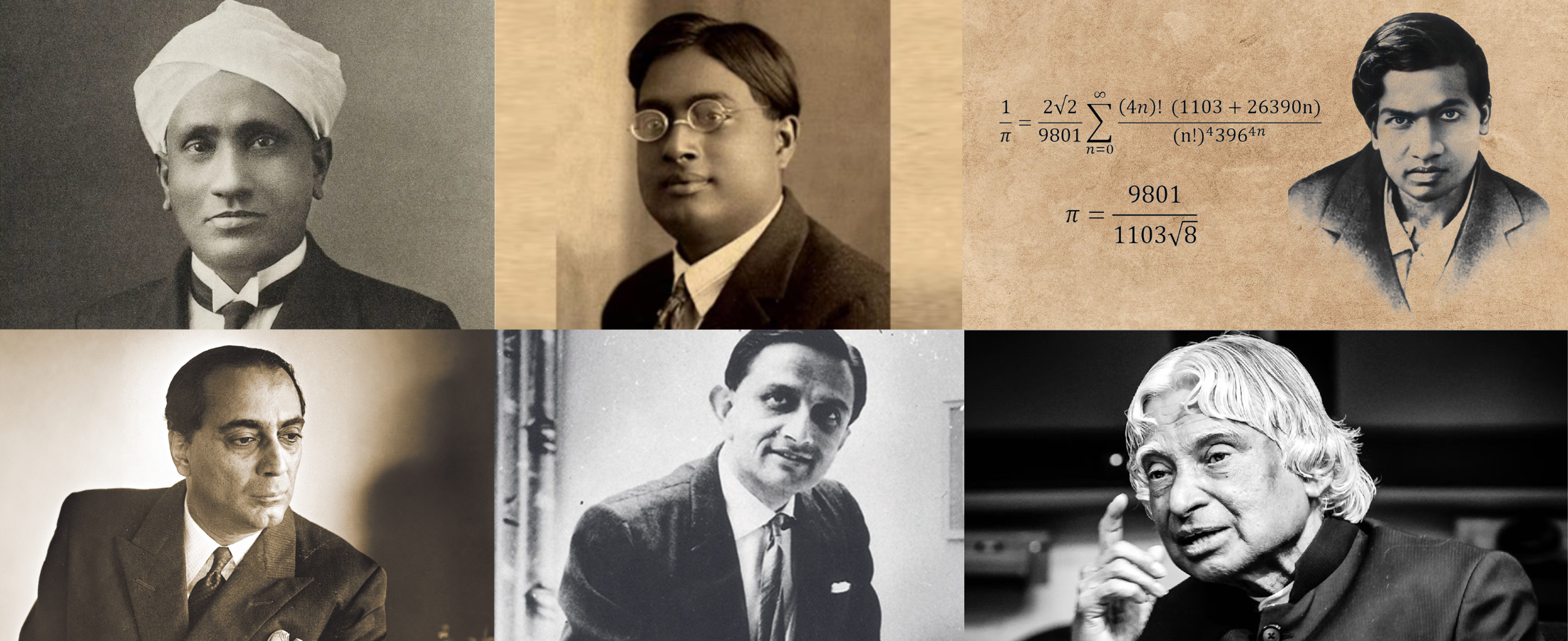
List of the best indian scientists
India has always been a land of great thinkers, scholars, and scientists whose contributions have shaped the world we live in today. From ancient to modern times, Indian scientists and their inventions and discoveries have pushed the boundaries of knowledge in physics, mathematics, biology, and space exploration. At Bethany, we believe in nurturing future leaders who will carry on this proud tradition of scientific excellence.
In this article, we explore the inspiring journeys of 15 renowned scientists who transformed science in India and made significant contributions to the global scientific community, leaving an enduring legacy of innovation and discovery.
1. C.V. Raman: The Raman Effect
C.V. Raman was a Nobel Prize-winning physicist who discovered the “Raman Effect” in 1928, explaining the scattering of light through different materials. This discovery earned him the Nobel Prize in Physics in 1930, making him the first Asian to win in this category. His work has profound implications in spectroscopy and paved the way for innovations in chemistry, biology, and medicine. To date, his research remains one of the most important inventions and discoveries in modern physics.
2. Satyendra Nath Bose: Bose-Einstein Condensate
Satyendra Nath Bose’s collaboration with Albert Einstein led to the formulation of Bose-Einstein statistics, the foundation of quantum mechanics. His key contribution was predicting the Bose-Einstein condensate, a new state of matter. His work remains crucial in quantum physics, and particles following Bose-Einstein statistics are called “bosons” in his honour. This reflects the significant contribution of Indian scientists to advancing quantum theory worldwide.
3. Srinivasa Ramanujan: Contributions to Mathematics
Srinivasa Ramanujan is one of India’s most celebrated mathematicians. His work on number theory, continued fractions, and infinite series was groundbreaking and continues to shape how students learn core concepts such as fractions and percentages, which are essential for strong mathematical foundations. His legacy is celebrated each year on National Mathematics Day, inspiring students to appreciate the beauty and importance of mathematics. Ramanujan was largely self-taught, and his contributions are fundamental to many areas of pure and applied mathematics.
4. Homi J. Bhabha: Father of the Indian Nuclear Program
Homi Jehangir Bhabha is called the father of India’s nuclear program. His pioneering research in quantum theory and cosmic radiation was groundbreaking. He played a crucial role in establishing India’s nuclear energy program and founded the Tata Institute of Fundamental Research (TIFR) and Bhabha Atomic Research Centre (BARC), making India a nuclear-capable nation. Many regard him as one of India’s best scientists for his foundational role in nuclear science.
5. Vikram Sarabhai: Founder of ISRO
Vikram Sarabhai is considered the father of India’s space program. He founded the Indian Space Research Organisation (ISRO) and played a key role in developing India’s satellite technology. Under his leadership, India launched its first satellite, Aryabhata, in 1975, marking a pivotal moment in its space exploration journey. He is among India’s great scientists of India for his contributions to defence and space research.
6. APJ Abdul Kalam: Missile Man of India
Dr. APJ Abdul Kalam, known as the “Missile Man of India,” made significant contributions to India’s missile development program. He was the driving force behind India’s indigenous satellite launch vehicle (SLV) and missile technology, including the Agni and Prithvi missiles. His work made India a self-reliant space and defence power.
7. Jagadish Chandra Bose: Father of Radio Science
Jagadish Chandra Bose Jagadish Chandra Bose is regarded as a pioneer of radio science. His invention, the crescograph, measured plant growth and showed that plants respond to external stimuli. His radio and microwave optics research laid the groundwork for wireless communication technology.: Indian Space Research
Dr. K. Radhakrishnan, a key figure in ISRO, made significant contributions to India’s space program. His leadership during the Mars Orbiter Mission (Mangalyaan) made India the first nation to succeed in its maiden attempt to reach Mars, establishing India as a leader in space exploration. He is among the famous Indian scientists who brought global recognition to India’s space achievements.
9. Meghnad Saha: Astrophysics and Thermal Ionization
Meghnad Saha developed the Saha Ionisation Equation, which explains stars’ chemical and physical properties. His work in astrophysics significantly contributed to our understanding of stellar atmospheres and the spectrum of stars.
10. Har Gobind Khorana: Genetic Code and Protein Synthesis
Har Gobind Khorana was a biochemist who won the Nobel Prize in 1968 for his work on the genetic code and protein synthesis. He conducted experiments to demonstrate that nucleotides in nucleic acids control protein synthesis, laying the foundation for modern genetics and biotechnology.
11. Subrahmanyan Chandrasekhar: The Chandrasekhar Limit
Subrahmanyan Chandrasekhar’s research on the structure and evolution of stars led to the discovery of the “Chandrasekhar Limit.” This is an important concept in the study of stellar evolution and black holes. In 1983, his work earned him the Nobel Prize.
12. Prafulla Chandra Ray: Father of Indian Chemistry
Prafulla Chandra Ray is considered the father of Indian chemistry. He founded Bengal Chemicals & Pharmaceuticals that is India’s first pharmaceutical company. His research led to the discovery of Mercurous Nitrite, a chemical compound used in medicine.
13. Aryabhata: Ancient Indian Mathematician and Astronomer
Aryabhata was a mathematician and astronomer from ancient India. His research on the solar system continues to inspire astronomy for children, helping young learners to develop curiosity about planets, stars, and space while also laying the groundwork for modern arithmetic and algebra.
14. S.S. Abhyankar: Contributions to Algebraic Geometry
S.S. Abhyankar was a distinguished mathematician known for his work in algebraic geometry. His contributions in birational geometry and the resolution of singularities play a significant role in modern mathematical research.
15. G.N. Ramachandran: Pioneer in Molecular Biophysics
G.N. Ramachandran made contributions to molecular biophysics by developing the “Ramachandran Plot,” which provides a graphical representation of protein structures. His work remains foundational in the study of molecular biology and structural bioinformatics.
Notable Indian Women Scientists
There are many respected scientists in India who have strengthened the country’s scientific progress across different fields.
While this article highlights 15 famous Indian scientists, we must not overlook the incredible contributions of Indian women in science:
- Asima Chatterjee: A pioneering chemist who contributed significantly to medicinal chemistry and phytochemistry.
- Janaki Ammal: Her work in botany and cytogenetics helped advance plant breeding, especially sugarcane research.
- Tessy Thomas: Known as the “Missile Woman of India,” she played a key role in India’s missile development program.
- Kalpana Chawla: A NASA astronaut and the first woman of Indian origin in space who inspires aspiring scientists.
Conclusion
The legacy of these 15 famous Indian scientists continues to inspire generations of learners and researchers. At Bethany, we celebrate their contributions and encourage our students to strive for excellence like these great minds. These remarkable individuals have shown that dedication, innovation, and persistence can lead to new heights in science and technology.
To foster a scientific mindset among our students, we organise educational trips to the Visvesvaraya Industrial and Technological Museum. Our annual Science Exhibitions provide hands-on learning experiences that help students develop problem-solving and teamwork skills. We aim to inspire the next generation of thinkers, innovators, and scientists.
FAQs
Who is the father of mathematics in India?
Aryabhata is often considered the father of Indian mathematics. His work in astronomy and mathematics, especially his introduction of zero and his development of algebra, trigonometry, and the value of pi had a monumental influence on mathematical history. He also authored the famous treatise “Aryabhatiya,” which contains various important mathematical formulas.
How to become a scientist?
Becoming a scientist requires a passion for discovery, followed by rigorous academic and practical training. To become a scientist, one should:
- Complete higher education in a specific field of science, such as physics, biology, or chemistry.
- Pursue a bachelor’s degree followed by a master’s, and then consider doing a PhD to specialise in a particular area.
- Participate in internships, research projects, and publish scientific papers to gain experience.
- Many scientists also work in laboratories, universities, or research institutions where they continue to innovate and contribute to scientific knowledge.
Who is the first scientist in the world?
While it is difficult to identify the first scientist in the world, Aristotle (384–322 BC) is often considered one of the earliest scientists. He made significant contributions to biology, physics, and natural sciences. His method of systematic observation and inquiry laid the foundation for the scientific method used today.
How to become a space scientist?
To become a space scientist, you can start by obtaining a bachelor’s degree in a field related to space sciences, like astronomy, physics, or aerospace engineering. Further, you can pursue a master’s and PhD in a specialised area such as astrophysics, space engineering, or planetary sciences. Gaining experience through internships at space research organisations like ISRO or NASA is crucial. Staying up to date on advancements in space technology and engaging in research projects will enhance your knowledge and prepare you for a career in this field.
Who is a scientist?
A scientist is an individual who conducts systematic research to discover new knowledge, test hypotheses, and create new applications in various fields of science. Scientists use empirical methods, observations, and experiments to understand the natural world. Learning about different scientists’ names helps students understand various scientific careers and achievements.
What does a scientist do?
Scientists conduct experiments, collect data, and analyse results to test theories or develop new technologies. Their work often involves solving complex problems, inventing new processes, and contributing to our understanding of the universe. Depending on their field, they may work in laboratories, universities, research institutions, or in the field.
Who is the father of Indian nuclear science?
Homi J. Bhabha is known as the father of Indian nuclear science. He played a pivotal role in developing India’s atomic energy program and was the founding director of the Tata Institute of Fundamental Research (TIFR).
What is the Raman Effect?
The Raman Effect is the scattering of light that occurs when it passes through a material, resulting in a change in the light’s frequency. C.V. Raman discovered it in 1930, and it earned him the Nobel Prize in Physics.
Which Indian scientist worked with Albert Einstein?
Satyendra Nath Bose worked with Albert Einstein to develop Bose-Einstein statistics and the concept of the Bose-Einstein condensate, both of which contributed to quantum mechanics.
What is a Bose-Einstein Condensate?
Bose-Einstein Condensate (BEC) is a state of matter formed when particles called bosons are cooled to near absolute zero, causing them to occupy the same space and quantum state. Satyendra Nath Bose and Albert Einstein predicted this phenomenon.
What contribution did Srinivasa Ramanujan make to mathematics?
Srinivasa Ramanujan significantly contributed to number theory, infinite series, and continued fractions. His work laid the foundation for various mathematical concepts, including the Ramanujan prime and Ramanujan theta function.
How did Jagadish Chandra Bose contribute to wireless communication?
Jagadish Chandra Bose demonstrated the use of radio waves for communication in 1895, laying the groundwork for modern wireless communication technology.
What did Har Gobind Khorana discover in genetics?
Har Gobind Khorana discovered how nucleotides in nucleic acids control the synthesis of proteins. His work in genetic code research earned him the Nobel Prize in 1968.
How to improve our Scientific skills?
To improve scientific skills, nurturing curiosity, asking questions, and engaging in hands-on learning is essential. At Bethany Primary School, we support this by offering interactive science classes, encouraging participation in science fairs, and organising educational trips to places like the Visvesvaraya Industrial and Technological Museum. Our students also participate in school-hosted Science Exhibitions, fostering problem-solving, teamwork, and critical thinking. Through these activities, we help students sharpen their scientific abilities and stay updated on the latest advancements.
Who is the father of physics?
The father of physics is Isaac Newton.
Who was the first Indian scientist?
The first Indian scientist is Aryabhata.