

Have you ever wondered why lemon juice tastes sour, or why soap feels slippery? The answer lies in a simple but powerful concept in chemistry — pH. Understanding how to find the pH of a solution helps us see how acidic or basic something is, and it plays a huge role in everything from biology and medicine to food, farming, and water treatment.
Let’s dive in together and learn how to calculate pH step by step, understand what it means, and even see how it’s used in real life.
Understanding What pH Means
Before we start crunching numbers, let’s understand what pH actually tells us.
In simple terms, pH is a measure of hydrogen ion concentration in a solution — written as [H⁺]. The more hydrogen ions present, the more acidic the solution is.
The pH scale runs from 0 to 14:
- 0–6 → Acidic (think lemon juice or vinegar)
- 7 → Neutral (like pure water)
- 8–14 → Basic or Alkaline (like baking soda or soap)
So, a low pH means the solution is acidic, while a high pH means it’s basic.
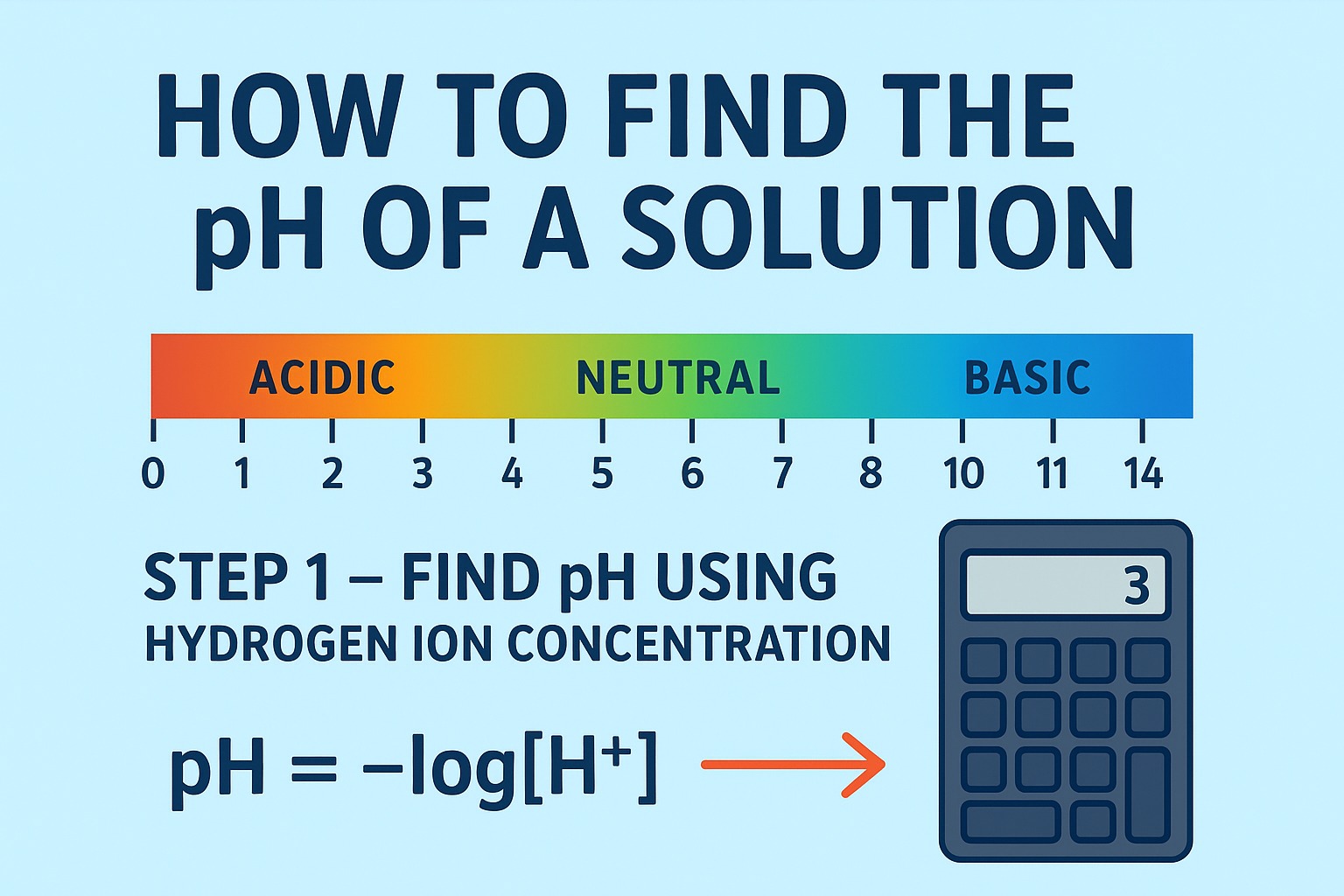
Visual idea: A colourful pH scale from red (acidic) to blue (basic), showing where everyday items like lemon juice (pH 2), water (pH 7), and soap (pH 10) fit in.
Step 1 – Find pH Using Hydrogen Ion Concentration
Now that we know what pH means, let’s move on to how we actually calculate it.
The pH calculation formula is:
pH=−log[H+]\text{pH} = -\log[H^+]pH=−log[H+]
This simply means we take the negative logarithm (base 10) of the hydrogen ion concentration.
Example:
If the hydrogen ion concentration is [H⁺] = 1 × 10⁻³,
then
pH=−log(1×10⁻³)=3\text{pH} = -\log(1 × 10⁻³) = 3pH=−log(1×10⁻³)=3
So the pH is 3, meaning it’s an acidic solution.
💡 Tip: The lower the [H⁺], the higher the pH — and that means the solution becomes more basic.
Visual idea: An image of a scientific calculator displaying the log function or a simple logarithmic scale.
Step 2 – Calculate pH from pOH (for Basic Solutions)
Not all solutions start with hydrogen ions. Sometimes, we’re given hydroxide ion concentration [OH⁻] instead. For these, we first calculate pOH and then find pH using their relationship.
The formulas are:
pOH=−log[OH−]\text{pOH} = -\log[OH^-]pOH=−log[OH−]
and at 25°C,
pH+pOH=14\text{pH} + \text{pOH} = 14pH+pOH=14
Example:
If [OH⁻] = 1 × 10⁻²,
then
pOH=−log(1×10⁻²)=2\text{pOH} = -\log(1 × 10⁻²) = 2pOH=−log(1×10⁻²)=2
and
pH=14−2=12\text{pH} = 14 – 2 = 12pH=14−2=12
That tells us the solution is strongly basic.
| [OH⁻] | pOH | pH |
| 1×10⁻¹ | 1 | 13 |
| 1×10⁻² | 2 | 12 |
| 1×10⁻³ | 3 | 11 |
This makes it much easier to calculate pH from OH⁻ concentration directly.
Step 3 – Find pH of a Buffer Solution (Henderson–Hasselbalch Equation)
Sometimes we deal with solutions that resist changes in pH even when we add small amounts of acid or base. These are called buffers.
The Henderson–Hasselbalch equation helps us calculate their pH:
pH=pKa+log[A−][HA]\text{pH} = \text{pKa} + \log\frac{[A^-]}{[HA]}pH=pKa+log[HA][A−]
Where:
- pKa = dissociation constant of the acid
- [A⁻] = concentration of the conjugate base
- [HA] = concentration of the weak acid
Example:
For an acetic acid buffer where pKa = 4.76 and [A⁻]/[HA] = 1,
pH=4.76+log(1)=4.76\text{pH} = 4.76 + \log(1) = 4.76pH=4.76+log(1)=4.76
That’s how we calculate pH of acidic solution containing a weak acid and its conjugate base.
Visual idea: Diagram showing the balance between a weak acid and its conjugate base, labelled “Buffer Zone”.
Step 4 – Calculate pH During a Titration
When we perform a titration (adding one solution to another to determine its concentration), the pH changes gradually. Let’s look at how to calculate it at different stages.
Before the Equivalence Point
The pH depends on the excess of the unreacted acid or base. If we’re titrating a weak acid with a strong base, we can use the buffer formula here.
At the Equivalence Point
- For a strong acid–strong base titration, pH = 7 (neutral).
- For a weak acid–strong base titration, pH > 7 because of salt hydrolysis.
After the Equivalence Point
Once the base (or acid) is in excess, the pH is determined by that extra component.
Visual idea: A titration curve graph (pH vs. volume added), showing the rise in pH before, at, and after the equivalence point.
Step 5 – Physical Methods to Measure pH
So far, we’ve looked at how to calculate pH theoretically. But in a lab or in the real world, we can also measure it directly.
Using a pH Meter
A pH meter gives the most accurate measurement. It works by detecting the voltage difference between two electrodes dipped in the solution. The reading is instantly converted into pH.
Visual idea: A diagram or photo of a pH meter setup.
Using Litmus Paper or pH Strips
For a quick and simple check, pH strips or litmus paper can be used. We just dip the strip into the solution and match the colour to a chart to estimate the pH.
Visual idea: Colour chart with shades corresponding to different pH levels.
Common Mistakes to Avoid
As we calculate pH and pOH, there are a few common errors that often trip us up:
- Using the wrong logarithm base (always log₁₀, not natural log).
- Forgetting that pH + pOH = 14 is valid only at 25°C.
- Mixing up [H⁺] and [OH⁻] in the formulas.
- Not balancing concentrations correctly in buffer calculations.
Paying attention to these details helps us avoid unnecessary confusion and get accurate results.
Real-Life Applications of pH Calculation
Knowing how to calculate pH isn’t just for exams — it’s incredibly useful in real life!
- Soil testing in agriculture: Farmers monitor soil pH to ensure crops grow in the right conditions.
- Water treatment and swimming pools: pH control prevents corrosion and maintains safety.
- Food and beverages: From yoghurt to soft drinks, acidity levels affect taste and preservation.
- Healthcare: Blood pH monitoring is vital for detecting health conditions.
So, the next time we dip a strip into water or see “pH balanced” on a shampoo bottle, we’ll know the science behind it!
FAQs
Q1.What is the easiest formula to calculate pH?
The simplest and most common formula is pH = −log[H⁺].
Q2.How do I find pH if I only know pOH?
Use pH = 14 − pOH (at 25°C).
Q3.What is the pH of pure water?
Pure water is neutral, so pH = 7 at 25°C.
Q4.Why does the pH + pOH = 14 rule change with temperature?
Because the ionisation constant of water (Kw) changes with temperature, slightly altering the sum.
How is pH measured in real experiments?
With a pH meter for precise results, or with pH paper for a quick estimate.