

Introduction
“Ravi went to Ravi’s school because Ravi forgot Ravi’s bag.”
Doesn’t this sound odd? What is it that makes it sound weird? The repetition of the same name over and over again. This is where a pronoun steps in for a noun, so you don’t have to repeat it.
The same sentence becomes: “Ravi went to his school because he forgot his bag.”
Just using ‘he’ and ‘his’ makes everything sound normal.
Pronouns may be small words, but they play a big role in making sentences sound natural. Before we look at the different types, let us first understand the pronoun definition and how these words are used in everyday English.
What Is a Pronoun?
To understand grammar clearly, it helps to know the definition of a pronoun in simple terms.
A pronoun is a word that replaces a noun or noun phrase to avoid repetition. We use it when the person, place, thing, or idea has already been mentioned or is obvious from the context.
Pronoun Definition
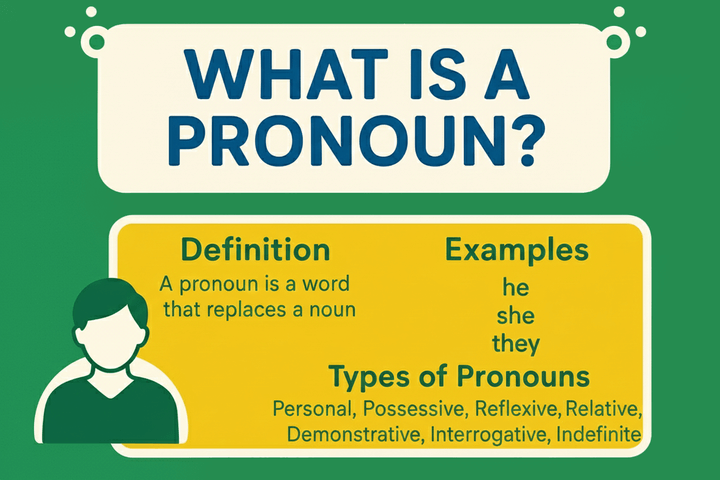
A pronoun is a word used in place of a noun.
Examples:
- Riya loves dancing. She practices every day.
- Riya is my friend. She is very kind.
- (She = Riya)
- The book is on the table. It belongs to me.
- (It = the book)
- Ravi and Meera are classmates. They study together.
- (Ravi and Meera = They)
Words like “he,” “she,” “it,” “they,” “this,” and “those” are all pronouns you use every day without even thinking about it.
To make the idea clearer, it also helps to look at the pronoun definition and examples used in everyday sentences.
Pronoun Definition for Class 2
For young learners, especially those in primary school, the easiest explanation is:
A pronoun is a word used instead of a noun.
Examples:
- Rahul is playing. He is happy.
- The cat is sleeping. It is sleeping on the mat.
This simple pronoun definition for Class 2 is often taught using pictures and worksheets.
Why Are Pronouns Important?
Pronouns keep language smooth, easy to follow, and concise. Without them, our sentences would sound stiff and robotic.
Here’s why they matter:
- They make language concise
- “My brother likes my brother’s bike” → “My brother likes his bike.”
- They help the writing flow
- Sentences read better when nouns aren’t repeated again and again.
- They make speech sound natural
- Imagine telling a whole story with no pronouns; it would be exhausting to hear.
- They help us refer to things quickly
- Words like this, that, these, and those point to things without naming them every time.
Pronouns make communication easier and more comfortable.
Understanding the definition and types of pronouns also helps learners recognise how they function in different situations.
How Many Types of Pronouns Are There?
Before learning them in detail, it is helpful to see the types of pronouns with definitions so that each category becomes easier to recognise.
There are seven main types:
- Personal Pronouns
- Possessive Pronouns
- Reflexive Pronouns
- Relative Pronouns
- Demonstrative Pronouns
- Interrogative Pronouns
- Indefinite Pronouns
1. Personal Pronouns
Used for particular people or things.
They change depending on whether they are the subject or object.
| Person | Subject | Object |
| First | I, we | me, us |
| Second | you | you |
| Third | he, she, it, they | him, her, it, them |
Examples:
- I love reading.
- They invited us.
- Can you help me?
2. Possessive Pronouns
Show ownership or belonging.
mine, yours, his, hers, ours, theirs
Examples:
- This book is mine.
- That house is theirs.
- Is this pen yours?
3. Reflexive Pronouns
Used when the subject and object are the same.
They end in -self or -selves.
myself, yourself, himself, herself, itself, ourselves, yourselves, themselves
Examples:
- She prepared herself for the exam.
- I hurt myself.
- They introduced themselves.
4. Relative Pronouns
Used to connect clauses or give more information about a noun.
who, whom, whose, which, that
Examples:
- The boy who won the race is my cousin.
- This is the girl whose bag was lost.
- The car that I bought is red.
5. Demonstrative Pronouns
Used to point towards specific things.
this, that, these, those
Examples:
- This is my favourite book.
- Those are the mountains we visited.
- These look delicious.
Use this/these for things close by and that/those for things further away.
6. Interrogative Pronouns
Used to ask questions.
who, whom, whose, which, what
Examples:
- Who is your teacher?
- Whose bag is this?
- What is your favourite colour?
- Which of the following is not a pronoun?
7. Indefinite Pronouns
Refer to people or things in a general way.
everyone, someone, anyone, nobody, nothing, everything, many, few, several, all, each, both
Examples:
- Everyone is excited.
- Nothing is impossible.
- Someone left their umbrella here.
- Many were invited, but few attended.
After learning each category, remembering the pronoun and its types and their definitions becomes easier when reading or writing sentences.
Noun and Pronoun Chart
| Noun | Pronoun | Example |
| Riya | she | Riya is my friend → She is my friend |
| The book | it | The book is new → It is new |
| Ravi and Meera | they | Ravi and Meera are here → They are here |
| Students | they | Students are in class → They are in class |
| My brother | he | My brother is tall → He is tall |
These noun and pronoun example sentences clearly show how pronouns replace naming words.
Examples in Sentences
If you are still wondering what pronouns are and their types are, the following examples show how they appear in everyday sentences.
- I am learning English. (Personal)
- This pencil is mine. (Possessive)
- He blamed himself. (Reflexive)
- This is the teacher who helped me. (Relative)
- These are beautiful flowers. (Demonstrative)
- Which of the books do you want? (Interrogative)
- Everyone enjoyed the concert. (Indefinite)
Five pronouns in one short paragraph
Riya said she would come to the park. I met her there, and we played together. This made everyone happy because they missed her last time.
Pronouns used: she, her, we, this, they
Quick Exercise
Identify the pronouns:
- He is my best friend.
- Those are beautiful paintings.
- Someone knocked on the door.
- The girl who sang is my cousin.
- I did it myself.
Answers: He, Those, Someone, who, myself
To build stronger grammar skills, students can also practice using common-noun and proper-noun worksheets, as well as pronoun exercises.
Common Mistakes Students Make
- Repeating the noun too many times.
- Using the wrong pronoun for singular and plural nouns.
- Confusing possessive adjectives (my, your) with possessive pronouns (mine, yours).
- Using “he” or “she” for objects instead of “it.”
Conclusion
Pronouns may be small words, but they play a big role in English grammar. They replace nouns, reduce repetition, and help sentences sound smooth and natural. Once students understand the different types of pronouns, they can write and speak with greater clarity and confidence.
Whether you are learning the pronoun definition for Class 2, practising with a personal pronouns worksheet, or trying to find the pronoun in a sentence, each exercise helps build a stronger understanding of how pronouns work.
With regular practice, using pronouns becomes second nature. The more you read, write, and speak, the more naturally you will use pronouns in everyday communication.