

Introduction
Nouns are one of the most important parts of the English language. Every time we speak, read, or write, we use nouns—often without even realising it. From talking about our family and school to sharing our feelings and ideas, nouns help us express ourselves clearly.
Nouns help us name the world around us. They give names to people, places, things, and even ideas that we cannot see or touch. Without nouns, it would be almost impossible to form meaningful sentences.
In this lesson, students will learn what a noun is, the definition of a noun and its types, how many kinds of nouns there are in English, and how to use nouns correctly with easy examples.
What Is a Noun?
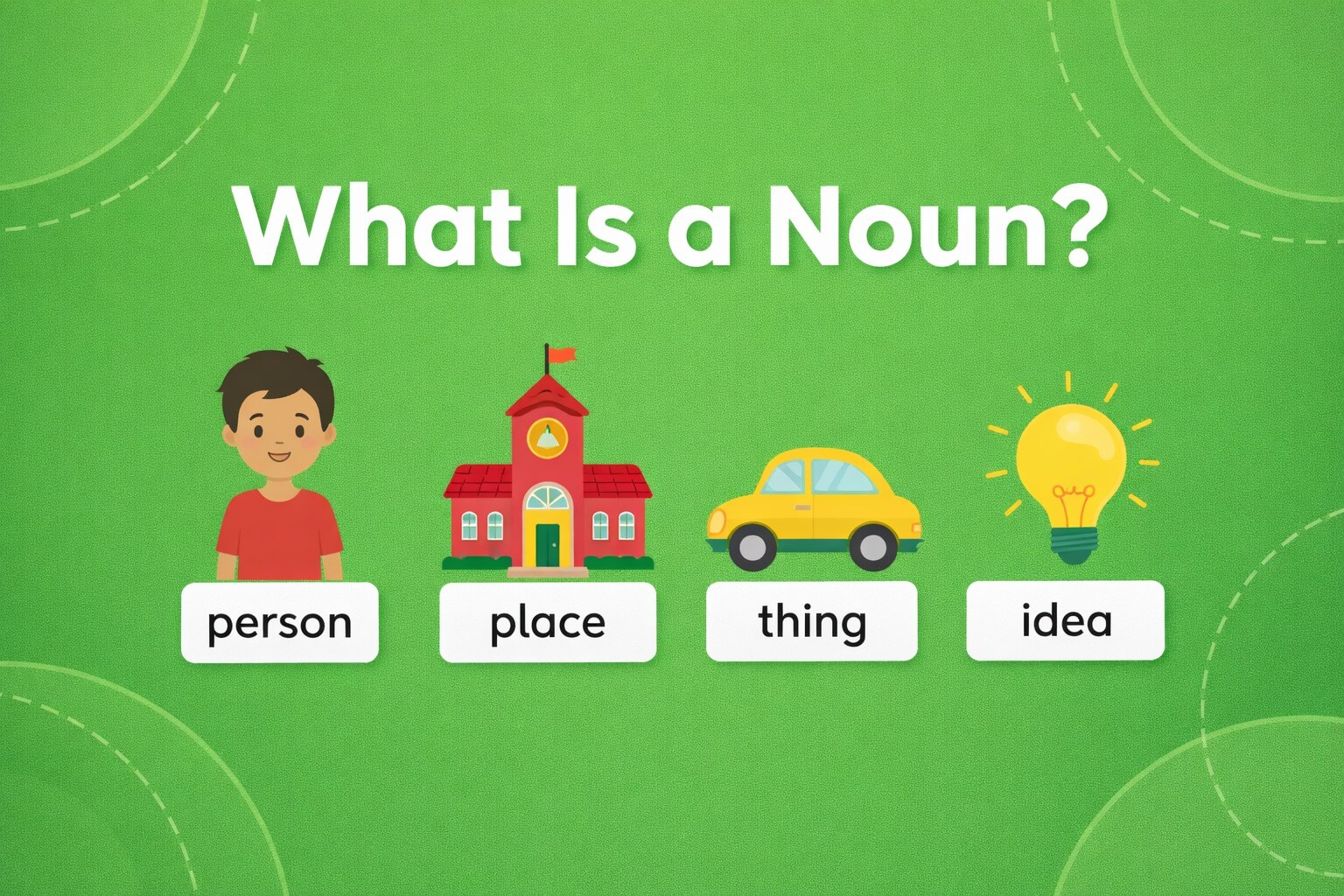
A noun is a naming word.
In simple words, a noun is the name of a person, place, thing, or idea.
Nouns help us identify who or what we are talking about. The language here is kept simple so that young learners can easily understand and remember it.
Examples of Nouns
To understand nouns better, let us look at some easy examples.
People
- teacher
- doctor
- child
Places
- school
- park
- city
Things
- book
- table
- phone
Ideas or Feelings
- happiness
- honesty
- love
These are all nouns because they name something.
Types of Nouns
Many students ask: How many kinds of noun are there in English?
There are different ways to classify nouns, but let us learn the most common and important types in a simple way.
Common Nouns
Common nouns are general names of people, places, or things.
Examples:
- boy
- school
- car
They do not begin with capital letters unless they start a sentence.
Proper Nouns
Proper nouns are the names of specific people, places, or things.
Examples:
- Rahul
- Delhi
- Monday
Important rule: Proper nouns always begin with a capital letter.
Concrete Nouns
Concrete nouns are things that we can see, touch, hear, smell, or taste.
Examples:
- apple
- dog
- chair
Abstract Nouns
Abstract nouns name feelings, ideas, or qualities. We cannot see or touch them.
Examples:
- happiness
- bravery
- honesty
Countable and Uncountable Nouns
Countable nouns are things we can count.
- one book, two books
- three pencils
Uncountable nouns are things we cannot count.
- water
- milk
- rice
How to Identify a Noun in a Sentence
Here are some easy ways to find a noun in a sentence:
- Ask “who” or “what”
- Look for naming words
Examples:
- The girl is reading a book.
- We went to the park.
The highlighted words are nouns.
Nouns Used in Sentences
Nouns are used in our daily speech all the time.
Examples:
- My mother cooks food.
- The cat is sleeping.
- I love my school.
These short sentences show how nouns fit naturally into everyday language.
Common Mistakes Students Make with Nouns
Students sometimes make small mistakes while using nouns.
- Confusing nouns with verbs
- run (verb) vs a run (noun)
- Forgetting capital letters in proper nouns
- india ❌ → India ✅
- Mixing abstract and concrete nouns
- happiness is not something we can touch
Tips to Learn Nouns Easily
Learning nouns can be fun and simple if you practise regularly.
- Look around and name objects in your room
- Read simple sentences aloud
- Practise using worksheets, flashcards, and games
The more you practise, the easier nouns become.
Why Learning Nouns Is Important
Learning nouns is very important because:
- It helps in sentence building
- It improves reading and writing skills
- It forms the base for learning grammar
Without nouns, learning English grammar would be incomplete.
Conclusion
To recap, a noun is a naming word. It names people, places, things, and ideas. There are different types of noun, such as common nouns, proper nouns, concrete nouns, abstract nouns, and countable and uncountable nouns.
Students are encouraged to notice nouns in daily life—at home, in school, and while reading books. Remember, nouns are everywhere, and learning them makes English easy and enjoyable.
FAQs
What is a noun in simple words?
A noun is a word that names a person, place, thing, or idea.
Can a sentence have more than one noun?
Yes, a sentence can have many nouns.
Is a name always a noun?
Yes, names of people or places are proper nouns.
How do I teach nouns to young children?
Use pictures, real objects, simple sentences, and fun activities like games and worksheets.