

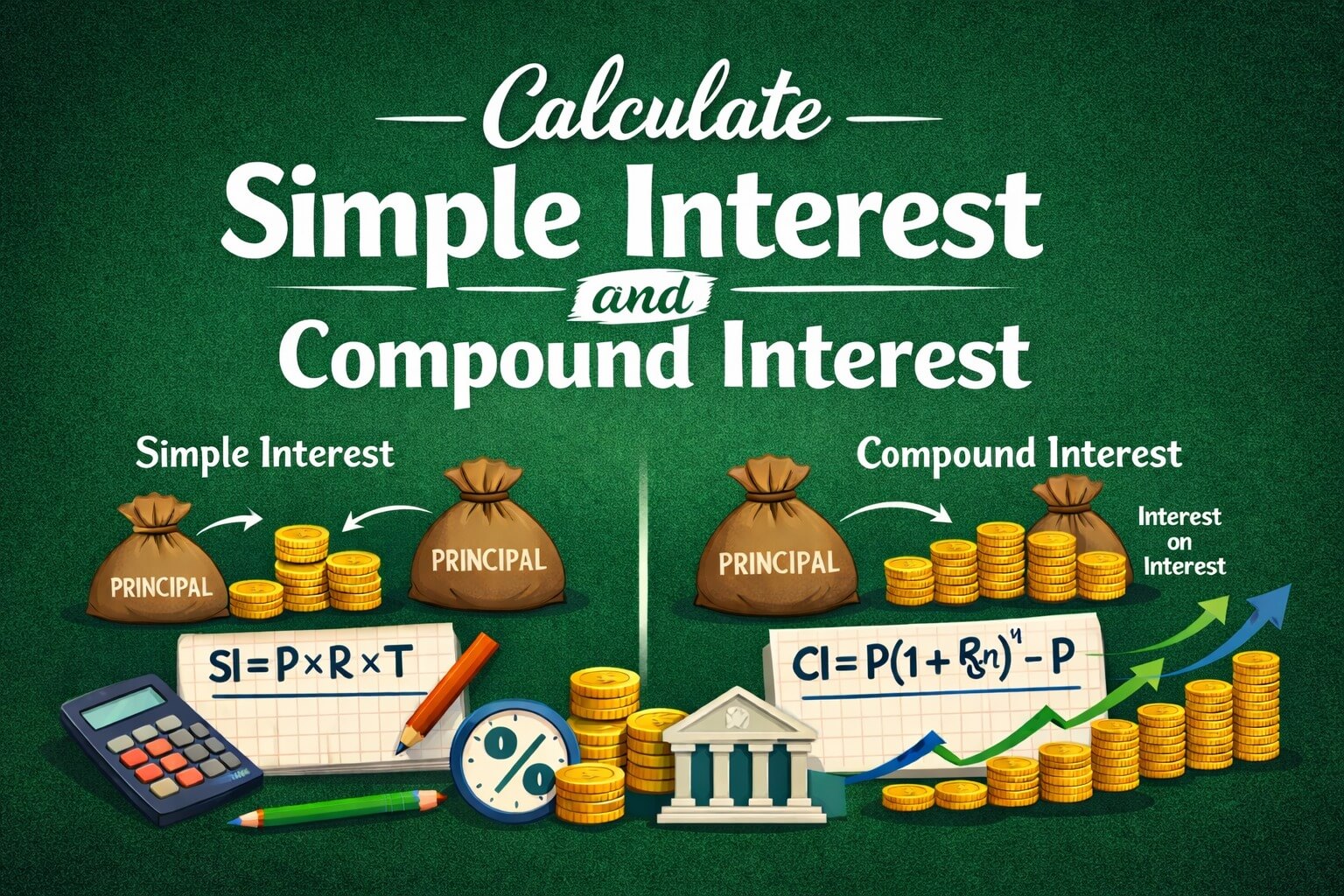
Interest is one of those things we hear about very early in life. It comes up in maths classes, at the bank, and later when we start earning or saving money. If you’ve ever wondered why banks give you extra money on savings or why loans cost more than what you borrow, interest is the reason.
In simple terms, simple interest is calculated only on the original amount, while compound interest keeps adding interest to interest. This article explains both in an easy way, with formulas, steps, and examples you can actually understand.
What Is Interest?
Interest is the extra money involved when money changes hands.
- When you borrow money, interest is what you pay back in addition to the amount taken.
- When you save money, interest is what the bank gives you for keeping your money with them.
There are two main types of interest you need to know:
- Simple Interest
- Compound Interest
We see interest being used in banks, loans, fixed deposits, and savings accounts.
What Is Simple Interest?
Simple interest is the most basic form of interest. It is calculated only on the principal amount, which means the original amount stays the same throughout the time period.
Simple interest is usually used in:
- Short-term loans
- Small money transactions
- School-level calculations
Simple Interest Formula
SI = (P × R × T) / 100
Where:
- P is the principal amount
- R is the rate of interest per year
- T is the time in years
How to Calculate Simple Interest (Step by Step)
To find simple interest:
- Write down the principal amount.
- Note the rate of interest.
- Check the time period in years.
- Put the values into the formula.
- Solve it to get the interest.
That’s all there is to it.
What Is Compound Interest?
Compound interest is slightly different. Here, interest is calculated on the principal plus the interest already earned.
This means the amount keeps increasing every year. That is why compound interest is often called interest on interest.
Compound interest is commonly used in:
- Fixed deposits
- Savings accounts
- Long-term investments
Compound Interest Formula
CI = P (1 + R/100)ᵀ − P
Where:
- P is the principal
- R is the rate of interest
- T is the time in years
How to Calculate Compound Interest
- Write down the principal, rate, and time.
- Divide the rate by 100 and add 1.
- Raise it to the power of the time period.
- Multiply the result by the principal.
- Subtract the principal to find the interest.
Difference Between Simple Interest and Compound Interest
- Simple interest is calculated only on the principal.
- Compound interest is calculated on the principal and the interest added earlier.
- Over time, compound interest gives more returns than simple interest.
Worked Examples
Example – Simple Interest
₹1,000 is borrowed at 10% per year for 2 years.
Simple Interest = (1000 × 10 × 2) / 100
Simple Interest = ₹200
So, the total amount to be paid is ₹1,200.
Example – Compound Interest
Now take the same ₹1,000 invested at 10% per year for 2 years.
Amount = 1000 (1 + 10/100)²
Amount = ₹1,210
Compound Interest = ₹210
Even with the same values, compound interest gives a higher amount.
Where Do We Use Simple and Compound Interest?
- Simple interest is mostly used for short-term loans and basic lending.
- Compound interest is used by banks for savings, fixed deposits, and investments.
Common Mistakes Students Make
- Using the wrong formula for the question.
- Forgetting to convert months into years.
- Not subtracting the principal in compound interest.
- Making calculation mistakes while solving powers.
Conclusion
Simple interest is easy to understand and calculate, which is why it is taught first. Compound interest may look a little confusing at the beginning, but it helps money grow faster over time. Knowing the difference between the two is useful not just for exams, but also for making better financial choices later in life.
FAQs
What is simple interest in easy words?
It is interest calculated only on the original amount.
What is compound interest in easy words?
It is interest calculated on the original amount and the interest added to it.
Which is better, simple or compound interest?
Compound interest gives more money over a longer period.
Do banks use compound interest?
Yes, banks use compound interest for savings and fixed deposits.
Can interest be calculated yearly or monthly?
Yes, interest can be calculated for different time periods.
Why is compound interest called interest on interest?
Because interest is earned on previously earned interest.