

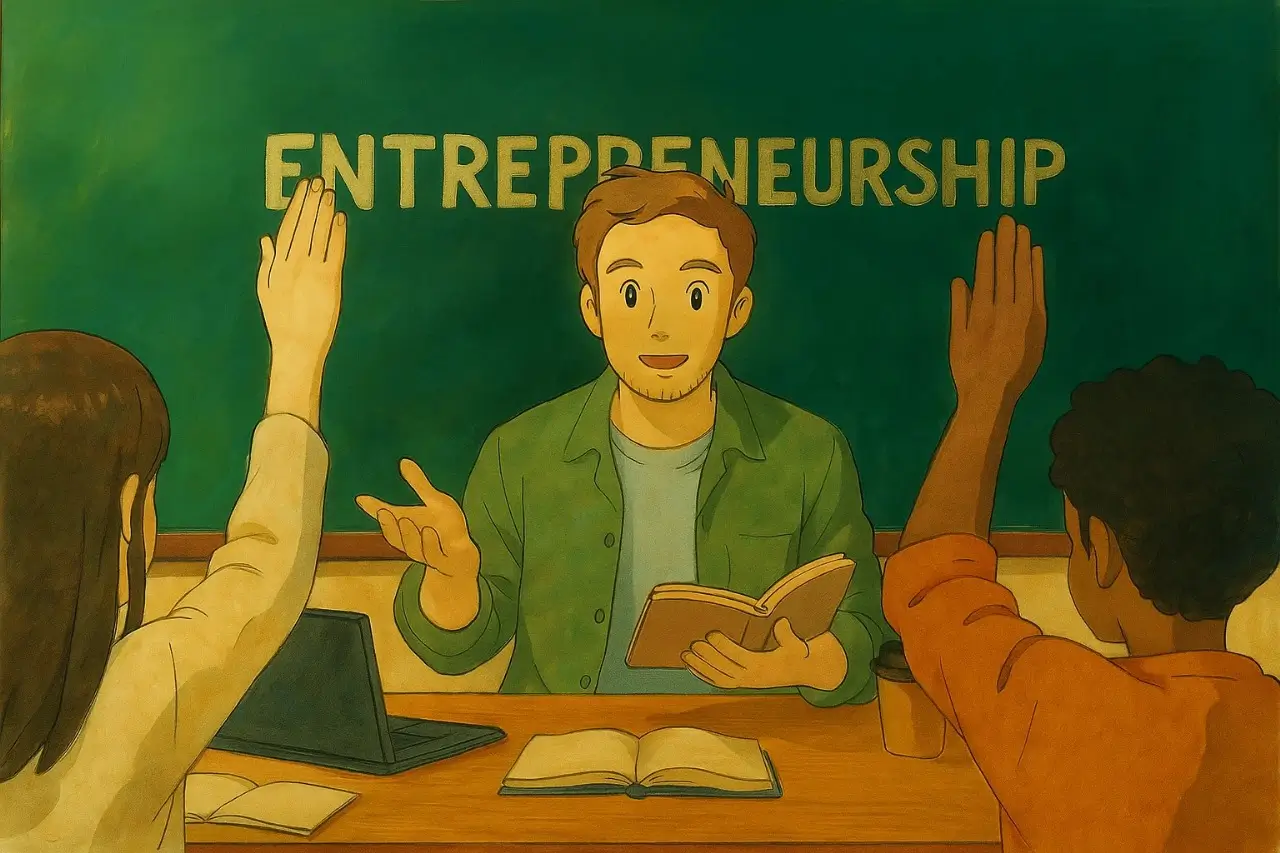
Imagine sitting through years of “Commerce” classes, memorising balance sheets and business laws, but never really learning how to start a business. In fact, it’s no surprise that while over 32% of students say they want to start their own businesses, very few feel prepared to take the leap.
The truth is, the world has changed. Start-ups can disrupt entire industries overnight. Take Zerodha, for instance. This Indian fintech startup revolutionised stock trading by introducing zero brokerage fees, forcing traditional players to rethink their entire business models. In this new reality, just learning traditional commerce isn’t enough.
Today’s world needs creators, problem-solvers, and leaders, not just employees. That’s why it is time for schools to move beyond theory and start teaching real-world entrepreneurship skills like innovation, resilience, leadership, and creative thinking that empower students to build their futures.
At Bethany Institutions, we have always championed forward-thinking education.
Our school believes that while traditional commerce classes do a great job of introducing students to business fundamentals at the high school level, they often stop short of igniting the entrepreneurial spirit that’s essential today.
Why Traditional Commerce Education Isn’t Enough
Commerce, as traditionally taught, builds a strong foundation in subjects like accounting, financial reporting, business studies, and economics. But in most Indian schools, the curriculum ends up being textbook-heavy, packed with theories and formulas.
While we understand that these are undoubtedly valuable, they are still primarily reactive skills and tools for managing an existing system, not for disrupting or innovating within it.
And that’s not all.
Traditional commerce curricula often miss out on:
- Innovation and Creativity: Students learn how businesses work, but not how to create or reinvent them.
- Risk-taking and Resilience: There is little exposure to the uncertainties and challenges of starting or managing new ventures.
- Practical Application: Theoretical knowledge isn’t always linked to real-world scenarios, leaving students underprepared for practical challenges.
In short, students often end up ready to fit into existing jobs, but not prepared to create new opportunities.
Entrepreneurship changes that. It teaches students to think independently, solve problems creatively, and embrace uncertainty. It is about having the courage to start something new, the resilience to keep going when things get tough, and the agility to pivot ideas when needed.
Of course, this doesn’t mean teaching entrepreneurship the way colleges or MBA programmes do. At the school level, it’s about sparking interest through simple, relatable experiences. When broken down into age-appropriate activities, even younger students can begin to grasp the mindset behind entrepreneurship and get a taste of what it means to think like an entrepreneur.
And in a country like India, where more than 65% of the population is under 35 (Economic Survey of India, 2024), can we afford not to nurture entrepreneurial thinking early on?
Why Entrepreneurship Matters More Than Ever
The 21st-century economy is much more than just finding a job. Students graduating today face a reality where:
Students graduating today face a reality where:
- Creativity and critical thinking outrank rote memorisation
- Leadership and adaptability are prized across every industry
- Tech entrepreneurship is reshaping economies globally
But that’s not all.
We are also living in an era where entire industries are being disrupted within years. Jobs that didn’t exist a decade ago (think app developers, digital marketers, sustainability consultants, driverless car engineers, or podcast producers) are booming today. Likewise, many traditional roles are evolving rapidly.
And that is where teaching entrepreneurship education to students matters.
It prepares students to:
- Identify opportunities where others see challenges
- Think out of the box and innovate solutions instead of waiting for them
- Create value for society, not just profit
- Lead ethically and empathetically
- Approach challenges with a solution-oriented mindset
In other words, teaching entrepreneurship requires cultivating a mindset that embraces responsibility, resilience, and making an impact.
Even the National Education Policy (NEP 2020) explicitly encourages fostering entrepreneurship and innovation skills among students (at the high school level). In fact, the policy advocates for experiential learning, critical thinking, and flexibility in course choices, all of which are vital to entrepreneurship education.
Additionally, initiatives such as the Atal Innovation Mission (AIM) and the Atal Tinkering Labs are already paving the way to provide students with the tools and platforms to experiment, innovate, and bring their business ideas to life.
In a similar spirit, Delhi’s Business Blasters programme has emerged as a pioneering initiative to grow entrepreneurial mindsets among school students. Launched under the Delhi government’s “Entrepreneurship Mindset Curriculum,” this scheme provides students with seed funding to develop and pitch fundamental business ideas, with some even becoming profitable before they graduate.
What Teaching Entrepreneurship Looks Like
So, what does teaching entrepreneurship look like in a school setting?
It’s hands-on, messy, and wonderfully transformative.
At Bethany, we believe in moving beyond textbooks into experiential learning. Our aim is to help students live the entrepreneurial mindset, and not just read about it. Some of the ways we do this include:
- Competitions where students defend their ideas, developing the confidence to pitch and problem-solve on the spot
- Workshops and hackathons where students brainstorm creative solutions to real-world problems and learn to think divergently
- Case study analysis of business successes and failures that encourages students to ask, “What would I have done differently?”
- Social impact challenges, where students design solutions for community issues, combining empathy with innovation
- Embedding entrepreneurship across subjects, so students start to see how business thinking applies to areas like science, arts, or even civics
- Encouraging students to initiate and manage projects, fostering ownership and practical experience
And these are not merely theoretical exercises. For instance, in our Junior College, students once conducted a simulation where they started a company, issued shares among classmates, declared profits, and even distributed dividends, getting a hands-on taste of what it means to run a business. In another initiative, students helped run a tuck shop, learning to manage inventory, track profits, and understand customer needs in real time.
Through these initiatives, we aim to nurture a generation of innovators, leaders, and changemakers. In fact, the skills our students develop naturally through such experiences include:
- Critical thinking
- Financial literacy
- Marketing basics
- Leadership and teamwork
- Persuasion and communication
The Road Ahead
At Bethany Institutions, we’ve always prided ourselves on preparing our students for the world they are about to enter, not the one we grew up in. That’s why we’ve begun teaching basic entrepreneurship skills to our high school students.
Although we know that not every student will become a startup founder, we believe every student will someday need to think independently, solve problems, and adapt quickly.
And that’s the true value of learning entrepreneurship early.
By shifting focus from solely teaching commerce to fostering entrepreneurship, we can equip students with the skills and mindset needed to navigate and shape the future. We invite more schools across India to join us on this journey.