

1. Introduction
Think about the objects you use every day — your notebook, study table, classroom board, door, or even your phone. Most of them have the same shape: a rectangle. Because rectangles are such a common part of our surroundings, learning about them feels familiar and easy.
One useful thing we learn about rectangles is how to find their area. Let’s go through this topic slowly and clearly, just the way it would be explained in class, with examples you can easily relate to.
2. What Is a Rectangle?
A rectangle is a simple shape with four sides and four corners. Each corner is a right angle, which means it measures 90 degrees. Another important point to remember is that the opposite sides of a rectangle are equal in length.
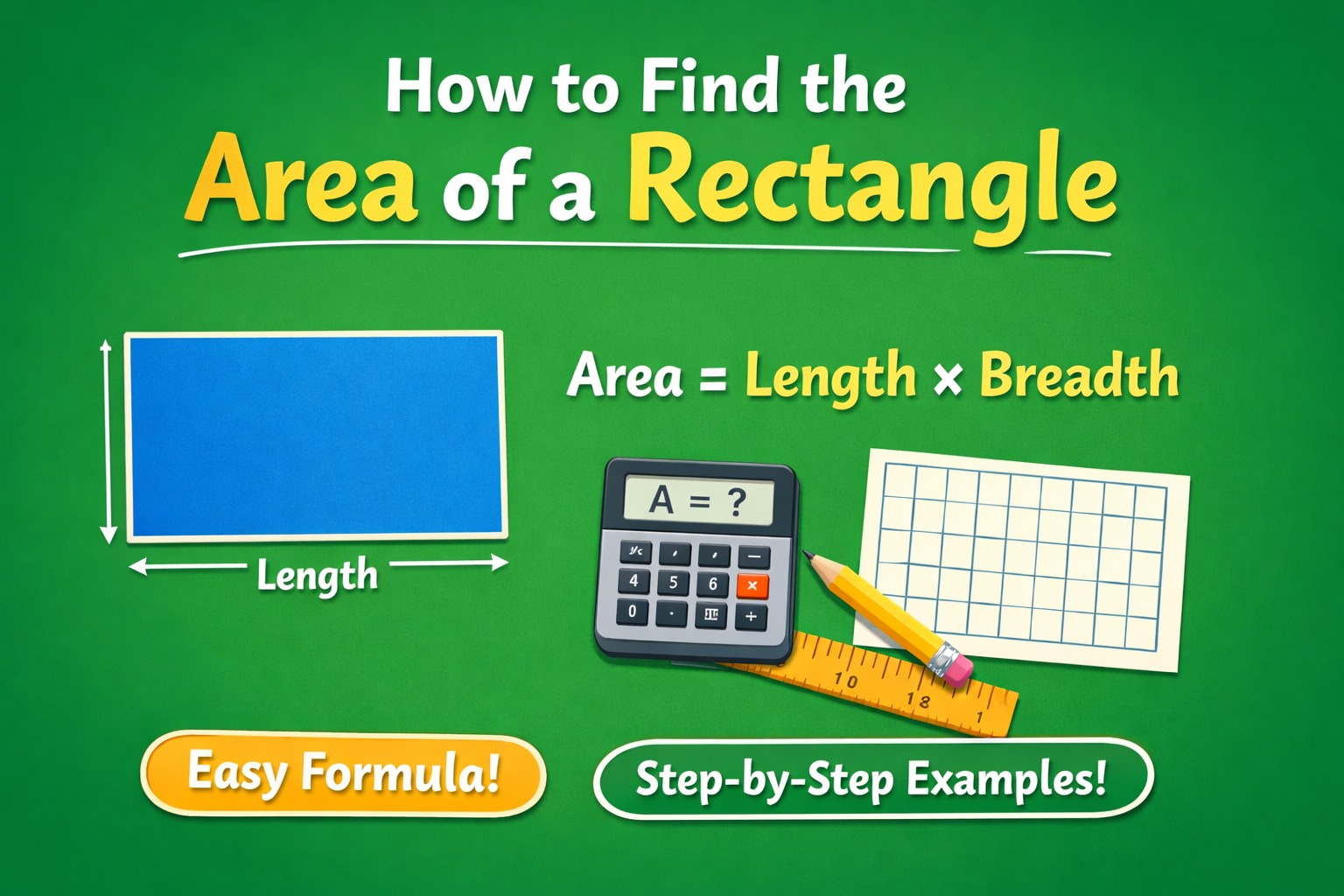
A rectangle has two main measurements: length and breadth (also called width). The length is usually the longer side, and the breadth is the shorter side.
3. What Does “Area” Mean?
In simple words, area means the amount of flat space a shape covers. When we find the area of a rectangle, we are finding the size of the surface inside its four sides. This is why area is always written in square units, such as square centimetres (cm²) or square metres (m²).
To understand this better, imagine placing small equal square tiles on the surface of a rectangle. If you cover the entire surface without leaving any gaps, the number of tiles you use gives you the area of the rectangle.
4. Formula for the Area of a Rectangle
4.1 The Basic Formula
The rule for finding the area of a rectangle is very straightforward:
Area = Length × Breadth
You may also hear teachers say this as length into breadth.
4.2 Why This Formula Makes Sense
The length tells us how long the rectangle is, and the breadth tells us how wide it is. If you imagine the rectangle filled with small equal squares, you’ll see that they are arranged in rows and columns. The number of rows depends on the length, and the number of columns depends on the breadth. Multiplying the length and breadth helps us count all these squares at once.
4.3 Units
Before writing your final answer, always check the units. If both length and breadth are given in centimetres, the area will be in square centimetres (cm²). If they are in metres, the area will be in square metres (m²). Forgetting the unit is a very common mistake, so be careful.
5. Step-by-Step Method to Find Area
You can find the area of any rectangle by following these simple steps:
Step 1: Read the question carefully and note down the length.
Step 2: Note down the breadth (or width).
Step 3: Multiply the length by the breadth.
Step 4: Write the answer along with the correct square unit.
Example:
Length = 8 cm
Breadth = 5 cm
Area = 8 × 5 = 40 cm²
So, the area of the rectangle is 40 square centimetres.
6. Solved Examples
Let’s solve a few examples together.
Example 1
Length = 7 cm, Breadth = 3 cm
Area = 7 × 3 = 21 cm²
Example 2
Length = 12 m, Breadth = 9 m
Area = 12 × 9 = 108 m²
Example 3
A classroom floor is 20 m long and 15 m wide.
Area = 20 × 15 = 300 m²
So, the area of the classroom floor is 300 square metres.
Example 4
Length = 5.5 cm, Breadth = 4 cm
Area = 5.5 × 4 = 22 cm²
7. Real-Life Uses of Rectangle Area
Finding the area of a rectangle is not just for exams. It helps in real life too — like knowing how much paint is needed for a wall, how big a table or book is, how much carpet is required for a room, or how much space is available when planning a garden or classroom seating.
8. Common Mistakes Students Make
Many students lose marks because of small mistakes. Some add the length and breadth instead of multiplying them. Others forget to write square units like cm² or m². Mixing different units, such as centimetres and metres, can also give the wrong answer.
Corrected example:
Length = 6 cm, Breadth = 4 cm
Wrong method: 6 + 4 = 10
Correct method: 6 × 4 = 24 cm²
9. Practice Questions
Try these questions on your own:
- Find the area of a rectangle with length 6 cm and breadth 4 cm.
- Find the area of a rectangle with length 15 m and breadth 10 m.
- A garden is 9 m long and 8 m wide. What is its area?
FAQs
What is the formula for the area of a rectangle?
Area = length × breadth.
Why do we use square units for area?
Because area is found by counting the number of squares that cover a surface.
Can length and breadth be the same in a rectangle?
Yes. When both are the same, the rectangle is called a square.