When it comes to choosing the right education board for your child, I know how overwhelming it can be. As parents, we all want to give our children the best possible foundation, and one of the biggest decisions we make is selecting the board of education that will shape their academic journey. At Bethany High, we’ve often met parents who are unsure about what makes the ICSE board different from others like CBSE or State Boards. So, let us walk you through what we’ve learnt over the years about the ICSE syllabus and why many parents choose it for their children.
The Indian Education System: A Quick Overview
India is home to a variety of school education boards, each offering unique teaching styles, exam patterns, and syllabus structures. The most common boards you will come across are:
- ICSE (Indian Certificate of Secondary Education)
- CBSE (Central Board of Secondary Education)
- State Boards (specific to each state)
- IB (International Baccalaureate)
- Cambridge (IGCSE)
While all boards aim to educate, the approach each one takes can make a significant difference in your child’s learning style, skill development, and even how they handle real-world challenges later on.
Understanding the ICSE Syllabus
We’ve worked with the ICSE curriculum for years, and one thing we can tell you is that it is a thorough and well-rounded syllabus. Unlike boards that lean heavily towards exam-based learning, ICSE focuses on comprehensive learning. Students are encouraged to not just memorise but understand, analyse, and apply what they learn.
The syllabus covers:
- Languages: English is given strong emphasis, which helps develop excellent communication skills.
- Sciences: Physics, Chemistry, and Biology are treated as separate subjects, giving students deeper knowledge.
- Mathematics: More detailed, with strong problem-solving components.
- Social Sciences: History, Civics, and Geography are taught in depth.
- Art, Craft, Physical Education, and even Environmental Education are compulsory parts of the curriculum.
This approach helps students not just score marks but also develop important life skills like analytical thinking, creativity, and strong communication — the very essence of skill development in ICSE.
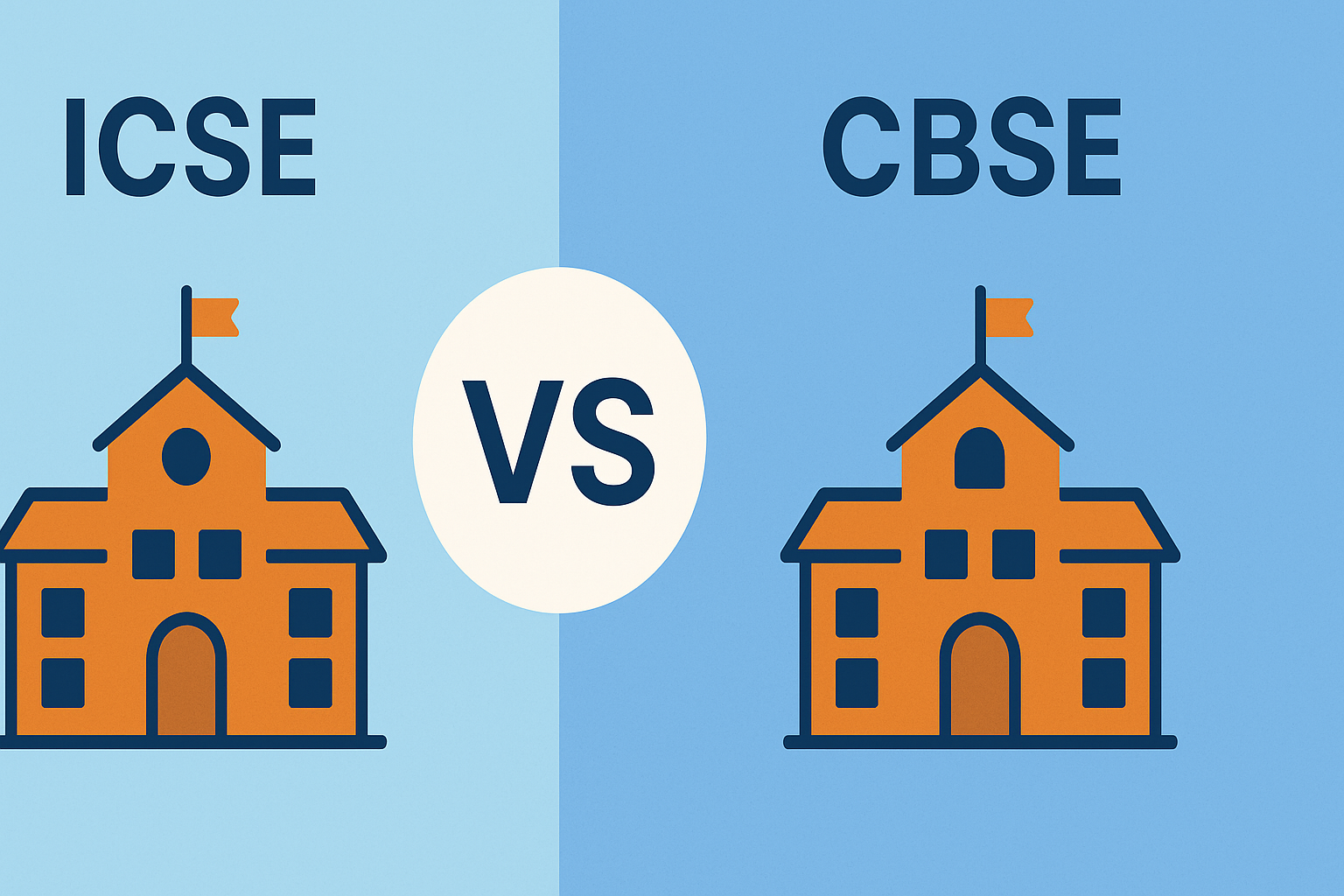
ICSE vs CBSE: What’s the Difference?
Let’s break it down.
| Aspect | ICSE | CBSE |
| Focus | Conceptual understanding and practical application | Exam-oriented and theoretical learning |
| Syllabus Depth | More detailed and extensive | More compact and easier to follow |
| Language | Strong emphasis on English | Bilingual (English & Hindi), less focus on English fluency |
| Subjects | More variety and compulsory subjects like Environmental Education and Arts | Offers more flexibility with subjects |
| Recognition | Highly valued in India and abroad | Preferred for Indian competitive exams |
In simple terms, the ICSE curriculum is perfect if you want your child to build a strong foundation, especially in English and analytical skills, while CBSE may suit those focusing more on competitive exams like NEET or JEE.
ICSE vs State Board: How Does the Syllabus Differ?
The ICSE vs State Board comparison is often about depth vs simplicity. State Boards vary from one state to another, with syllabi designed according to regional needs and often in the state language.
While this is beneficial for students aiming for state-level exams or colleges, the ICSE syllabus offers:
- More in-depth learning across all subjects
- A stronger focus on English proficiency
- Equal emphasis on arts, humanities, and sciences
- Practical knowledge through project work, lab sessions, and real-life applications
We’ve seen many students who transition from State Boards to ICSE find the curriculum initially challenging but ultimately rewarding as it opens up more avenues for global recognition and higher education abroad.
The Syllabus Advantage: Why ICSE Stands Out
We’ve personally noticed, year after year, that ICSE students don’t just learn to pass exams — they learn to understand. Here’s why we believe ICSE holds a unique advantage:
1. Comprehensive Learning in ICSE
Every subject is taught holistically. Students are not only expected to write answers but to understand the ‘why’ behind every concept.
2. Skill Development in ICSE
From analytical thinking to communication, the ICSE curriculum promotes critical life skills that are needed beyond the classroom.
3. Balanced Approach
Subjects like Art, Craft, Drama, Physical Education, and Environmental Studies are given equal importance, promoting a holistic education approach.
4. Project Work & Internal Assessments
ICSE places a good deal of emphasis on project work and practicals, which help in real-life application of knowledge, team work, and creativity.
5. Depth of ICSE Syllabus
The depth of the syllabus might seem like a lot at first, but it prepares students for higher education — both in India and abroad — without the shock of suddenly facing complex concepts.
Global Recognition: ICSE and International Standards
If you are considering education beyond Indian borders, ICSE is often a great advantage. The ICSE school system advantages are recognised by many international universities because:
- The syllabus is on par with international curricula.
- English language proficiency is naturally stronger.
- Students are already familiar with project-based and research-based learning.
It’s no surprise that students from ICSE schools in Bangalore, including ours, have often gone on to thrive in international universities.
Choosing the Right Board: Factors to Consider
Of course, every child is unique, and no one board fits all. Here are a few things we always suggest parents consider:
- Your child’s learning style: Does your child thrive with detailed concepts or prefer structured, exam-focused learning?
- Future academic goals: Are you aiming for competitive exams in India or exploring international opportunities?
- Location: If you are moving between states, CBSE or ICSE may offer more uniformity compared to State Boards.
- Skill development: Do you want your child to focus on creativity, analytical skills, and communication alongside academics?
Conclusion
In the end, what matters most is your child’s growth, confidence, and love for learning. At Bethany High, we strongly believe that the ICSE board offers a syllabus advantage that goes beyond just books and exams. It prepares children for life.
If you’re looking for ICSE Schools in Bangalore, do check out what we offer at Bethany Institutions. We would love to welcome you into our family!
FAQs
What is the main difference between ICSE and CBSE?
The ICSE focuses more on detailed, concept-based learning while CBSE is more exam-oriented.
Is ICSE harder than other boards?
It can feel more challenging because of its depth, but it also prepares students better for the future.
Which board is better for competitive exams, ICSE or CBSE?
CBSE has an advantage for Indian competitive exams, but ICSE students develop strong analytical skills that can be an asset in any exam.
Does ICSE have more global recognition than other boards?
Yes, ICSE is well-regarded by many international universities thanks to its comprehensive and English-rich curriculum.