

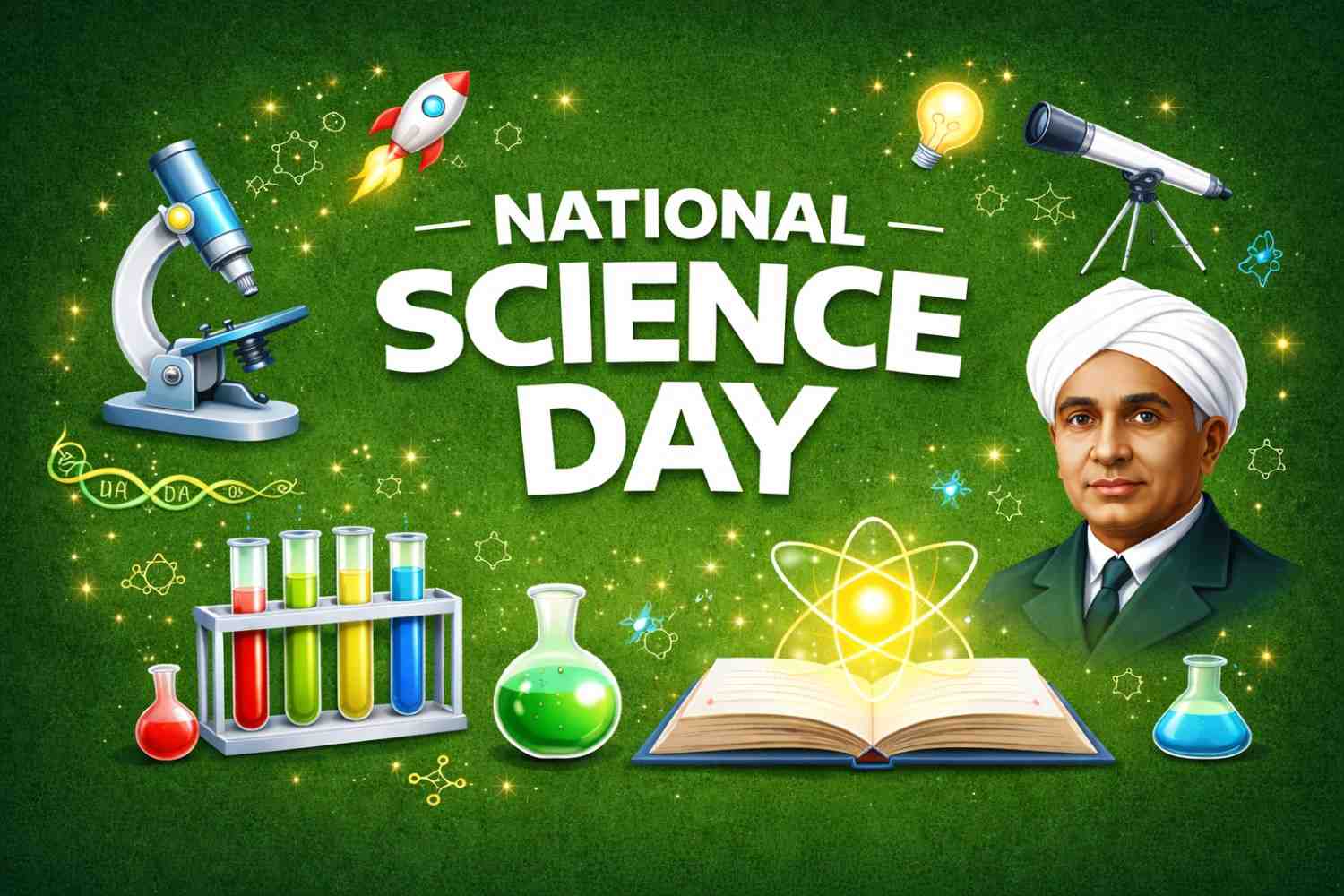
National Science Day is a special occasion in India dedicated to celebrating the achievements and progress in the field of science. It is a day to inspire curiosity, encourage innovation, and recognise the contributions of scientists in shaping modern society.
This day plays a key role in promoting scientific thinking among students, motivating them to explore new ideas and understand the importance of research in daily life.
National Science Day encourages curiosity and learning, helping students and everyone see how science improves our lives, drives progress, and solves everyday challenges in our changing world.
What Is National Science Day
National Science Day is observed on 28 February every year in India. The day is celebrated to spread awareness about science and its important role in society. Schools, colleges, and scientific organisations use this day to encourage learning, discussions, and activities related to science.
It reminds everyone of the value of understanding natural phenomena, using technology responsibly, and applying knowledge to solve real-life problems. The focus is not only on celebrating scientific achievements but also on inspiring students and the public to think critically, explore the world, and stay curious about new ideas.
Why National Science Day Is Celebrated
The importance of National Science Day lies in how it motivates people to explore, learn, and appreciate science in different ways. Some of the key reasons it is celebrated include
- Promote interest in science: The day motivates students and the public to take an interest in science and understand its role in daily life.
- Encourage research and innovation: It inspires young minds to explore new ideas and consider careers in scientific research and innovation.
- Inspire students to explore careers: Students are encouraged to see science as a pathway to exciting and meaningful careers that can make a difference.
- Spread awareness about achievements: National Science Day recognises the contributions of Indian scientists and helps everyone appreciate the value of scientific progress.
History of National Science Day
The celebration of National Science Day is closely connected to Sir C. V. Raman, one of India’s most famous physicists. On 28 February 1928, he discovered the Raman Effect, which showed how light scatters when it passes through a transparent material. This important discovery earned him the Nobel Prize in Physics in 1930 and brought India recognition on the global scientific stage.
The first National Science Day was celebrated in 1987, marking this historic achievement. Choosing this date honours Raman’s contribution and encourages people to remember that scientific breakthroughs can have a lasting impact on knowledge and society.
Importance of Science in Daily Life
Science affects nearly every part of our daily life, making things easier, faster, and safer. Here’s how it matters:
- Technology and medicine: Science drives innovations in technology and healthcare. It helps develop vaccines, treatments, and medical tools that save millions of lives.
- Communication and travel: Advances in science make communication and travel faster and more efficient. Smartphones, the internet, and modern transportation connect people around the world instantly.
- Environment and sustainability: Science helps us understand the environment, use resources wisely, and work towards sustainability to protect our planet.
- Improving quality of life: By solving problems and creating new solutions, science improves living standards and makes life more comfortable and safe for everyone
Role of Students in Promoting Science
Students play an important role in spreading scientific knowledge and curiosity. Here’s how they can contribute:
- Develop curiosity: Students should explore new ideas and ask questions to understand how things work. Curiosity drives learning and innovation.
- Participate in experiments and projects: Hands-on experiments help students see theories in action and learn practical applications of science.
- Ask questions and explore ideas: Challenging assumptions and seeking answers encourages critical thinking and deeper understanding.
- Build problem-solving skills: Engaging with science helps students develop problem-solving abilities, which are essential for future studies and careers.
How Schools Celebrate National Science Day
Schools celebrate National Science Day with fun and educational activities that make learning exciting. Here’s what usually happens:
- Science exhibitions: Students display models, experiments, and projects to show their understanding of scientific concepts.
- Quiz competitions: Quizzes test knowledge and encourage students to learn more about science in an interactive way.
- Model making: Creating models helps students understand ideas practically and encourages creativity.
- Guest lectures and workshops: Experts share knowledge and insights about research, discoveries, and innovations.
- Poster and project presentations: These activities improve students’ communication skills and help them explain scientific ideas effectively.
Theme of National Science Day
Each year, National Science Day carries a new theme that highlights a particular aspect of science. Themes often focus on innovation, sustainability, or emerging technologies. They aim to connect scientific ideas to real-world challenges and show how research can solve pressing problems.
Themes inspire students, researchers, and the public to explore new areas of science and consider their impact on society. By following the theme, activities and discussions become more focused, relevant, and educational, ensuring that the celebration has meaning beyond mere observance.
Benefits of Celebrating Science Day in Schools
Celebrating National Science Day in schools gives students many advantages and makes learning fun. Here’s how it helps:
- Encourages creativity: Activities inspire students to think creatively and come up with new ideas.
- Builds interest in STEM fields: Exposure to experiments, projects, and demonstrations motivates students to explore science, technology, engineering, and maths subjects.
- Promotes teamwork: Group activities teach collaboration, communication, and sharing of ideas effectively.
- Improves confidence and presentation skills: Presenting projects, answering questions, and explaining experiments boost self-confidence and public speaking abilities.
How Students Can Celebrate at Home
Students don’t need a classroom to enjoy science—they can explore it at home too. Here are some ways:
- Simple experiments: Using everyday materials, students can try easy experiments to learn hands-on science.
- Reading science books: Books and articles broaden knowledge and spark curiosity about different scientific topics.
- Watching educational content: Videos, documentaries, and online lessons make learning science engaging and visual.
- Discussing scientific ideas with family: Talking about experiments and ideas with family improves critical thinking and communication skills.
Conclusion
National Science Day shows us how science affects our lives and the future. By honouring great scientists and sparking curiosity, it encourages students to explore, ask questions, and try new ideas. Science helps in medicine, technology, and protecting the environment. Learning problem-solving and creative thinking prepares students to become future innovators and build a better tomorrow.
FAQs
When is National Science Day celebrated?
It is celebrated on 28 February every year in India.
Why is National Science Day important?
It promotes scientific thinking, innovation, and awareness among students and the public.
Who discovered the Raman Effect?
Sir C. V. Raman discovered the Raman Effect, which led to the celebration of this day.
How can students participate in National Science Day?
Students can join science exhibitions, experiments, quizzes, and projects to celebrate and learn.