What does it mean to educate a child?
Is it about perfect scores and flawless report cards?
Or is it about equipping young people to make sense of the world, to lead it, shape it, and serve it with compassion and courage?
At Bethany, we’ve always believed that the role of a school goes far beyond academics. We are not just preparing our students for university entrances or board exams.
We are preparing them for life. For leadership. For citizenship.
In today’s world, where climate change, social unrest, AI ethics, and political polarisation are daily headlines, we don’t just need students who can recite facts. We need young people who can ask the right questions, stand up for what’s right, and build a better future.
Because let’s face it: the world doesn’t just need toppers. It needs torchbearers. It needs changemakers. And that journey begins in the classroom.
Why Can’t Responsibility Wait?
We’re living in a time when the stakes are higher than ever. Whether it’s the climate crisis, inequality, digital ethics, or gender inclusion, the world’s problems are no longer distant or abstract. They’re personal, present, and pressing.
Young people around the globe are already stepping up. Greta Thunberg was just 15 when she sparked a global climate movement. Afroz Shah, a lawyer from Mumbai, mobilised thousands to clean up Versova Beach – one of the world’s largest citizen-led environmental efforts.
In other words, this is the era of young changemakers. But they don’t just appear out of nowhere. They’re shaped quietly and consistently by the values, environments, and people around them, which is why schools have an extraordinary role to play.
In fact, a study from McCann Worldgroup Truth Central (2021) found that 77% of APAC’s Gen Z believe they have a responsibility to drive social change. The intention is there. Our job as educators is to help turn that intention into a lifelong impact.
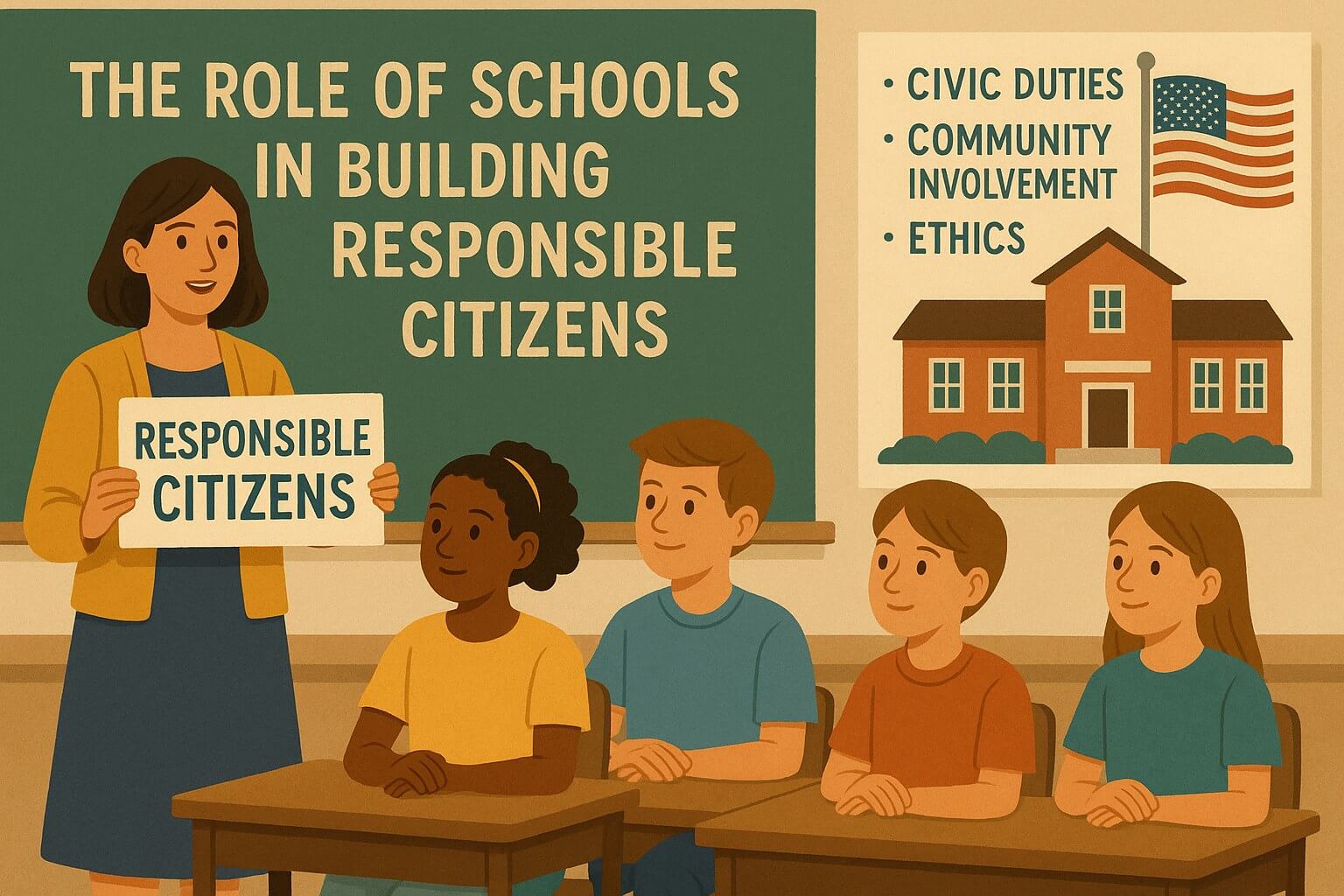
What Does a Responsible Citizen Look Like Today?
Gone are the days when being a “responsible citizen” simply meant following rules and casting a vote every five years. Today, citizenship is active, dynamic, and deeply human.
It means being aware of the world, but also willing to improve it.
It means having empathy in an increasingly divided world.
And the courage to act, even when it’s inconvenient.
A responsible citizen is someone who not only knows their rights but respects their responsibilities — to others, to the environment, to democracy, and to truth.
However, the challenge is that these aren’t skills students can memorize from a textbook. They have to be lived, practiced, and experienced. And that’s where schools come in.
Five Ways Schools Can Shape Future Leaders and Changemakers
1. Teaching values that matter
From youngest learners to graduating seniors, schools should build their curriculum around values that matter, like: honesty, compassion, humility, and responsibility.
For instance, when a child learns to reflect on ethical dilemmas in a novel or understands the human cost behind a scientific discovery, they begin to see the world differently. They start connecting knowledge to meaning.
2. Giving students a voice and real responsibility
Leadership doesn’t begin with titles. It begins with opportunity.
That’s why schools should actively involve students in decision-making through student councils, leadership forums, and class-led initiatives. From organising events to leading fundraisers, students must learn how to plan, collaborate, speak up, and take ownership. At Bethany, this comes alive through the Bethany Student Organisation (BSO), a dynamic student-led body that organises events and activities across the school.
In fact, on 16th August 2024, the BSO independently organised and presented an entire school assembly, complete with skits, music, dance, and even stand-up comedy. The assembly carried a strong message about what it means to lead and take responsibility. It was a reminder that when students are trusted with real responsibilities, they rise to the occasion and often surprise us with what they are capable of.
3. Connecting learning to the real world
Classrooms can’t be bubbles. To raise changemakers, we must expose students to real-world issues — not just in theory, but in practice.
Whether it’s a clean-up drive, a sustainability project, or a visit to an NGO, schools need to give students a chance to step outside their comfort zone and into the shoes of others.
At Bethany, for instance, our Annual Road Run has, in recent years, included a parallel clean-up initiative, giving students, staff, and even parents the opportunity to give back to the community while quite literally walking the talk on civic responsibility.
4. Creating space for curiosity and dissent
We believe respectful disagreement is a sign of a healthy democracy and a healthy classroom. That’s why we think schools should encourage students to question, debate, and express alternative viewpoints — not to win arguments, but to learn from each other.
One way we put this into practice is through platforms like Model United Nations (MUN) and debate competitions, both within school and on external stages. Our students regularly participate in conferences like Euro MUN, where Khushi Rao of Std 9 was recently recognised as Best Verbal Delegate in the Continuous Crisis Committee. Similarly, Joyce Naidu and Aisha Iqbal of Std 10 won first place at the prestigious Frank Antony Memorial Debate held at St. Joseph’s High School in July 2025.
As French playwright Eugène Ionesco once said, “It is not the answer that enlightens, but the question.” We couldn’t agree more. A changemaker is never afraid to ask why, and we believe that skill starts when a student learns to question things around them.
5. Introducing students to real role models
Children often become what they see. Therefore, schools should strive to expose students to leaders from diverse backgrounds, not just CEOs and celebrities, but also activists, educators, scientists, and everyday heroes. Over the years, we’ve had inspiring individuals like Retd. Major General Deepak Naidu, Dr. Deepa Malik, and Mr. Alistair Freese speak to our students, offering a glimpse into lives shaped by discipline, resilience, and service.
In other words, when students see change being led by people who look like them or even come from the same communities, they begin to believe they can lead, too.
What We’re Doing at Bethany
At Bethany, we see our role not just as educators, but as co-architects of character. From the moment a student walks through our gates, we begin planting the seeds of responsibility.
It starts with our values—integrity, empathy, service, and resilience, woven into every lesson, interaction, and opportunity.
We’ve also made civic engagement a living part of school life. Whether it’s clean-up drives, outreach to underserved communities, or awareness campaigns led entirely by our students, we make sure learning moves beyond the classroom and into the real world.
Our student leadership programmes are also designed not just for show, but for substance. From student councils that represent diverse voices to Model United Nations that teach diplomacy and empathy, we encourage every student to find their voice and use it with courage.
And then there are the small, everyday choices that build character: helping a peer, owning a mistake, and standing up for someone who is being excluded. We celebrate those just as much as academic wins.
Our Daily Promise
Every school morning, when we see our students walk in, some sleepy-eyed, chatty, full of potential, we’re reminded of the trust families place in us. And we take that trust seriously.
That means teaching our students how to lead, how to listen, how to care. It means helping them understand that the future isn’t something they inherit; it’s something they co-create.
At Bethany, we promise to shape citizens who don’t wait for change, but become the change.
Because the world needs leaders with heart, courage, and conscience.
And we believe those leaders are already here, sitting in our classrooms, dreaming big.
Final Thought
At Bethany, we don’t just see students. We see future activists, innovators, teachers, artists, entrepreneurs, and everyday heroes.
In fact, we believe every child has the potential to be a changemaker. And that belief isn’t just a vision, it’s already in motion. Whether it’s students leading clean-up drives, raising their voices in debates and Model UNs, organising assemblies through the BSO, or drawing inspiration from real-world leaders who’ve walked our halls, the seeds of responsible citizenship are being sown every day.
Because at Bethany, shaping future leaders isn’t a promise. It’s already happening. One lesson, one student, one bold idea at a time.