

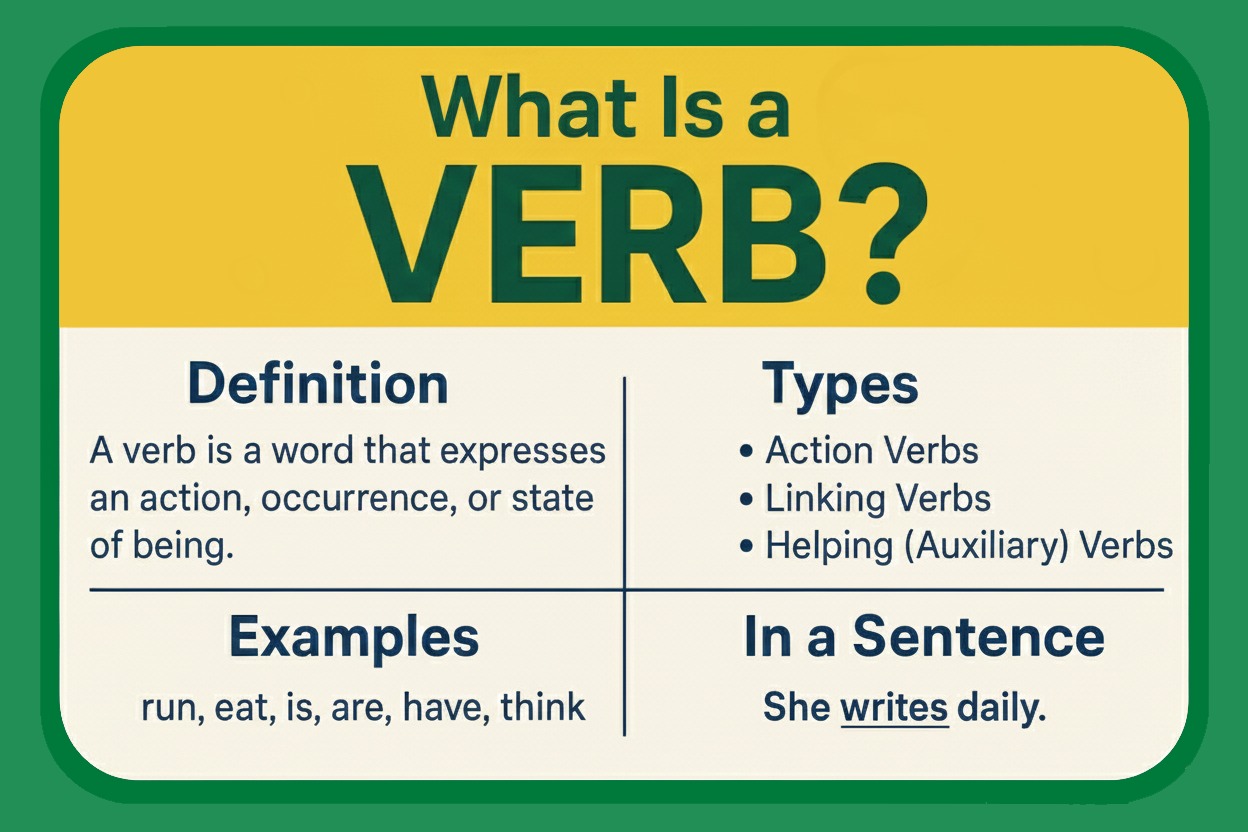
When we think about building strong English sentences, the first thing that comes to mind is the verb. Every sentence in English needs a verb, which is why I like to call it the heart of a sentence. Whether we talk, write, read or explain something, verbs help us express actions, ideas and even our feelings. Words like run, eat, is, are, have, and think are all verbs we use every single day.
Definition of a Verb
A verb is a word that expresses an action, an occurrence, or a state of being.
In simple textbook language: A verb tells us what the subject of a sentence does or experiences.
Without a verb, a sentence feels incomplete:
- Riya in the park. (No verb → incomplete)
- Riya plays in the park. (Verb makes it complete)
So, verbs are essential because they bring meaning, clarity and time (past, present or future) into every sentence.
Why Are Verbs Important?
Verbs do more than just show action. They help us:
1. Understand Time
Verbs change forms to show when something happens.
- I walk (present)
- I walked (past)
- I will walk (future)
2. Build Clear Meaning
Without verbs, we cannot express thoughts properly. Imagine trying to describe your day without using went, ate, studied, or slept !
Verbs hold the entire sentence together, making them the backbone of English grammar.
Types of Verbs
Let’s look at the main types of verbs students use in everyday writing and speaking.
1. Action Verbs
Action verbs show what the subject is doing. The action can be physical or mental.
Examples: run, write, jump, read, think
- She writes daily.
- The children run across the field.
- I think about my goals often.
2. Linking Verbs
Linking verbs do not show action. Instead, they connect the subject to extra information in the sentence.
Common linking verbs: is, am, are, was, were, seem, become
- He is tired.
- The soup smells good.
- They seem excited.
Here, is, smells and seem link the subject to a description or condition.
3. Helping (Auxiliary) Verbs
Helping verbs support the main verb. They help form questions, negatives, continuous tenses and perfect tenses.
Common helping verbs include: is, am, are, have, has, do, does, did, will, can, may, should
- She is reading a book.
- We have finished our homework.
- Did you enjoy the play?
Helping verbs + main verb = complete meaning
(is reading, have finished, did enjoy)
This is why learning the kinds of auxiliary verbs is so important for forming correct sentences.
Transitive and Intransitive Verbs
Another important area students often confuse is the difference between transitive and intransitive verbs.
Transitive Verbs
Transitive verbs need an object to complete their meaning.
- He plays football.
- She wrote a letter.
- I ate an apple.
Here, football, a letter, and an apple are objects that receive the action.
Intransitive Verbs
Intransitive verbs do not need an object.
- He sleeps.
- The children laughed.
- They arrived early.
The verb makes sense on its own.
Key difference:
Transitive = action + object
Intransitive = action only
This helps students understand different sentence structures when practising verb usage.
Regular Verbs in English
Regular verbs are the easiest to learn because they follow a simple rule in the past tense:
Base form + ed
Examples:
- walk → walked
- play → played
- clean → cleaned
- listen → listened
- finish → finished
Here is a short list of regular verbs in English:
- Talk
- Work
- Cook
- Open
- Move
- Wash
- Call
- Laugh
- Paint
- Help
All of these verbs take –ed to form the past tense.
Understanding Phrasal Verbs
A phrasal verb is a verb + preposition/adverb that creates a new meaning. Students often find them confusing because the meaning is not always literal.
Here are 10 phrasal verbs with meanings and sentences:
- Break down – stop working
The car broke down on the road. - Look after – take care of
She looks after her younger brother. - Turn on – switch on
Please turn on the lights. - Turn off – switch off
Turn off the fan before leaving. - Call back – return a call
I will call you back later. - Find out – discover
We found out the answer in class. - Give up – stop trying
Don’t give up on your goals. - Put off – postpone
They put off the meeting. - Run into – meet unexpectedly
I ran into an old friend yesterday. - Set up – arrange / organise
The school set up a science fair.
Phrasal Verb Rules (Simple Guide)
- The meaning often changes completely.
- Some phrasal verbs are separable (turn off the fan → turn the fan off).
- Some are inseparable (look after a child → NOT look a child after).
- Always learn phrasal verbs with examples to understand usage.
Verb–Noun Sentence Examples
Here are some simple sentences showing verbs used with nouns:
- The teacher explains the lesson.
- Riya reads a book.
- They built a bridge.
- We celebrated the festival.
These combinations help students understand sentence building clearly.
Main Verb and Helping Verb Examples
A main verb expresses the action.
A helping verb adds meaning to the main verb.
Examples:
- She is (helping verb) singing (main verb).
- They have (helping verb) completed (main verb) their work.
- Do* you know the answer?*
This also helps explain question formation in English.
Which Form of the Verb Is Used With “Did”?
A very common doubt students have is:
Which form of the verb comes after “did”?
Answer:
After did, we always use the base form of the verb.
- Did you eat? (NOT ate)
- He did not go.
- Did they finish the project?
Did already shows past tense, so the main verb does not change.
Common Mistakes Students Make With Verbs
1. Subject–Verb Agreement
- He go to school.
- He goes to school.
2. Wrong Verb Forms
- I seen him yesterday.
- I saw him yesterday.
3. Overusing “is/was”
Students often rely too much on is or was instead of stronger action verbs.
- The boy is making noise.
- The boy makes noise.
Stronger verbs improve writing quality instantly.
In Summary
Verbs are one of the most important parts of English grammar. They show action, connect ideas, and help us express thoughts clearly. Whether it’s understanding action verbs, linking verbs, auxiliary verbs or phrasal verbs, learning verbs step by step builds confidence and helps students write beautifully in English at the best school in Bangalore.