

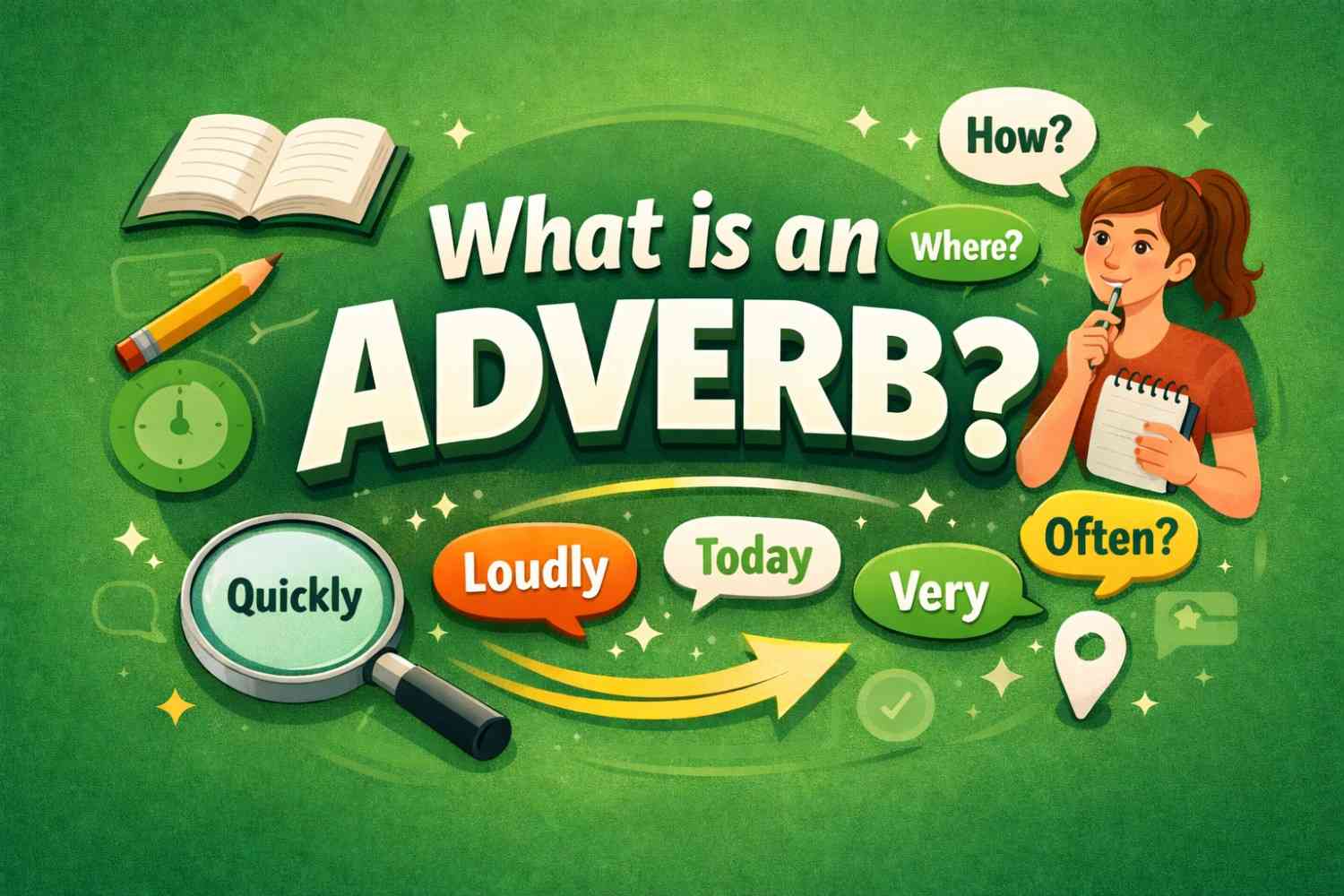
Have you ever wondered what makes a sentence more descriptive and detailed? The answer often lies in one powerful word, the adverb. In English grammar, adverbs play a key role in adding clarity and depth to your writing. They tell us how actions are performed, when they happen, where they occur, or to what extent something is true. Understanding adverbs helps improve both your writing and speaking skills. In this guide, we will explore what is an adverb, its types, examples, and practical tips for using them correctly.
What is an Adverb? — Definition
An adverb is a word that modifies a verb, an adjective, or another adverb. Its main function is to answer questions like How? When? Where? How often? and To what extent? For example:
- “She runs quickly.” — modifies the verb runs.
- “He is very tall.” — modifies the adjective tall.
- “She sings quite beautifully.” — modifies another adverb beautifully.
The term “adverb” comes from the Latin word ‘adverbium’, meaning “added to a verb.” Essentially, adverbs add more information to a sentence, making it precise and expressive.
What Does an Adverb Modify?
Adverbs are versatile and can modify different parts of a sentence.
- Modifies a verb: An adverb can describe how, when, or where an action happens. It adds more detail to the verb’s meaning. Example: “She spoke softly.” — tells us how she spoke.
- Modifies an adjective: Adverbs can change or intensify an adjective, showing the degree or extent of the quality described. Example: “It was extremely cold.” — emphasises how cold it was.
- Modifies another adverb: Adverbs can modify other adverbs to show the intensity or extent of the action, making it more precise. Example: “He drove very carefully.” — shows the degree of carefulness in driving.
- Modifies a Sentence: Some adverbs comment on or give context to an entire sentence, expressing attitude, opinion, or circumstance. Example: “Fortunately, we arrived on time.” — indicates luck or positive circumstance for the whole situation.
| Part of Sentence | Example |
| Verb | She ran quickly. |
| Adjective | It is incredibly hot. |
| Another Adverb | He sings very loudly. |
| Sentence | Sadly, the train was delayed. |
Types of Adverbs
Adverbs are divided into different categories based on their function:
Adverb of Manner
An adverb of manner describes how an action is performed. It tells us the way or style of doing something.
- Examples: quickly, slowly, carefully, loudly, politely
- Sentence: “She danced gracefully.” — shows the elegant way she danced.
Adverb of Time
An adverb of time indicates when an action occurs. It helps the reader or listener understand the timing.
- Examples: today, yesterday, soon, already, now, later
- Sentence: “He will call tomorrow.” — shows the specific time of the action.
Adverb of Place
An adverb of place shows where an action happens. It gives location or direction information about the verb.
- Examples: here, there, everywhere, outside, nearby
- Sentence: “The kids are playing outside.” — tells us the location of their play.
Adverb of Frequency
An adverb of frequency tells us how often an action occurs. It explains the repetition or regularity of actions.
- Examples: always, never, often, rarely, sometimes, usually
- Sentence: “She always wakes up early.” — indicates her habit or routine.
Adverb of Degree
An adverb of degree shows the intensity or extent of an action, adjective, or another adverb. It answers the question, “how much?
- Examples: very, quite, almost, too, enough, extremely
- Sentence: “The tea is too hot.” — indicates the level of heat.
Adverb of Reason / Purpose
An adverb of reason or purpose explains why something happens. It shows the cause or result of an action.
- Examples: therefore, hence, consequently, thus
- Sentence: “He was tired; therefore, he slept early.” — gives the reason for sleeping.
Interrogative Adverb
An interrogative adverb is used to ask questions. It helps gather information about time, place, reason, or manner.
- Examples: when, where, why, how
- Sentence: “Where did you go?” — asks for the location of the action.
Relative Adverb
A relative adverb connects clauses and modifies a noun or pronoun. It links ideas while providing additional information.
- Examples: where, when, why
- Sentence: “This is the place where we met.” — describes the location related to the noun place.
Conjunctive Adverb
A conjunctive adverb connects two independent clauses and shows the relationship between them, like contrast, result, or sequence.
- Examples: however, meanwhile, therefore, otherwise
- Sentence: “I was busy; however, I made time for you.” — shows contrast between two ideas.
How to Form Adverbs
Most adverbs are formed by adding -ly to an adjective:
- quick → quickly
- careful → carefully
- happy → happily
Some adverbs are irregular and do not use -ly:
- fast → fast
- hard → hard
- well → well
- late → late
Be careful with adjectives that look like adverbs:
- “He works hard.” (adverb)
- “It is a hard job.” (adjective)
Spelling rules:
- Words ending in -y: happy → happily
- Words ending in -le: gentle → gently
- Words ending in -ic: basic → basically
Position of Adverbs in a Sentence
Adverbs can appear in different positions in a sentence, depending on what they modify and the emphasis you want to create.
- Before the Verb: Placing an adverb before the main verb shows frequency or manner.
Example: “She always arrives early.” — emphasizes how often she arrives early. - After the Verb: Some adverbs naturally come after the verb to describe the action.
Example: “He runs fast.” — tells us how he runs. - After the Object: When there is an object, the adverb can follow it to describe the action.
Example: “She completed the task quickly.” — shows how the task was done. - At the Beginning of a Sentence: Adverbs at the start can set the scene or express attitude about the whole sentence.
Example: “Suddenly, the lights went off.” — indicates an unexpected event. - At the End of a Sentence: Ending with an adverb emphasizes the action or manner.
Example: “He spoke clearly.” — highlights how he spoke.
Adverbs vs. Adjectives — Key Differences
| Feature | Adjective | Adverb |
| Modifies | Noun / Pronoun | Verb / Adjective / Adverb |
| Answers | Which? What kind? | How? When? Where? |
| Example | beautiful | beautifully |
| Sentence | She is a beautiful singer. | She sings beautifully. |
Common Mistakes with Adverbs
When using adverbs, learners often make errors that can change the meaning of a sentence or make it unclear. Here are some common mistakes to avoid:
- Using an adjective instead of an adverb:
Example: “She sings beautiful.”
Correct: “She sings beautifully.”
- Confusing “good” and “well”: Good is an adjective, while well is an adverb. Using them incorrectly changes the meaning.
Example: “He plays tennis good.”
Correct: “He plays tennis well.”
- Double negatives: Using two negatives can make a sentence confusing or incorrect.
Example: “I don’t know nothing.”
Correct: “I don’t know anything.”
- Misplacing adverbs: Incorrect placement can create ambiguity.
Example: “She almost drove her kids to school every day.”
Correct: “She drove her kids to school almost every day.”
- Overusing adverbs: Using too many adverbs can make writing weak. It is often better to show actions clearly rather than relying on excessive adverbs.
Examples of Adverbs in Sentences
Here are 10 examples of adverbs in sentences:
- She speaks softly.
- He arrived early.
- The baby sleeps peacefully.
- They worked hard to finish the project.
- She sings beautifully.
- We will meet tomorrow.
- He is extremely talented.
- The dog ran outside.
- Fortunately, the rain stopped on time.
- He answered the question correctly.
Fun Ways for Students to Learn Adverbs
Learning adverbs can be enjoyable and interactive. Here are some effective ways for students to practice and understand them:
- Play adverb charades: Students act out an adverb while others guess the word, helping them understand the meaning through actions.
- Fill-in-the-blank exercises: Use sentences with missing adverbs, and students fill in the correct word to complete the meaning.
- Identify adverbs in a paragraph: Students read a passage and underline or highlight all the adverbs, improving recognition and understanding.
- Write a short story using adverbs: Encourage students to include at least five adverbs in their story to make it descriptive and detailed.
- Find adverbs while reading books or newspapers: Students look for adverbs in real texts, helping them see how adverbs are used naturally in writing.
Conclusion
Adverbs are essential building blocks of English. They add detail, clarity, and color to your sentences. By understanding their types and correct usage, you can make your writing more expressive and precise. Practice using adverbs in your daily writing and conversations to master them. Remember, great writing is not just about what you say — it’s about how you say it, and that’s where adverbs shine.
Frequently Asked Questions (FAQ)
Q1. What is an adverb in simple words?
An adverb is a word that describes or modifies a verb, adjective, or another adverb — telling us how, when, where, or how often something happens.
Q2. What are the 5 types of adverbs?
The main types are: Adverbs of manner, time, place, frequency, and degree.
Q3. How do you identify an adverb in a sentence?
Ask: How? When? Where? How often? To what extent? — the word that answers the question is likely an adverb.
Q4. What is the difference between an adverb and an adjective?
An adjective modifies a noun, while an adverb modifies a verb, adjective, or another adverb.
Q5. Do all adverbs end in -ly?
No. Many adverbs end in -ly (quickly, softly), but some do not, like fast, hard, well, late, and already.