

Let me ask you something.
Have you ever pushed open a door that was heavier than you expected? Or tried to stop a bicycle right before rolling into a pothole? Maybe you’ve wondered why a bowling ball feels impossible to throw as fast as a tennis ball.
That thing you’re feeling—the push, the pull, the effort—that’s force.
I remember sitting in my first physics class, staring at the whiteboard, thinking “what is force?” The teacher kept saying it’s a push or a pull, and honestly, I thought it couldn’t be that simple. But it really is. Let me explain it the way I wish someone had explained it to me back then.
Okay, So What Actually Is Force?
Here’s the thing.
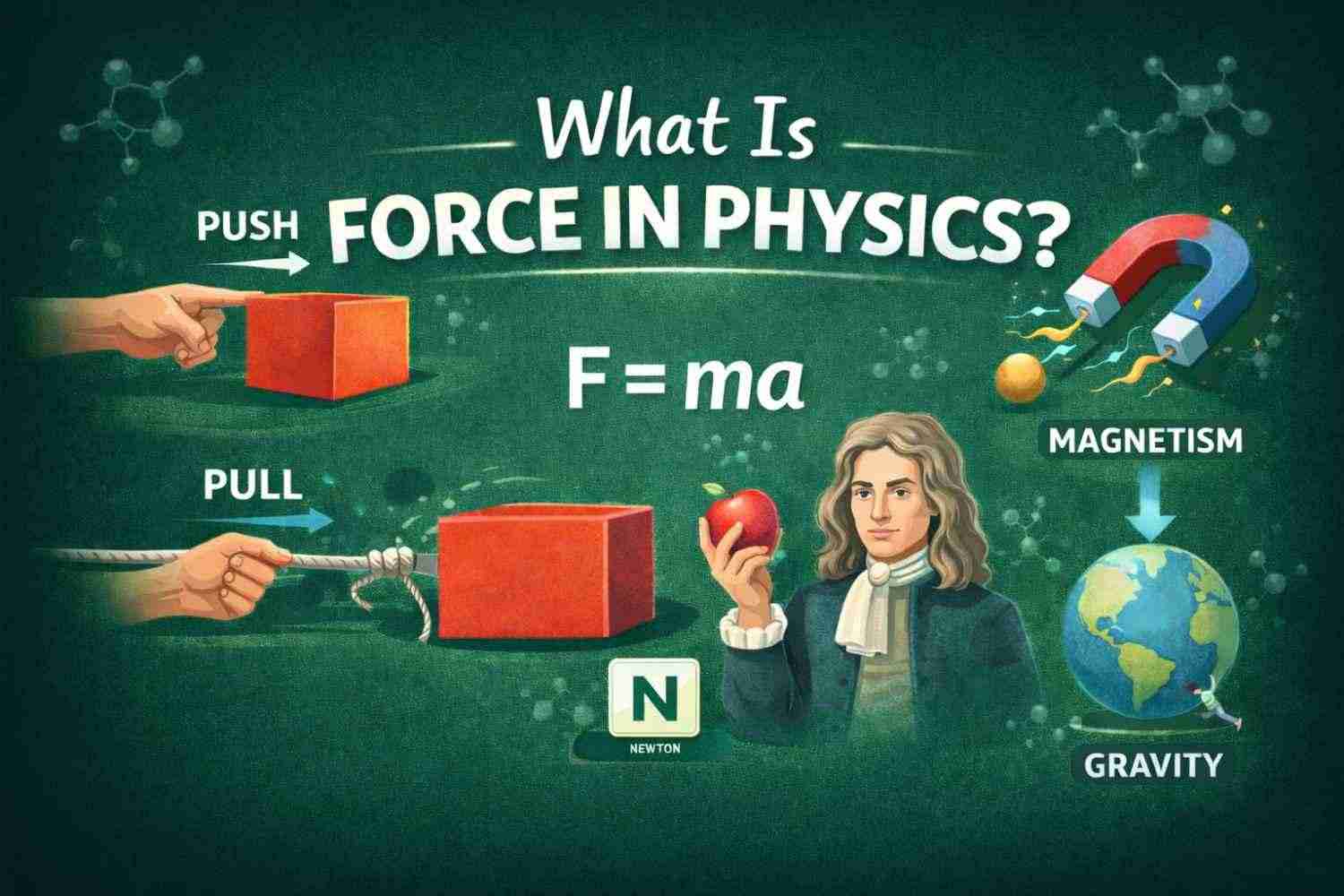
Force is just a push or a pull. That’s it. Nothing more complicated than that.
When you shove a shopping cart forward, you’re applying force. When your phone slips from your hand and smacks the floor, gravity just applies some force to it. When you squeeze a stress ball because your exam is tomorrow, yep—that’s force too.
The neat part? Force doesn’t just move stuff around. It can also change how fast something is going, which way it’s heading, or even squish it into a different shape.
There’s a formula you’ll see everywhere: F = ma. Force equals mass times acceleration. All it’s saying is that heavier things take more effort to get moving. Common sense, right?
We measure force in something called Newtons, or just N for short. Named after Isaac Newton—you know, the apple guy.
Not All Forces Are the Same
Some forces only work when you’re touching something. Others can reach across a room and do their thing without any contact at all. Let me walk you through both.
Forces That Need You to Touch Stuff
- Friction: This one’s the party pooper. It’s always trying to slow things down. It’s why your bike eventually stops if you stop pedaling. It’s also why you don’t eat pavement every time you walk on a sidewalk. Annoying sometimes, but honestly, we’d be sliding everywhere without it.
- Tension: Remember tug of war in school? That tight, pulling feeling running through the rope? That’s tension. It’s also what’s happening when a crane lifts a steel beam or when you pull your little brother around in a wagon.
- Normal Force: Fancy name, simple idea. Put a book on a table. Gravity wants to pull it down. The table? It pushes right back up. That upward push is the normal force. Basically, surfaces don’t like being pushed into, so they push back.
Forces That Work From a Distance
- Gravity: The classic. Drop something, it falls. Jump up, you come back down. Gravity’s just quietly pulling on everything all the time.
- Magnetism: Those magnets holding stuff on your fridge? That is magnetic force at work. It pulls certain metals toward it without ever touching them.
- Electrostatic Force: Ever rubbed a balloon on your hair and stuck it to the wall as a kid? That’s this one. Objects with electric charge either pull toward each other or push away. Pretty cool, honestly.
Newton’s Three Laws (But Make It Simple)
Isaac Newton figured out three rules that explain how force and motion work. They sound fancy, but they’re really just common sense when you break them down.
First Law: Things Are Lazy
Objects just want to keep doing whatever they’re already doing.
A ball sitting on the floor? It’ll stay there forever unless someone kicks it. A skateboard rolling down the driveway? It’ll keep rolling until friction or a curb stops it.
Ever been on a bus that stops suddenly and felt your body jerk forward? That’s this law in action. Your body wanted to keep moving. The bus disagreed.
Second Law: Heavier Stuff Is Harder to Move
This one’s just life experience dressed up as physics.
Push a friend on a skateboard—pretty easy, right? Now try pushing a car. Good luck.
That’s all F = ma is saying. More mass means more force needed to get things moving. Simple.
Third Law: Everything Gets a Reaction
For every action, there’s an equal and opposite reaction.
Push against a wall? The wall pushes back. That’s why your hands don’t just go through it.
Swim? You push water backward, water pushes you forward.
Rocket launches? Engines push hot gases downward, gases push the rocket upward.
It’s like the universe’s way of saying “whatever you do, something’s coming back at you.”
So What Does Force Actually Do?
When you apply a force to something, a few things can happen:
- It can start something moving. Kick a ball, and off it goes.
- It can stop something moving. Hit the brakes on your bike, and you stop.
- It can change direction. Turn the steering wheel, and the car turns.
- It can change shape. Squeeze some clay, and it squishes.
| If you do this… | This is what happens… |
| Kick a ball | It starts rolling |
| Hit the brakes | You stop |
| Turn the wheel | The car turns |
| Squeeze clay | It changes shape |
You’re Surrounded by Force Right Now
Seriously. Look around.
- That apple in the fruit bowl? Gravity’s pulling on it.
- The fact that you’re not sliding off your chair? Friction’s holding you there.
- A crane lifting something heavy outside your window? Tension’s doing the work.
- Those magnets holding up your kid’s drawings? Magnetic force.
- A cricket ball flying through the air? Muscular force from whoever threw it.
- A parachute floating down? Air resistance is slowing the fall.
It’s everywhere. You can’t escape it.
Wrapping This Up
So yeah. Force is just a push or a pull. It changes how things move, or what shape they take. Newton gave us a few simple rules to understand how it all works, and honestly, once you see it, you can’t unsee it.
Next time you’re walking, driving, or watching a game, pay attention for a second. You’ll notice force doing its thing all around you.
Actually, look around right now. Can you spot three different forces acting on things in your room? I bet you can.
FAQs
Q1. What is force in simple words?
A push or a pull. Honestly, that’s it.
Q2. What’s the unit of force?
Newton. Or just N. Named after Isaac Newton—the apple guy.
Q3. What are the two main types of force?
Contact forces—things like friction and tension where you need to touch something. And non-contact forces—like gravity and magnetism—where stuff happens without touching.
Q4. What does F = ma mean?
It’s Newton’s Second Law. Force equals mass times acceleration. Heavier things need more force to get moving. That’s all.
Q5. What’s the difference between balanced and unbalanced forces?
Balanced forces cancel each other out, so nothing changes. Unbalanced forces don’t cancel, so you get movement or a change in what’s happening.