

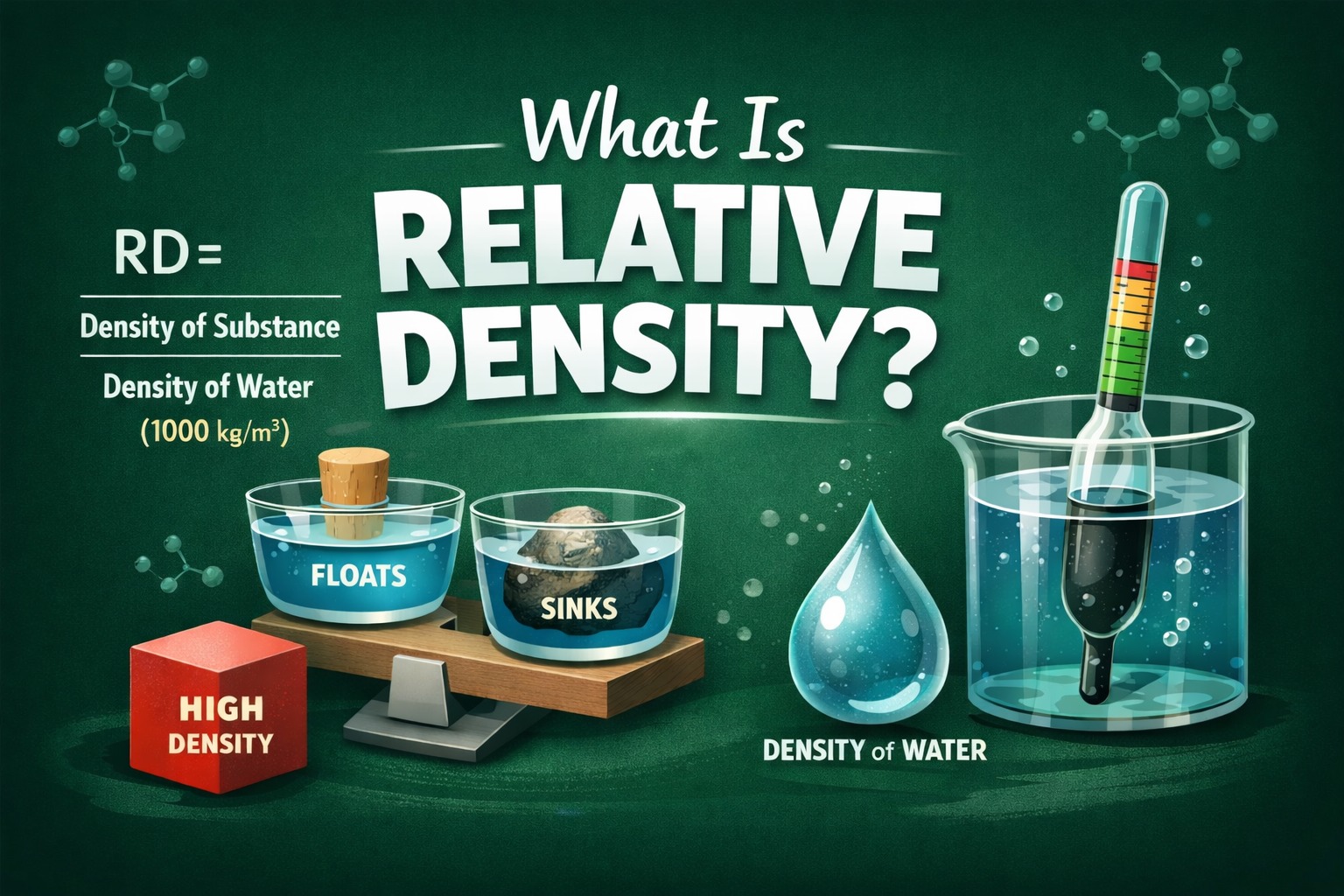
Why does ice float on water? Why does a ship made of steel stay afloat? The answer lies in what is relative density. Simply put, relative density helps us understand why some substances float while others sink. It is a key concept in physics and everyday life, from designing ships to testing liquids in laboratories. In this article, we will explore the definition, formula, measurement techniques, and real-life examples of relative density. By the end, you will clearly understand how this simple ratio explains complex physical behaviors.
What Is Relative Density?
We define relative density as the ratio of the density of a substance to the density of water. It is also called specific gravity. The formula is:
Relative Density = Density of Substance ÷ Density of Water
Here, the density of water is 1000 kg/m³ or 1 g/cm³. Relative density is a pure number and does not have any units. If the RD is greater than 1, the substance sinks in water. If it is less than 1, the substance floats. A relative density equal to 1 means the substance neither sinks nor floats. This simple measure helps compare substances without worrying about the units of density.
Formula of Relative Density
So, what is the formula for relative density is:
RD = Density of Substance / Density of Reference Substance (Water)
There are alternative ways to calculate it:
- Using mass: RD = Mass of Substance / Mass of Equal Volume of Water
- Using weight: RD = Weight of Substance in Air / Loss of Weight in Water
For example, suppose a substance has a density of 8000 kg/m³. Its relative density is:
RD = 8000 ÷ 1000 = 8
Since 8 > 1, the substance will sink in water. This simple calculation is widely used in laboratories, schools, and industries to compare materials efficiently.
Relative Density of Common Substances
Here is a quick look at the relative density of water and other common substances:
| Substance | Relative Density |
| Ice | 0.92 |
| Wood (Oak) | 0.6 – 0.9 |
| Water | 1.0 |
| Milk | 1.03 |
| Seawater | 1.025 |
| Aluminium | 2.7 |
| Iron | 7.87 |
| Copper | 8.96 |
| Gold | 19.3 |
| Mercury | 13.6 |
From this table, we can see that substances with RD < 1 float, while those with RD > 1 sink.
How Is Relative Density Measured?
Relative density can be measured in several ways. The most common is using a hydrometer. A hydrometer is a graduated float that directly measures RD. It is widely used in industries for liquids like milk, alcohol, and battery acid.
Another method uses Archimedes’ Principle. Measure the weight of a substance in air and then its weight when submerged in water. The difference gives the buoyant force, which equals the weight of water displaced. This allows calculating RD accurately.
A density bottle or specific gravity bottle is also used in laboratories. It compares the mass of a substance to the mass of an equal volume of water. This method is reliable for solids and liquids alike. Accurate measurement is crucial in industries where purity and quality control matter.
Relative Density vs. Density — Key Difference
It is important to understand the difference between density and relative density.
| Feature | Density | Relative Density |
| Definition | Mass per unit volume | Ratio of density to water’s density |
| Formula | ρ = m/v | RD = ρ substance / ρ water |
| SI Unit | kg/m³ | No unit (dimensionless) |
| Value of Water | 1000 kg/m³ | 1 |
| Purpose | Measures compactness | Compares substances to water |
Density measures how compact a substance is. Relative density provides a comparison without units, making it easier to predict whether a substance will float or sink.
Real-Life Applications of Relative Density
Relative density is not just a classroom concept — it plays an important role in many industries and everyday situations. Here are some key applications:
- Shipping & Shipbuilding — Helps determine if materials will float or sink, ensuring ships and boats are safe and buoyant.
- Food Industry — Used with a hydrometer to check the purity and quality of milk, honey, and edible oils.
- Medical Field — Measures urine specific gravity to monitor kidney function and detect potential health issues.
- Petroleum Industry — Classifies crude oil grades based on density for proper processing and storage.
- Gemology — Identifies precious stones by comparing their specific gravity to known standards.
- Battery Testing — Checks the acid density in car batteries to determine charge levels.
- Construction — Assists engineers in selecting materials with appropriate density ratios for safe and durable structures.
- Oceanography — Studies seawater density to understand currents, marine life behavior, and climate patterns.
Conclusion
Relative density is the ratio of a substance’s density to water’s density. Being dimensionless, it directly indicates whether a substance floats or sinks. Its applications span from food and medicine to engineering and oceanography. The next time you see ice floating in a glass or a wooden boat on a lake, you are observing relative density in action. Try comparing the relative density of everyday objects like oil, ice, and coins to predict which ones float. Relative density may be a simple ratio, but it reveals a lot about the physical world around us.
FAQs
Q1. What is relative density in simple words?
Relative density is the ratio of the density of a substance to the density of water. It tells us whether a substance will float or sink.
Q2. What is the formula for relative density?
RD = Density of Substance ÷ Density of Water (1000 kg/m³)
Q3. What is the unit of relative density?
Relative density has no unit. It is dimensionless because it compares two similar quantities.
Q4. What instrument is used to measure relative density
A hydrometer is the most common instrument for measuring relative density, especially for liquids.
Q5. What is the difference between density and relative density?
Density measures mass per unit volume (kg/m³), while relative density is a unitless ratio that compares a substance’s density to that of water.