

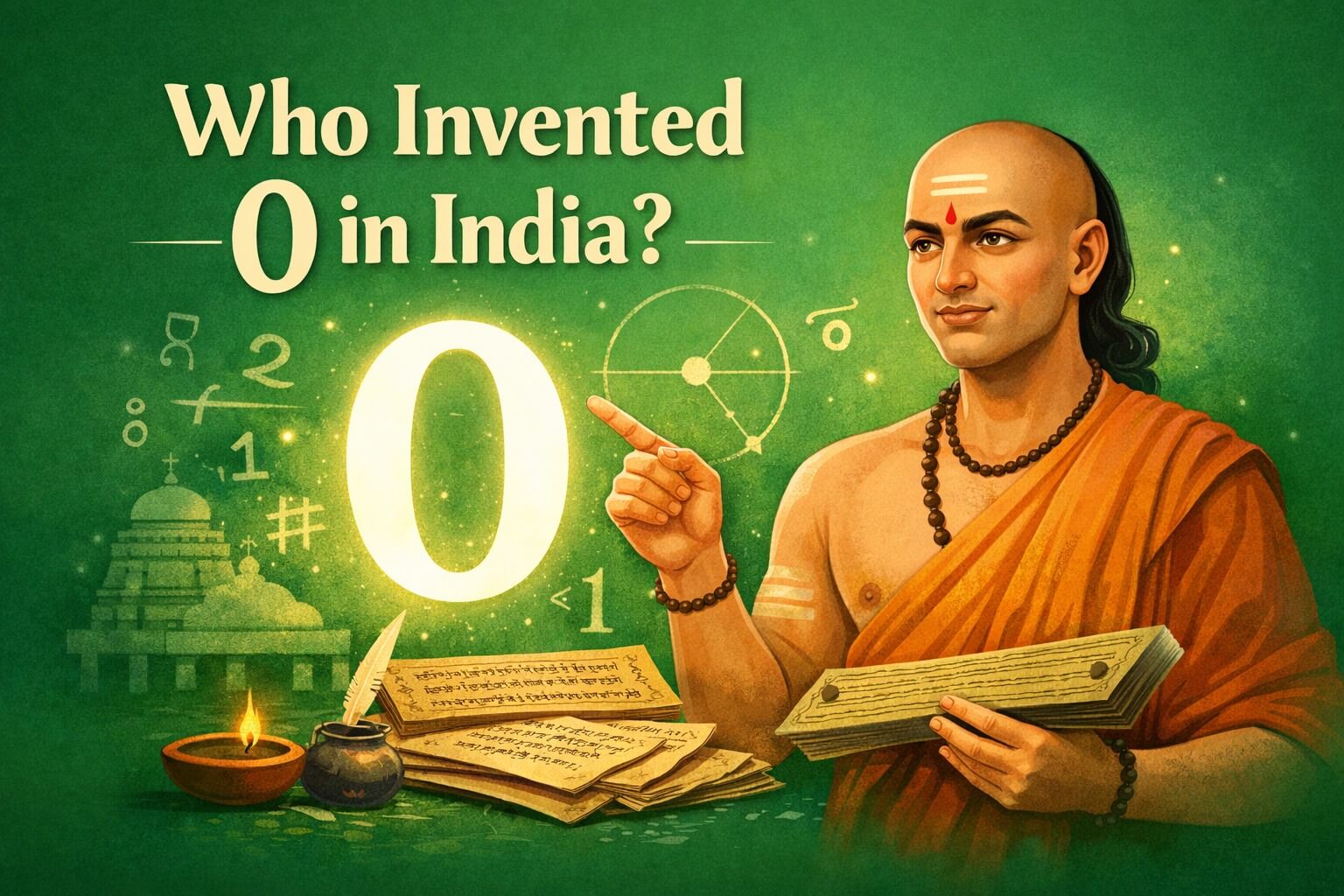
What Is Zero?
Zero means there is nothing or no amount. It is more than just “nothing”—it is a real number we can use in math. Zero has two main jobs. First, it acts as a placeholder in numbers like 102, 305, or 1,007. Without zero, we wouldn’t know if a number is one hundred or ten! Second, zero is a number on its own.
For example, 7 + 0 = 7, 0 × 5 = 0, and 10 − 0 = 10. The importance of 0 in mathematics is huge because it forms the base for dividing numbers, understanding negative numbers, and writing large or small numbers like 1,000 or 0.01. Its role is the base for counting, calculations, and even computers today.
The Origin of Zero – Early Traces in Ancient Civilizations
Zero may seem simple, but its story goes back thousands of years. Different civilizations noticed the need to show “nothing” in numbers, and each created its own way to represent it. Here’s how zero first appeared in history:
Babylonian Civilisation
Around 300 BCE, the Babylonians used a symbol to show an empty place in their number system. They didn’t have zero as a number like we use today, but this symbol helped them avoid mistakes in calculations. It was an early step toward the zero we know now.
Mayan Civilisation
Far away in Central America, the Mayans developed zero around the 4th century CE. They used it in calendars and astronomy to keep track of days, months, and planets. Their zero was shown as a shell-shaped symbol. This shows that even in distant lands, people understood the need to show “nothing” in numbers.
Ancient India
The biggest change came in Ancient India. Indian mathematicians were the first to treat zero as a real number, not just a placeholder. They used it in calculations and discovered its special properties. When we ask which country invented zero, the answer is India. Indian scholars made zero a useful tool in mathematics, helping develop the decimal system we still use today.
Who Invented Zero as We Use It Today?
Two Indian mathematicians are very important in the story of zero: Aryabhata and Brahmagupta.
Many people ask, did Aryabhata invent zero? The answer is Yes. Aryabhata, a mathematician from the 5th century, used zero as a placeholder in his numbers. For example, in the number 102, the zero shows there are no tens. This made writing numbers easier and clearer. However, he did not fully create the rules for using zero in calculations, but his work helped spread the idea. His contributions are remembered as part of Aryabhata contribution in mathematics.
Later, in the 7th century, Brahmagupta wrote the first clear rules for using zero in math. He explained how to add, subtract, and multiply by zero. He even wrote about dividing by zero, which is still tricky today. Because of this, he is called the founder of modern zero.
Some people think Ramanujan invented zero, but that is not true. Ramanujan used the ideas already discovered by Aryabhata and Brahmagupta. The main credit for who invented the number 0 goes to these Indian mathematicians, who made zero more than just a placeholder and turned it into a real number that we use in math today.
How Zero Spread Across the World
Zero started in India, but over time, it traveled to other parts of the world. Different countries learned about it, used it, and made it even more useful. Here’s how zero spread:
From India to the Arab World
Zero reached Europe in the 12th century through Arabic books. At first, many Europeans did not accept it because the idea of “nothing” seemed strange or even risky. Slowly, scholars realized how useful zero was for counting, trade, and science. Over time, zero became widely accepted in Europe.
Introduction to Europe
Zero reached Europe in the 12th century through Arabic texts. At first, many Europeans resisted it because “nothing” seemed strange or even dangerous. But over time, scholars saw how useful zero was for arithmetic, trade, and science. Eventually, zero became widely accepted.
Global Adoption in Scientific Revolution
During the Scientific Revolution, zero became essential for science and technology. Mathematicians, astronomers, and engineers used it for accurate calculations. Zero made complex math possible and became a key part of modern science, technology, and everyday life.
Why Zero Is the Most Powerful Number
Zero is the foundation of the decimal system. It allows us to write very large and very small numbers. Zero helps us understand negative numbers and is used in algebra and calculus. In computing, zero and one form the binary code, which powers computers, smartphones, and AI. This shows the importance of 0 in mathematics and proves that a number representing “nothing” can change the world.
Real-Life Importance of Zero
Zero is everywhere in daily life, and students use it more than they realize. Here are some ways zero is important:
School and Exams
- Helps in math calculations like 50 + 0 = 50 or 100 × 0 = 0.
- Example: Scoring 0 marks in a question still counts and shows what to improve next time.
Time and Schedules
- Helps track class timings and schedules.
- Example: Your timetable shows periods starting at 10:00 AM or 00:30 for online study sessions.
Science Experiments
- Used in lab measurements.
- Example: Water freezes at 0°C, and zero can show no motion in physics experiments.
Computers and Technology
- Powers coding, online learning apps, and games.
- Example: When you play online games or use study apps, zero is used in programming and storing data safely.
Even though it seems like “nothing,” zero is very powerful and makes daily student life easier, from schoolwork to online learning.
Fascinating Facts About Zero
Zero is more than just a number. It has many unique and interesting features:
Zero as a Number
Zero is neither positive nor negative. It is neutral and sits in the middle of the number line, separating positive numbers from negative numbers. For example, 0 is the point between +5 and −5.
Zero in Roman Numerals
The Roman numeral system had no symbol for zero. Without zero, representing large numbers or performing certain calculations was much harder. This shows how important zero is in modern math.
Zero and the Calendar
In the Gregorian calendar, there is no year zero. The calendar goes from 1 BCE to 1 CE. This makes historical calculations tricky, especially when comparing events before and after this divide.
Zero in Language
The word “zero” comes from the Arabic word “sifr”, meaning empty or vacant. It became “zero” in Italian and English. Even the word cipher, used in coding and encryption, comes from “sifr,” showing zero’s role in technology and communication.
Zero in Sports
Zero is used in sports too! In tennis, a score of zero is called “love”, possibly from the French word l’œuf meaning egg, because of the shape of zero. In hockey or soccer, zero can also mean a “shutout,” showing strong defense.
Conclusion
Zero was not created overnight. It evolved over centuries, shaped by many civilizations and brilliant thinkers. From Babylon to India, from the Arab world to Europe, zero changed how humans understand numbers. The smallest number has the biggest impact in math, science, and technology. Asking who discovered 0 or who invented the number 0 reminds us of the genius of our ancestors. Zero shows that even “nothing” can hold infinite possibilities.
FAQs
Who is considered the father of zero?
Brahmagupta is called the father of zero because he created rules for using it in arithmetic.
Why is zero difficult to define?
Zero is unique because it means nothing and is also a number.
How is zero used in computers and digital technology?
Zero, with one, forms the binary code that runs computers and smartphones.
Can zero be positive or negative?
No. Zero is neutral. It is neither positive nor negative.