

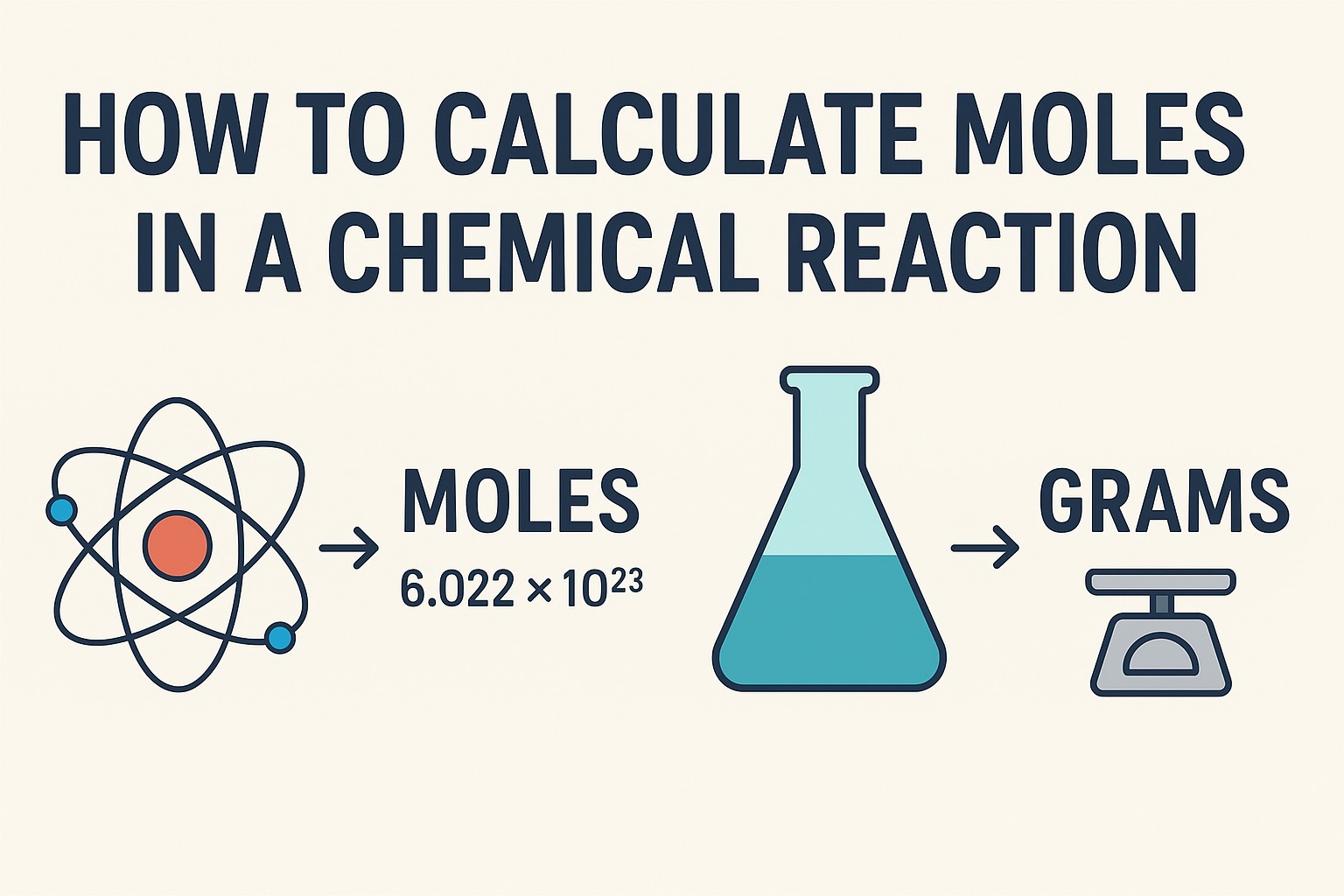
Understanding how to calculate moles is the key to unlocking all of stoichiometry. Think of a mole as a chemist’s “dozen”—but instead of 12, it’s a huge number (6.022 × 10²³) that allows us to count tiny atoms and molecules by weighing them or measuring their volume. We use moles to balance chemical equations, predict how much product we’ll get, and determine the exact amounts of reactants needed.
Understanding What a Mole Means
Simply put, a mole is the standard unit for measuring the amount of a substance in chemistry.
- 1 mole of any substance contains Avogadro’s number of particles (atoms, molecules, ions). That’s 6.022 × 10²³.
- Why do we use moles? We can’t count atoms one by one, but we can easily measure grams or liters. The mole bridges this gap, connecting the microscopic world of atoms to the macroscopic world we live in.
Step 1 – Find the Number of Moles of a Known Substance
Your starting point is always calculating the moles of the substance you already have information about. The method depends on the data you’re given.
(a) From Mass
This is the most common method. You use it when you know the mass of your solid or liquid.
Formula:
Moles (n) = Mass (g) / Molar Mass (g/mol)
- Molar Mass: The mass of 1 mole of a substance. Find it by adding the atomic masses of all the atoms in its formula from the periodic table.
Example: Calculate the moles of NaCl in a 58.5 g sample.
- Molar Mass of NaCl: (Atomic mass of Na = 23.0) + (Atomic mass of Cl = 35.5) = 58.5 g/mol.
- Moles (n): n = 58.5 g / 58.5 g/mol = 1.00 mol
| Substance | Mass (g) | Molar Mass (g/mol) | Moles (n) |
| NaCl | 58.5 | 58.5 | 1.00 |
(b) From Concentration (Solutions)
Use this when you are working with a liquid solution of known concentration.
Formula:
Moles (n) = Concentration (M) × Volume (L)
- Crucial: Volume must be in Liters (L).
Example: Calculate the moles of HCl in 0.5 L of a 2 M solution.
- Moles (n): n = 2 mol/L × 0.5 L = 1.0 mol
(c) From Gas Volume (at STP)
For gases at Standard Temperature and Pressure (STP: 0°C and 1 atm), 1 mole of any gas occupies 22.4 Liters.
Formula:
Moles (n) = Volume of Gas (L) / 22.4 L/mol
Example: How many moles are in 44.8 L of O₂ gas at STP?
- Moles (n): n = 44.8 L / 22.4 L/mol = 2.00 mol
Note: This is only valid at STP. For other conditions, use the Ideal Gas Law (PV = nRT).
Step 2 – Use the Mole Ratio from the Balanced Equation
This is the heart of stoichiometry. The coefficients in a balanced chemical equation tell you the ratio in which moles of reactants and products interact.
Formula:
Moles of Unknown = Moles of Known × (Coefficient of Unknown / Coefficient of Known)
Example: In the reaction 2H₂ + O₂ → 2H₂O, if 1.39 moles of H₂O are formed, how many moles of O₂ were used?
- Identify the Mole Ratio: From the equation, 2 moles of H₂O are produced for every 1 mole of O₂ consumed. So the ratio of (O₂ / H₂O) is 1/2.
- Apply the Formula:
Moles of O₂ = Moles of H₂O × (Coefficient of O₂ / Coefficient of H₂O)
Moles of O₂ = 1.39 mol × (1 / 2) = 0.695 mol
Step 3 – Cross-Check Units and Consistency
Accuracy is key! Always double-check your units to avoid simple mistakes.
| If You Have | And You Want | Conversion Action |
| mL | L | ÷ 1000 |
| mg | g | ÷ 1000 |
| g | mol | ÷ Molar Mass |
| mol | atoms/molecules | × 6.022×10²³ |
| L of Gas (at STP) | mol | ÷ 22.4 L/mol |
Step 4 – Practice Example: Calculating Moles in a Reaction
Let’s combine all the steps into one complete problem.
Question: What mass of water (H₂O) is produced when 4.0 grams of hydrogen gas (H₂) reacts with excess oxygen?
Solution Steps:
- Write the balanced equation:
2H₂ + O₂ → 2H₂O - Step 1: Find moles of known substance (H₂).
- Molar Mass of H₂ = 2 × 1.008 = 2.016 g/mol
- Moles of H₂ = 4.0 g / 2.016 g/mol ≈ 1.98 mol
- Step 2: Use the mole ratio to find moles of unknown (H₂O).
- From the equation: 2 mol H₂ produces 2 mol H₂O. Ratio is 2/2 = 1.
- Moles of H₂O = 1.98 mol H₂ × (2 mol H₂O / 2 mol H₂) = 1.98 mol H₂O
- Convert back to mass (if required).
- Molar Mass of H₂O = (2×1.008) + 16.00 = 18.016 g/mol
- Mass of H₂O = 1.98 mol × 18.016 g/mol ≈ 35.7 g
Final Answer: Approximately 36 grams of water are produced.
Common Mistakes to Avoid
- Skipping the balance step: Always start with a balanced chemical equation.
- Incorrect molar mass: Remember H₂ is 2 g/mol, not 1 g/mol. For NaCl, it’s Na + Cl, not just Na.
- Unit mix-ups: Never use mL in M₁V₁ = M₂V₂ or the concentration mole formula without converting to L first.
- Misapplying the mole ratio: Make sure the “known” and “unknown” are in the correct positions in the ratio fraction.
Real-Life Applications of Mole Calculations
- Pharmaceuticals: Determining the precise amount of each reactant needed to synthesize a drug.
- Environmental Science: Calculating the amount of CO₂ emissions from burning a tank of gasoline.
- Agriculture: Formulating fertilizers with the correct nitrogen, phosphorus, and potassium (N-P-K) ratios for crops.
- Cooking: It’s the same principle as using a recipe—a balanced equation tells you the “mole ratio” of flour to eggs to sugar to make a perfect cake!
FAQ Section
Q1. What is the formula to calculate moles from mass?
n = Mass (g) / Molar Mass (g/mol)
Q2. How do you find the mole ratio in a chemical equation?
From the coefficients in the balanced equation. For N₂ + 3H₂ → 2NH₃, the ratio of N₂ to H₂ is 1:3.
Q3. What is 22.4 L in mole calculations?
It is the molar volume of an ideal gas at Standard Temperature and Pressure (STP), meaning 1 mole of any gas occupies 22.4 Liters.
Q4. Why do we use moles in chemistry?
To create a practical bridge between the number of atoms/molecules (which we can’t count directly) and a measurable quantity like mass or volume.
Q5. Can I calculate moles for gases at non-STP conditions?
Yes! For non-STP conditions, you must use the Ideal Gas Law: PV = nRT, where P is pressure, V is volume, n is moles, R is the gas constant, and T is temperature in Kelvin.