

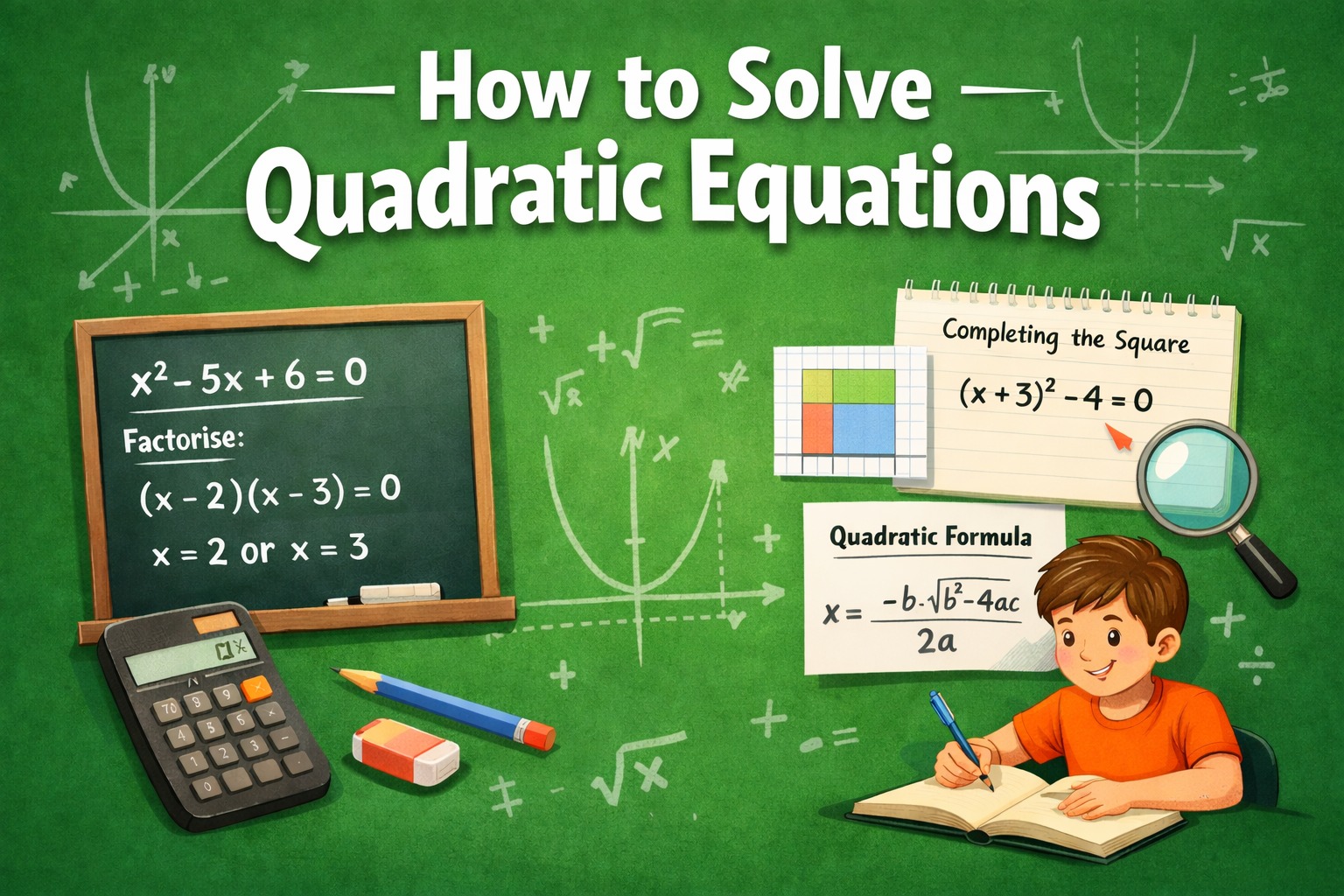
Quadratic equations are one of those topics that look scary at first—but once you understand the logic, they actually become quite manageable. You’ll start seeing them from Class 9 onwards, and they play a very important role in Class 10 board exams, competitive exams, and higher maths too.
A quadratic equation can be solved in more than one way. Some methods are quick, some help you understand the concept better, and one method works every single time. In this guide, I’ll walk you through all the main methods step by step, with clear explanations and examples, so you know which method to use and when.
What is a Quadratic Equation? (Simple Meaning)
A quadratic equation is an equation where the highest power of the variable is 2.
The standard form is:
ax² + bx + c = 0
Here:
- a, b, and c are real numbers
- a ≠ 0 (this is very important)
- x is the variable
If the highest power of x is 2, it’s quadratic. If it’s 1, it’s linear. If it’s 3, it’s cubic.
Graphically, a quadratic equation forms a parabola, which is a U-shaped curve. But for now, we’ll focus on solving it algebraically.
Before You Solve: Quick Checks
Before jumping into any method, always do these quick steps:
- Bring the equation to standard form
Make sure it looks like ax² + bx + c = 0 - Identify a, b, and c clearly
- Check for common factors
If all terms can be divided by a number, simplify first. This can make solving much easier.
These small checks save time and prevent silly mistakes in exams.
Method 1 — Factorisation (Fastest When It Works)
When to Use Factorisation
Factorisation is the fastest method, but it doesn’t always work easily.
Use it when:
- Numbers are small
- Factors are easy to spot
- The constant term (c) is simple
This method is very common in Class 10 board questions.
Step-by-Step Factorisation Process
Let’s understand the steps clearly:
- Write the equation in standard form
- Split the middle term (if required)
- Factorise into two brackets
- Set each bracket equal to zero
- Solve for x
Common Factorisation Patterns
- (x + p)(x + q) = 0
- (ax + p)(x + q) = 0 when a ≠ 1
- Perfect square trinomials like (x + 3)²
With practice, your eyes will start recognising patterns quickly.
Method 2 — Completing the Square
(Best for Understanding Concepts)
When to Use Completing the Square
This method is useful when:
- Factorisation is difficult
- You want to understand how the graph behaves
- You later need to find the minimum or maximum value
It may feel long initially, but it builds strong conceptual clarity.
Step-by-Step Completing the Square
- Make the coefficient of x² equal to 1 (divide if needed)
- Move the constant term to the other side
- Take half of the coefficient of x, square it, and add it to both sides
- Write the left side as a perfect square
- Take square roots on both sides
- Solve for x
Go slow with this method—accuracy matters more than speed here.
Method 3 — Quadratic Formula
(Works for All Quadratic Equations)
The Formula
x=−b±b2−4ac2ax = \frac{-b \pm \sqrt{b^2 – 4ac}}{2a}x=2a−b±b2−4ac
This formula works every single time, no matter how difficult the equation looks.
Step-by-Step Using the Formula
- Identify values of a, b, and c
- Substitute carefully into the formula
- Solve the part inside the square root first
- Simplify the square root if possible
- Write two answers using ±
Most calculation mistakes happen here, so work neatly.
Understanding the Discriminant (b² − 4ac)
The expression b² − 4ac is called the discriminant. It tells us about the nature of roots.
- b² − 4ac > 0 → Two different real roots
- b² − 4ac = 0 → Two equal roots
- b² − 4ac < 0 → No real roots
This is often asked directly in exams.
Worked Examples
Example 1 — Easy Factorisation
Solve: x² + 5x + 6 = 0
Factorising:
(x + 2)(x + 3) = 0
So,
x = −2 or x = −3
Example 2 — Completing the Square
Solve: x² + 4x + 1 = 0
x² + 4x = −1
Add (4/2)² = 4 to both sides
(x + 2)² = 3
x = −2 ± √3
Example 3 — Quadratic Formula
Solve: 2x² + 3x − 1 = 0
Here,
a = 2, b = 3, c = −1
Using the formula:
x = [−3 ± √(9 + 8)] / 4
x = (−3 ± √17) / 4
Common Mistakes to Avoid
- Not converting to ax² + bx + c = 0
- Sign errors while factorising
- Forgetting ± when taking square roots
- Wrong value of b² or 2a
- Skipping simplification before solving
Most lost marks come from small errors—not lack of knowledge.
Quick Practice Questions
- Solve: x² − 7x + 10 = 0
- Find the roots of: 2x² + 5x + 2 = 0
- Solve using quadratic formula: x² − 4x + 1 = 0
- Find the nature of roots: x² − 6x + 9 = 0
- Solve: x² + 2x + 5 = 0
Try them before checking answers—it builds confidence.
Conclusion
Quadratic equations don’t have to be confusing. If the equation factorises easily, go with factorisation. If you want a deeper understanding, try completing the square. And when in doubt, remember—the quadratic formula always works. With regular practice, you’ll start solving these questions faster and with fewer mistakes.
FAQs
What is the standard form of a quadratic equation?
ax² + bx + c = 0, where a ≠ 0.
Which method is the easiest?
Factorisation is the easiest when it works.
When should I use the quadratic formula?
When factorisation is difficult or not possible.
What does the discriminant tell us?
It tells us the number and type of roots.
Can a quadratic equation have no real roots?
Yes, when the discriminant is negative.
Why do we get two answers?
Because squaring a number gives the same result for positive and negative values.
How do I check my answers?
Substitute the value of x back into the original equation.