

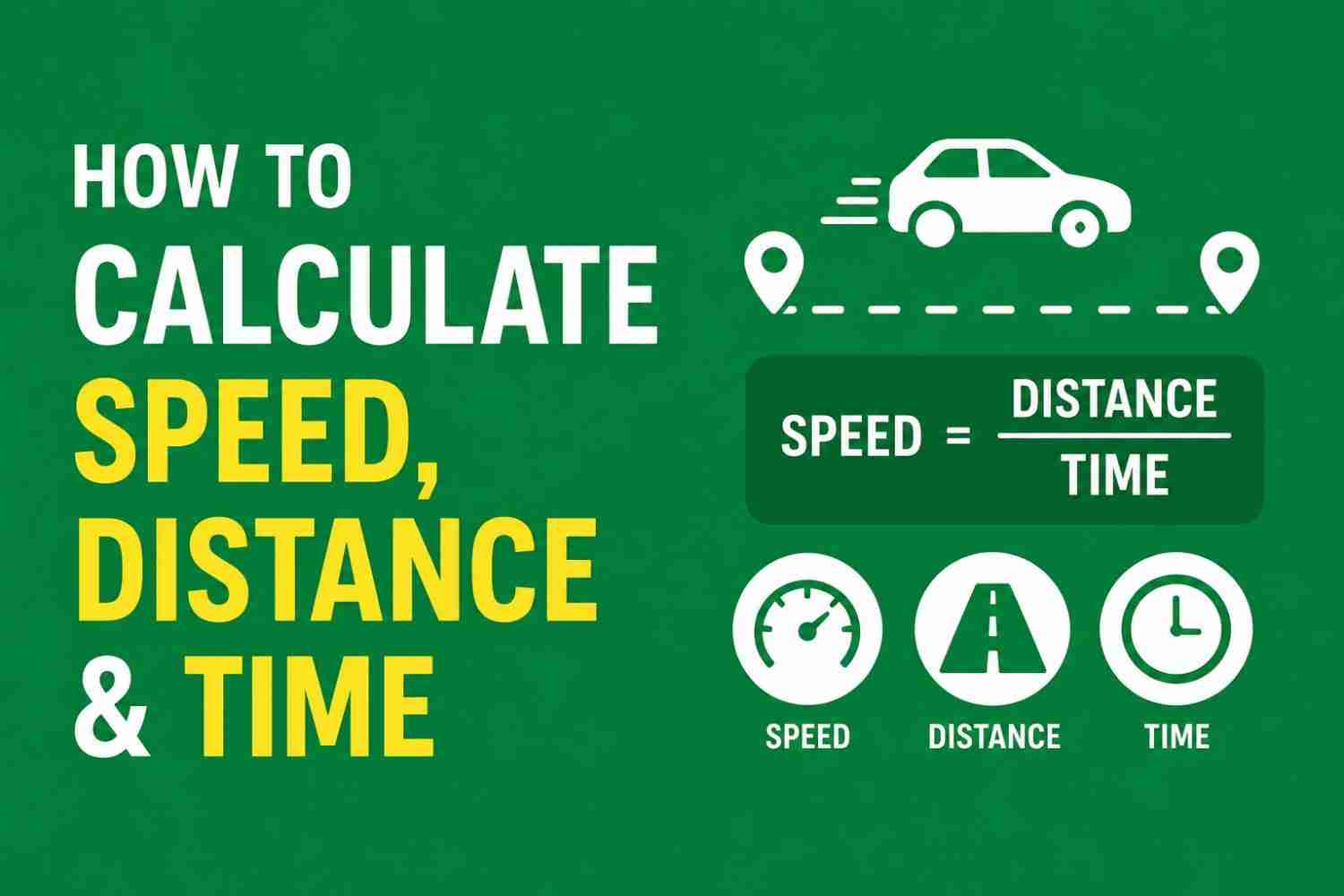
Whether you’re planning a road trip, tracking your morning run, or solving a physics problem, understanding the relationship between speed, distance, and time is a fundamental skill. These three concepts are deeply interconnected: if you know two of them, you can always find the third. Learning the time-speed-distance formula helps simplify many everyday calculations and physics problems.
This guide will walk you through the formulas, provide clear examples, and share handy tricks to master these calculations.
Understanding the Relationship Between Speed, Distance, and Time
At its core, the relationship is simple and logical. Speed is how fast something is moving, Distance is how far it has traveled, and Time is how long it took.
Many students first learn this concept through the time and distance formula, which connects these three quantities in a simple mathematical relationship.
The Core Formula
What is the formula of speed? The connection is captured by this single, powerful formula, which can be rearranged in three ways:
- Speed = Distance ÷ Time
- Distance = Speed × Time
- Time = Distance ÷ Speed
Why It Matters
This trio of formulas isn’t just for textbooks. We use the speed calculation formula constantly in daily life for:
- Travel Planning: Figuring out how long a journey will take.
- Vehicle Tracking: Monitoring fuel efficiency and average speed.
- Sports: Measuring an athlete’s performance over a set distance.
- Physics Problems: Understanding the basics of motion.
How to Calculate Speed
Speed is the rate of covering a distance. It tells us the distance traveled per unit of time. The following three steps will show you how to find speed with distance and time
Step 1: Note down the total distance covered and the total time taken.
Step 2: Apply the formula: Speed = Distance ÷ Time
Step 3: Always include the correct units (e.g., km/h, m/s, mph).
Example: A car travels 80 miles in 4 hours. What is its speed?
- Speed = 80 miles ÷ 4 hours = 20 miles per hour (mph)
| Distance | Time | Formula | Speed |
| 80 miles | 4 hours | 80 ÷ 4 | 20 mph |
| 150 km | 3 hours | 150 ÷ 3 | 50 km/h |
How to Calculate Distance
Distance is the total ground covered while moving at a constant speed for a certain time.
Formula: Distance = Speed × Time
Example: A cyclist rides for 2 hours at a constant speed of 6 km/hr. How far do they travel?
- Distance = 6 km/hr × 2 hours = 12 kilometers
Tip: Before calculating, ensure your speed and time units are compatible (e.g., don’t use km/h with minutes without converting first).
How to Calculate Time
Time is the duration it takes to cover a distance at a given speed.
Formula: Time = Distance ÷ Speed
Example: A runner covers 5 km at a steady speed of 2 km/hr. How long does it take?
- Time = 5 km ÷ 2 km/hr = 2.5 hours
Note: If your answer is a decimal like 2.5 hours, remember that 0.5 hours is 30 minutes. So, the time would be 2 hours and 30 minutes.
Unit Conversion Tips
Consistent units are critical for accurate calculations. Here are the most common conversions.
| Conversion | Formula |
| km/h → m/s | Multiply by 5/18 (or divide by 3.6) |
| m/s → km/h | Multiply by 18/5 (or multiply by 3.6) |
| miles/hr → km/hr | Multiply by 1.609 |
💡 Pro Tip: Always convert all measurements to the same unit system before you start your calculation to avoid errors.
The Triangle Method (Easy Memory Trick)
This method helps students quickly remember the speed distance time worksheet problems often given in maths practice exercises.
This method helps students quickly remember the speed, distance, and time worksheet problems often given in maths practice exercises.
🧠 How to use the DST Triangle:
- Cover the variable you want to find with your finger.
- The remaining visible parts show you the formula.
- To find Distance (D), cover D. You see S × T.
- To find Speed (S), cover S. You see D over T, so D ÷ T.
- To find Time (T), cover T. You see D over S, so D ÷ S.
Average Speed Concepts
Sometimes a journey involves traveling at two different speeds. In such cases, students often ask how to calculate average speed when two speeds are given.
When the same distance is covered at two different speeds, the formula used is called the formula of average speed when distance is same, which is:
Average Speed = (2 × Speed₁ × Speed₂) ÷ (Speed₁ + Speed₂)
This formula is commonly used in competitive exams and advanced word problems.
Common Mistakes to Avoid
- Mixing Units: Using kilometers for distance and seconds for time will give a nonsensical answer for speed. Convert everything first!
- Ignoring Time Conversions: Forgetting to convert minutes to hours (e.g., 30 minutes = 0.5 hours).
- Rounding Too Early: Rounding numbers in the middle of a calculation can lead to an inaccurate final answer. Only one round at the end.
- Incorrect Unit Symbols: Writing “hrs” instead of the standard “h” for hours or “m” (which could be meters or minutes) instead of “mi” for miles.
Real-Life Applications
These calculations are everywhere:
- Navigation Apps: Calculating your ETA based on current speed and traffic.
- Logistics & Delivery: Estimating package delivery times.
- Athletics: A coach calculating a runner’s average speed over 100m.
- Aviation: Pilots calculating fuel requirements based on flight time and speed.
- Astronomy: Measuring the immense distances between stars and the time it takes for their light to reach us.
FAQ Section
How do you calculate speed in km/h and m/s?
Calculate speed using Speed = Distance ÷ Time. If you have the answer in m/s and need km/h, multiply by 18/5 (or 3.6). To convert from km/h to m/s, multiply by 5/18.
What’s the easiest way to remember the formulas?
The DST Triangle is the easiest memory trick. Cover the variable you want to find, and the arrangement of the other two gives you the formula.
Can I use these formulas for non-linear motion?
No. These formulas only work for constant (uniform) speed. If the speed is changing (accelerating or decelerating), you need the principles of calculus or specific equations of motion from physics.
How do I convert hours to minutes or seconds for time?
Remember: 1 hour = 60 minutes and 1 hour = 3600 seconds. To convert hours to minutes, multiply by 60. To convert minutes to hours, divide by 60.
Why does unit consistency matter in speed problems?
Speed is defined as distance over time (e.g., km/h). If the units are mismatched (e.g., km and minutes), the result will not represent a true speed and will be incorrect. Consistent units ensure the calculation is physically meaningful.