

Introduction
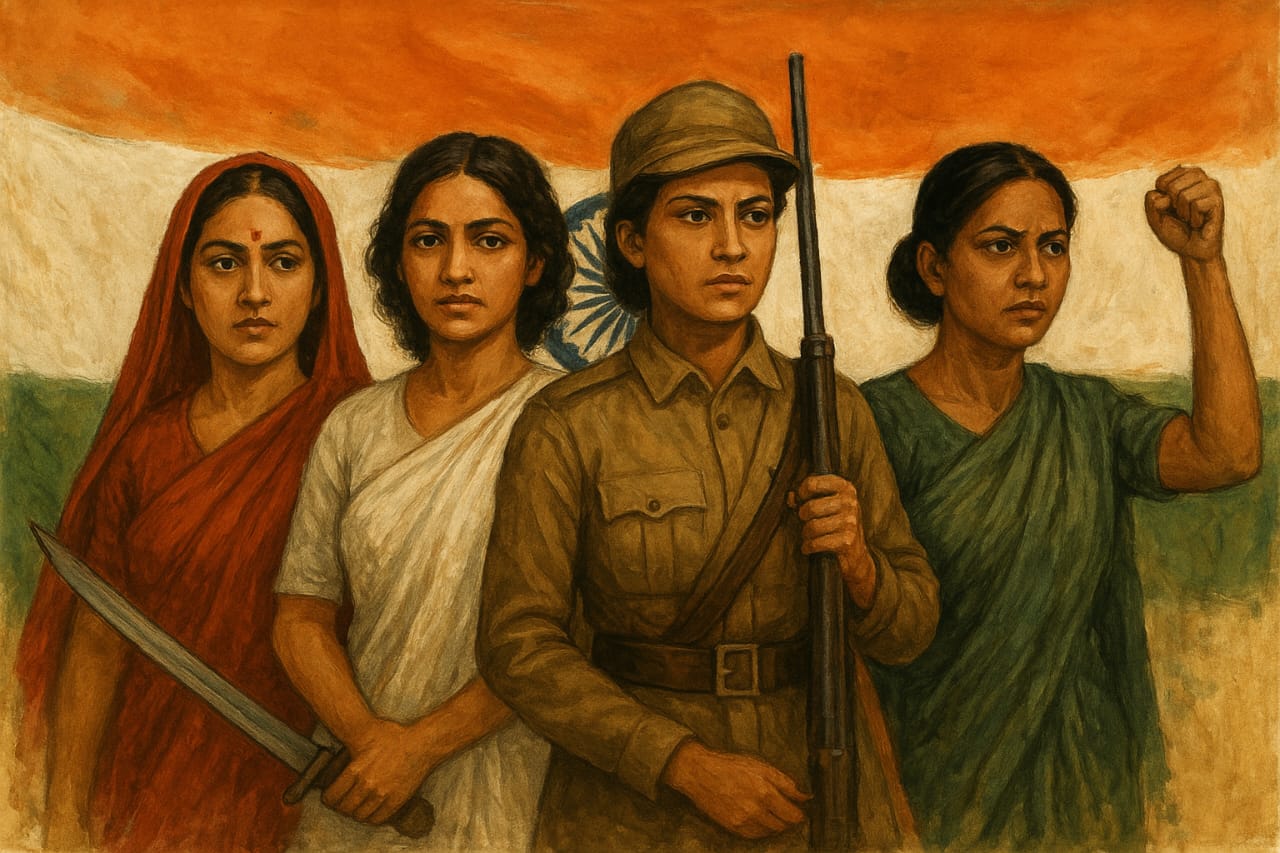
India’s freedom struggle is filled with stories of courage, sacrifice, and resilience. Women, too, played a powerful role in leading armies, spreading revolutionary ideas, defying colonial laws, and inspiring entire communities. These were the women from every walk of life: queens, poets, teachers, reformers, and even teenagers.
Their stories are not just footnotes to history; they are shining examples of leadership, bravery, and vision. Some names are remembered across generations, while others remain hidden in regional tales and local folklore. Together, these women created a legacy that continues to inspire us.
In this blog, we will explore 20 female freedom fighters from India who have shaped history. We will group them into battle leaders, non-violent protesters, reformers, revolutionaries, and local heroines. Their courage has shaped the country’s path to independence.
Armed Rebellion & Battle Leaders
- Rani Lakshmibai (1828–1858)
The fearless queen of Jhansi, Rani Lakshmibai led her troops in the Revolt of 1857. Refusing to surrender her kingdom, she fought bravely on horseback, sword in hand, and became a lasting symbol of resistance against British rule.
- Begum Hazrat Mahal (1820–1879)
Another fiery leader of 1857, Begum Hazrat Mahal took charge after her husband, Nawab Wajid Ali Shah, was exiled. She led forces in Lucknow, rallying soldiers and common people alike. Her leadership proved that women could strategise and lead revolts as strongly as men.
- Uda Devi (mid-19th century)
Uda Devi, a Dalit warrior, displayed incredible courage in 1857. Disguised and positioned atop a banyan tree, she shot down British soldiers until she fell. Her story reminds us that revolutionary women came from every corner of society.
- Rani Chennamma of Kittur (1778–1829)
Often cited as the first woman freedom fighter of India, she fought against the British decades before 1857. When the East India Company tried to annex her kingdom under the “Doctrine of Lapse,” she took up arms and defended Kittur with unmatched determination.
Non-violent Protesters & Political Leaders
- Sarojini Naidu (1879–1949)
Known as the Nightingale of India, Sarojini Naidu was both a poet and a powerful leader. She participated in the Non-Cooperation and Civil Disobedience movements, became the first female president of the Indian National Congress, and later the Governor of Uttar Pradesh.
- Aruna Asaf Ali (1909–1996)
A fearless activist, she played a major role in the Quit India Movement of 1942. Aruna Asaf Ali is remembered for hoisting the Congress flag at Gowalia Tank Maidan in Bombay, defying British orders.
- Kamala Nehru (1899–1936)
The wife of Jawaharlal Nehru, Kamala was not just a companion but a strong leader in her own right. She organised protests against British salt laws, mobilised women, and worked closely with Gandhi in grassroots movements.
- Annie Besant (1847–1933)
Although British by birth, Annie Besant became a fierce supporter of Indian self-rule. She founded the Home Rule League in 1916 and mentored many future national leaders of India, female and male alike.
Social Reformers & Educators
- Savitribai Phule (1831–1897)
Savitribai Phule, along with her husband Jyotirao, pioneered girls’ education in India. She faced stones and abuse for teaching young girls, but never gave up. Her contribution reminds us that freedom is not just about independence from colonial rule, it’s also about social justice.
- Fatima Sheikh (1831)
One of India’s first Muslim women teachers, Fatima Sheikh worked alongside Savitribai to set up schools for marginalised communities. Her quiet yet powerful role shows us how revolutionary women shaped the foundation of education.
- Pandita Ramabai (1858–1922)
A social reformer, scholar, and advocate of women’s rights, Pandita Ramabai fought against child marriage and caste oppression. Her writings inspired generations of women to think beyond traditional roles.
Revolutionaries & Underground Movements
- Captain Lakshmi Sahgal (1914–2012)
A fiery commander of the Rani of Jhansi Regiment in Subhas Chandra Bose’s Indian National Army, Lakshmi Sahgal broke stereotypes by leading an all-women’s regiment into battle.
- Pritilata Waddedar (1911–1932)
A young revolutionary from Bengal, Pritilata led an attack on a European club that denied entry to Indians. When caught, she consumed cyanide rather than surrender. Her courage continues to inspire youth today.
- Kalpana Dutt Joshi (1913–1995)
Kalpana was part of the Chittagong Armoury Raid alongside Surya Sen. Arrested and imprisoned, she later became a strong advocate for women’s rights in independent India.
- Usha Mehta (1920–2000)
Usha Mehta used the power of radio to spread the Quit India Movement’s message. Her underground station, “Congress Radio,” kept the spirit of resistance alive when many leaders were jailed.
Lesser-Known Local Heroes
- Matangini Hazra (1869–1942)
Known affectionately as Gandhi Buri (old lady Gandhi), she led processions during the Quit India Movement. Shot while carrying the national flag, she continued chanting “Vande Mataram” until her last breath.
- Durgabai Deshmukh (1909–1981)
Founder of the Andhra Mahila Sabha, she combined social work with political activism, working closely with Gandhi and later becoming a member of the Constituent Assembly.
- Bhikaiji Cama (1861–1936)
A fiery nationalist who lived in exile, she unfurled the first version of the Indian flag at a conference in Germany in 1907. Her global voice gave India’s freedom struggle international attention.
- Kanaklata Barua (1924–1942)
From Assam, Kanaklata was only 17 when she led a procession holding the national flag. She was shot by police but became a symbol of youthful bravery.
- Tara Rani Srivastava (early 20th century)
During the Quit India Movement, Tara Rani marched with her husband to hoist the flag. When he was shot, she bandaged his wounds and continued leading the protest before returning to him, an unforgettable act of courage.
Remembering Their Stories
We’ve just explored 20 incredible women who shaped India’s freedom struggle. From fearless warriors to bold reformers, each of them played a unique role. With so many names, dates, and movements, it can be tricky to remember who did what. Here are a few simple tips that can help.
Tips to Keep in Mind
- Link each name to the time and movement they were part of—like the 1857 Revolt, Non-Cooperation, or Quit India.
- Understand the difference between armed struggles and non-violent protests. Both were powerful, but in very different ways.
- Don’t overlook local heroines. Many courageous women made their mark in villages and towns, even if they aren’t widely known.
- Each fighter teaches us something, be it courage, leadership, sacrifice, or the power of the ordinary people.
Common Mistakes to Avoid
- Remembering only the most famous names, like Rani Lakshmibai or Sarojini Naidu.
Focusing only on well-known figures can make your understanding of history one-sided.
Knowing about regional heroes and lesser-known fighters helps you see the bigger picture, perform better in exams or quizzes, and bring fresh examples during debates or discussions. It also teaches important lessons about courage and leadership that go beyond the textbook.
- Mixing up who fought battles versus who worked through non-violence.
Confusing armed rebels with non-violent leaders can weaken your grasp of how the freedom struggle actually unfolded. Understanding the method of struggle helps you answer questions accurately in exams, use examples effectively in essays, and appreciate the diverse strategies women used to fight for independence.
- Forgetting the context of where and when the action happened.
Ignoring the time and place of events can make history feel abstract and disconnected. Knowing the context (e.g., whether it was a village revolt in 1857 or a protest in the Quit India Movement) helps you analyze cause and effect, give precise answers in tests, and form thoughtful opinions on historical events and their significance.
Let’s Understand With an Example
Take Uda Devi as an example. During the 1857 revolt, she climbed a banyan tree with a rifle and fought British soldiers until the very end. She wasn’t a queen or a nationally famous leader. She was a local hero whose bravery is often found only in regional stories.
So, why does her story matter?
- First, it helps you remember that freedom fighters came from all walks of life and diverse backgrounds, not just cities or famous families.
- Second, it shows the difference between armed struggle and non-violent protest, helping you avoid common mistakes when recalling who did what.
- Finally, it’s a memorable story you can use in exams, quizzes, or debates to illustrate courage, strategy, and local resistance during India’s freedom struggle.
Conclusion
These 20 women show us that India’s freedom wasn’t won by a handful of leaders alone. Women were involved in every aspect of the struggle, whether fighting, organizing, teaching, or inspiring others.
Remembering their stories helps students understand history more fully and inspires courage and leadership in their own lives.
Frequently Asked Questions
Q1. Who was India’s first female freedom fighter?
Rani Chennamma of Kittur (1824) is often considered one of the earliest female freedom fighters, though many women played important roles even before her.
Q2. What roles did women take in the freedom struggle?
They led battles, organized protests, taught and reformed society, wrote, broadcast underground messages, and inspired communities.
Q3. Why are some women freedom fighters not well known today?
History books often focus on national figures, while regional heroes are less documented. Language differences and fewer written records also contributed to this.