

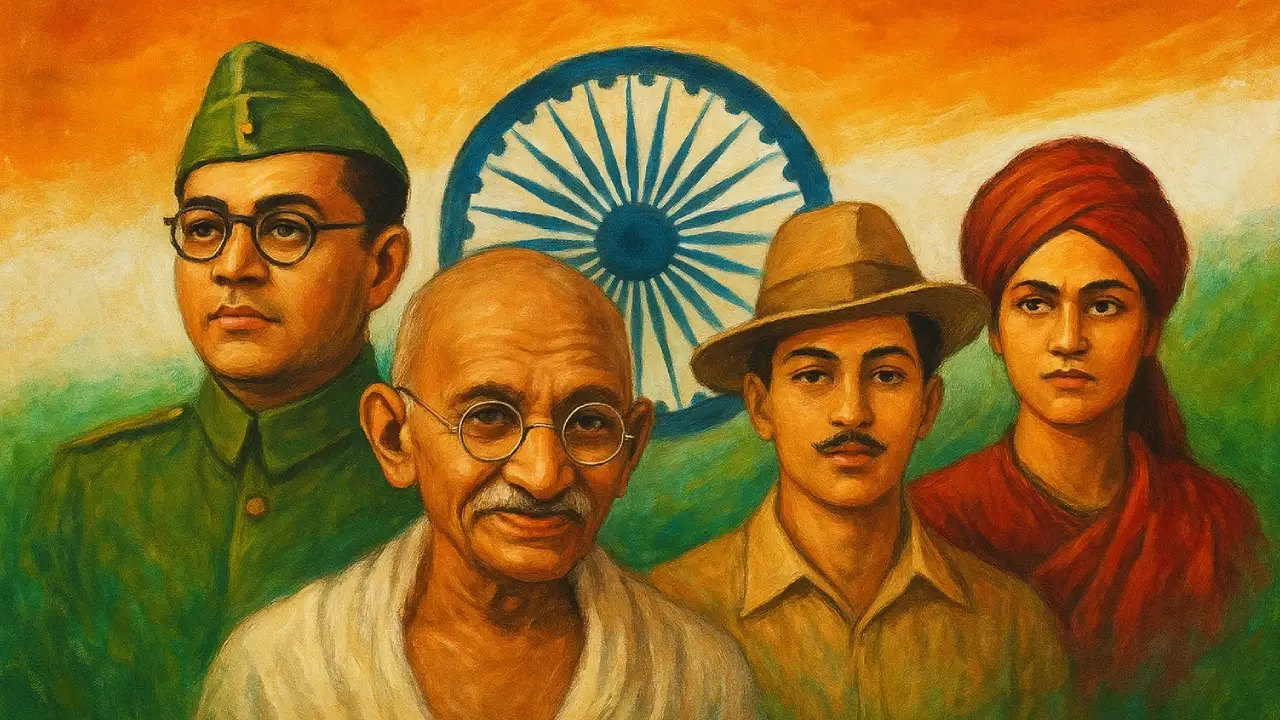
When we talk about India’s freedom struggle, names like Mahatma Gandhi, Jawaharlal Nehru, and Subhas Chandra Bose often take the spotlight. But have you ever paused to wonder who else stood up, fought, and sacrificed for India’s freedom?
Thousands of brave individuals from across the country, regardless of caste, class, or religion, played crucial roles in the freedom movement. Their stories teach us that bravery and patriotism know no boundaries, that freedom was won by many, not just a few, and that every contribution, no matter how big or small.
Who Are the Unsung Freedom Fighters of India?
So, who exactly are these “unsung” heroes? They are individuals who fought for India’s independence but were often overlooked by mainstream history. Many came from rural areas or tribal communities. Some were women who defied societal norms. Others were young revolutionaries whose lives were cut short before they could be celebrated.
These heroes are not unsung because they lacked bravery. They’re unsung because they were marginalised by region, caste, gender, or language, and their stories were never told widely. ͏These are people who stood up wh͏en it ͏wa͏s difficult, who raised thei͏r voices when s͏i͏lence was safer.͏ And today,͏ thei͏r ͏stories can inspire͏ t͏he next ge͏neration to val͏ue freedom, inclusion, a͏nd the c͏oura͏ge to do what’s͏ right.
Stories of Lesser-Known Unsung Heroes
India’s independence was not won by just a few͏ renowned l͏eaders. It was the result͏ of co͏untl͏ess brave souls who stood ͏up to colonial rule,͏ of͏t͏en them sacrificing their li͏ves. Here are eight͏ ͏freedom fighters ͏whose͏ re͏ma͏rkable courag͏e de͏serves to͏ be remembered.
Matangini Hazra
Matangini Hazra, affectionately called “Gandhi Buri” (Old Lady Gandhi), was a fearless participant in India’s freedom struggle from Bengal. Despite being widowed early and uneducated, she actively participated in the Salt Satyagraha and later the Quit India Movement.
At the age of 73, she led a procession to take over the Tamluk police station. When British forces opened fire, she kept marching forward with the tricolour in hand, even as bullets struck her. Her final words were “Vande Mataram,” symbolising her unshakable spirit till her last breath.
Alluri Sitarama Raju
A young revolutionary from Andhra Pradesh, Alluri Sitarama Raju, became a tribal hero during the Rampa Rebellion of 1922–24. Disturbed by British exploitation of forest-dwelling communities, he organised the tribal people to resist unfair forest laws.
Using guerrilla tactics, Raju led a series of attacks on British police stations and confiscated weapons. Though captured and executed at just 27 years of age, his bravery earned him immense respect, and he remains a legendary figure in tribal history.
Peer Ali Khan
Peer Ali Khan was one of the earliest martyrs of the Indian Rebellion of 1857. A bookbinder by profession, he was deeply influenced by the growing unrest against British rule and became part of a secret network planning uprisings across Bihar.
He distributed pamphlets, mobilised rebels, and played a key role in organising resistance. Arrested by the British, he was hanged publicly in Patna on July 7, 1857, along with 33 others. His dedication and early sacrifice mark him as a true pioneer in the freedom struggle.
Velu Nachiyar
Decades before Rani Lakshmibai, Velu Nachiyar of Tamil Nadu waged war against the British colonial powers. Born in 1730, she was trained in warfare, horse riding, and martial arts, and after her husband died in battle, she took up arms to reclaim her kingdom.
She formed alliances with neighbouring rulers and used strategic warfare to fight British forces. In 1780, she successfully led an attack to regain her throne, becoming the first Indian queen to win a war against the British. Her courage and leadership were truly ahead of her time.
Kanaklata Barua
Kanaklata Barua was just 17 when she became a martyr during the Quit India Movement in Assam. Determined to participate actively in the freedom struggle, she led a group of volunteers to hoist the national flag at the local police station.
British police opened fire to stop them. Kanaklata refused to retreat and was shot while carrying the flag. Her bravery at such a young age has made her a symbol of youthful courage and sacrifice in India’s independence story.
Tirot Sing
Tirot Sing was the chief of the Khasi tribe in present-day Meghalaya and led an armed resistance against British intrusion into tribal lands in the early 19th century. When the British attempted to construct a road through his territory without consent, Tirot Sing declared war.
Using guerrilla warfare, he held off British advances for years. Eventually captured and deported to Dhaka, where he died in 1835, his legacy lives on as one of the earliest protectors of tribal sovereignty and independence.
Bhikaji Cama
Bhikaji Cama was one of India’s earliest female revolutionaries and an international voice for Indian independence. Born in 1861 in Bombay, she was a fierce advocate for women’s rights and Indian freedom while living in exile in Europe.
In 1907, at a Socialist Congress in Stuttgart, Germany, she unfurled what is considered one of the earliest versions of the Indian national flag, demanding freedom from British rule. Her work with international revolutionaries and persistent advocacy made her a vital figure in India’s global freedom network.
Birsa Munda
Birsa Munda was a tribal freedom fighter, folk hero, and religious leader who led the Munda Rebellion against British rule in the late 19th century. Born in 1875 in what is now Jharkhand, he mobilised tribal communities against land policies that favoured British landlords.
He called for a return to indigenous customs and united tribal people under the banner of “Ulgulan” or revolution. Though he died young in British custody at age 25, Birsa Munda remains a powerful symbol of tribal identity, resistance, and pride.
Recognising Women Freedom Fighters of India
In most school textbooks, male leaders dominate the narrative. But the truth is, women freedom fighters of India played crucial roles, often without recognition.
From Rani Gaidinliu of Nagaland, who led a spiritual and armed movement at just 13, to Aruna Asaf Ali, who became the face of the Quit India Movement, women’s contributions are diverse and powerful. These stories teach girls that bravery has no gender, and they teach boys to respect and value women as equal patriots.
By including these heroines in classroom storytelling, we promote gender-inclusive patriotism, where every student can find a role model in India’s freedom struggle.
Bringing History to Life: How Students Connect with the Freedom Struggle
Helping students truly understand the freedom movement means going beyond textbooks. When history is presented through stories, activities, and real-world experiences, it becomes personal, meaningful, and memorable. Here’s how schools can introduce students to the lives and values of India’s unsung heroes:
Reading Programmes that Spark Curiosity
Libraries can include curated biographies of freedom fighters from diverse backgrounds. These age-appropriate books introduce students to stories that highlight courage, sacrifice, and resilience, offering new role models often missing from mainstream narratives.
Guest Talks that Make History Relatable
Historians, educators, and speakers can bring historical figures to life through engaging sessions. Personal insights and lesser-known facts help students connect emotionally to the people behind the freedom movement.
Storytelling Events that Build Connection
On national days like Independence Day, students can participate in storytelling sessions, sharing the stories of lesser-known freedom fighters. This not only boosts awareness but also deepens their emotional connection to the country’s past.
Activities That Bring Learning to Life
Role plays and reenactments allow students to step into the shoes of historical figures, experiencing their dilemmas and bravery. Art competitions and debates further encourage creative thinking and critical engagement with historical themes.
Exploring History Firsthand
Museum visits and heritage walks offer tangible links to the past. Standing in places where history happened gives students a strong sense of connection, pride, and belonging.
Through these activities, students learn more than history. They grow into informed, empathetic individuals who understand the importance of freedom and the responsibilities that come with it.
Keeping Their Legacy Alive Through Education
The stories of India’s unsung freedom fighters are powerful reminders of courage, justice, and sacrifice. By exploring these lesser-known lives, students gain more than knowledge. They build empathy, pride, and a deeper sense of responsibility. Keeping these stories alive through education ensures that their legacy continues to shape thoughtful, informed citizens for the future.
FAQs
Who are some of the unsung freedom fighters of India?
Some inspiring names include Matangini Hazra, Velu Nachiyar, Alluri Sitarama Raju, Kanaklata Barua, Tirot Sing, Bhikaji Cama, Birsa Munda, and Peer Ali Khan.
Why don’t we learn about these heroes in mainstream history books?
Many of these heroes came from rural or marginalised communities. Their contributions weren’t documented as widely, which led to historical oversight.
What activities can help students engage with India’s freedom movement?
Role plays, museum visits, debates, and storytelling can make historical events more personal and relatable for students.
Are there any female unsung freedom fighters we should know about?
Yes! Velu Nachiyar, Kanaklata Barua, Rani Gaidinliu, and Bhikaji Cama are just a few of the many brave women who made significant contributions.