

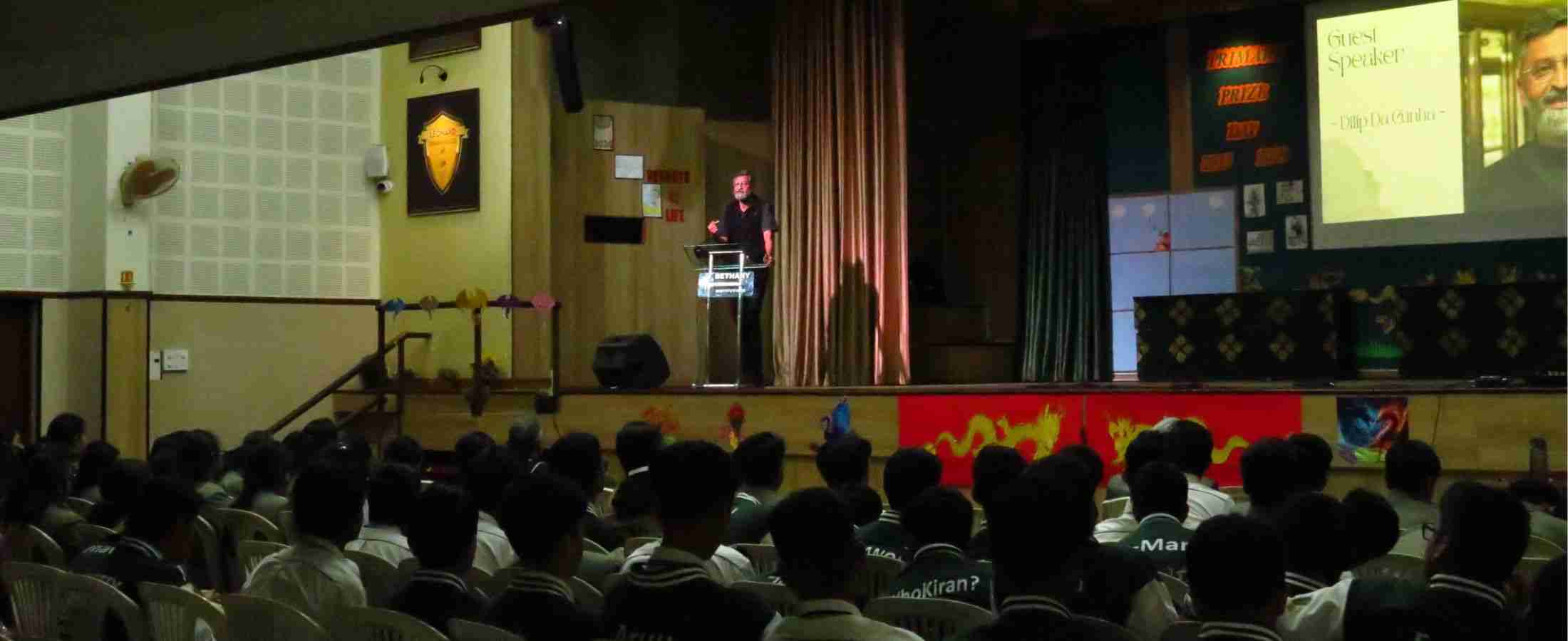
On July 16th, 2024, renowned architect and designer Dilip da Cunha shared his groundbreaking ideas on place, design, and sustainability. As someone deeply involved in transforming spaces and teaching design studios, his perspective on the intersection of climate change and social injustice is both timely and transformative. In his lecture he challenges conventional understandings of rivers, flooding, and our relationship with water. Through a deep dive into historical, geographical, and social contexts, da Cunha’s ideas invite us to rethink how we perceive and interact with our environment.
Redefining Place in the Modern Context
Da Cunha starts by challenging our understanding of “place.” Traditionally seen as an established space, he broadens this concept to encompass the entire planet. He asks, “As a designer, what is my role on the planet?” His answer is clear: “I design place.” He emphasizes the importance of grounding our world in time, allowing natural elements like rain to have their place, and working with the rhythms of nature, such as clouds and aquifers.
Surface and Line: The Building Blocks of Construction
In the realm of land and water, surface and line play crucial roles. Da Cunha describes surfaces as depthless areas and lines as breadthless lengths—fundamental devices we learn in school. However, he challenges us to reconsider how we establish and measure these surfaces. The conflict between surface and line has become evident due to climate change, driven by human exploitation and resource abuse.
Rethinking Floods and Rivers
Da Cunha begins with a simple yet profound statement: “Rivers flood when water crosses a line that I have drawn.” This line, an arbitrary boundary imposed by humans, defines what we consider a flood. He contrasts this with the natural, cyclical expansion of rivers like the Nile, which historically flooded vast floodplains without the rigid boundaries we associate with modern flooding. The Egyptians, he notes, lived within the river’s fluctuations, building high grounds amidst the floodplain rather than on its banks. This dynamic relationship with water is lost in our contemporary understanding, where rivers are contained, controlled, and their natural rhythms disrupted.
The Nile: A case study
Da Cunha’s exploration of the Nile provides a historical lens to understand how our perceptions of rivers have evolved. In ancient Egypt, the Nile’s annual flooding was a source of life and fertility, a natural phenomenon that shaped their civilization. However, when Herodotus asked the Egyptians about the Nile’s flooding, they had no clear answer, as they did not perceive the river in the same way the Greeks did. To them, the river’s expansion during the flood season was as natural as its contraction during the dry months. This observation underscores a fundamental shift in how different cultures understand and interact with natural phenomena.
Rivers, Rain, and Colonization
Da Cunha argues that the concept of a river as a fixed entity has colonized the more fluid, dynamic understanding of rain. He distinguishes between the Ganges (a river) and the Ganga (a phenomenon of rain), highlighting how colonial and modern perspectives have imposed rigid definitions on natural processes. This imposition has led to environmental degradation and social injustice, as communities traditionally dependent on rain cycles are forced to adapt to artificial constructs like rivers and dams.
Addressing Local Issues: Bangalore’s Water Challenges
Peninsular Gneiss is one of the oldest rock formations in India, dating back over 3 billion years. Bangalore, situated on peninsular Gneiss, has unique challenges with its water bodies and clay economies. He attributes the problem to exploration and improper treatment of low grounds. Covering drains leads to clogging, resulting in floods. He advocates for treating low grounds as valuable spaces that can be cultivated with grass, and not just seen as “lowly gutters”.
Using Bangalore as a case study, da Cunha illustrates the consequences of designing urban landscapes around the concept of rivers. Bangalore, historically reliant on rainwater harvesting through tanks and embankments, now faces severe water shortages due to the destruction of these traditional systems. The city’s current reliance on piped water from distant sources like the Cauvery River exemplifies the unsustainable nature of this approach. Da Cunha emphasizes the need to revert to rain-based water management systems, recognizing the intelligence of ancient practices that harmonized with natural water cycles.
The Interplay of Climate Change and Social Injustice
Da Cunha’s discourse extends to the broader implications of climate change and social injustice. He highlights how marginalized communities, particularly in formerly colonized regions, bear the brunt of climate impacts. These areas, already grappling with the legacy of colonization, face exacerbated challenges as climate change disrupts traditional agriculture and livelihoods. The migration of affected populations seeking better prospects underscores the urgent need to address both environmental and social inequities.
A Call for New Beginnings
Da Cunha’s lecture resonates with a call for new beginnings, urging the next generation to reimagine their relationship with the environment. He challenges us to move beyond the conventional spatial understanding of place, advocating for a temporal perspective that embraces the interconnectedness of our world. By recognizing the planet as our collective place, we can foster a holistic approach to design and sustainability.
Conclusion
Dilip da Cunha’s insights compel us to reconsider our definitions of rivers, floods, and our broader environmental interactions. His emphasis on rain-based systems, historical context, and the interplay of climate change and social injustice offers a comprehensive framework for rethinking our approach to environmental design. As we navigate the challenges of the 21st century, da Cunha’s vision of living between clouds and aquifers provides a compelling alternative to the river-centric paradigms that have dominated our thinking about the social issues of our time.