

Introduction
A conjunction is a fundamental part of speech often referred to as a “joining word.” Its primary job is to connect words, phrases, or clauses within a sentence. Think of conjunctions as the glue that holds related ideas together, making our communication clear and structured. For example, in the sentence “I wanted to go out, but it was raining,” the word “but” is a conjunction that links two contrasting ideas.
Definition of a Conjunction
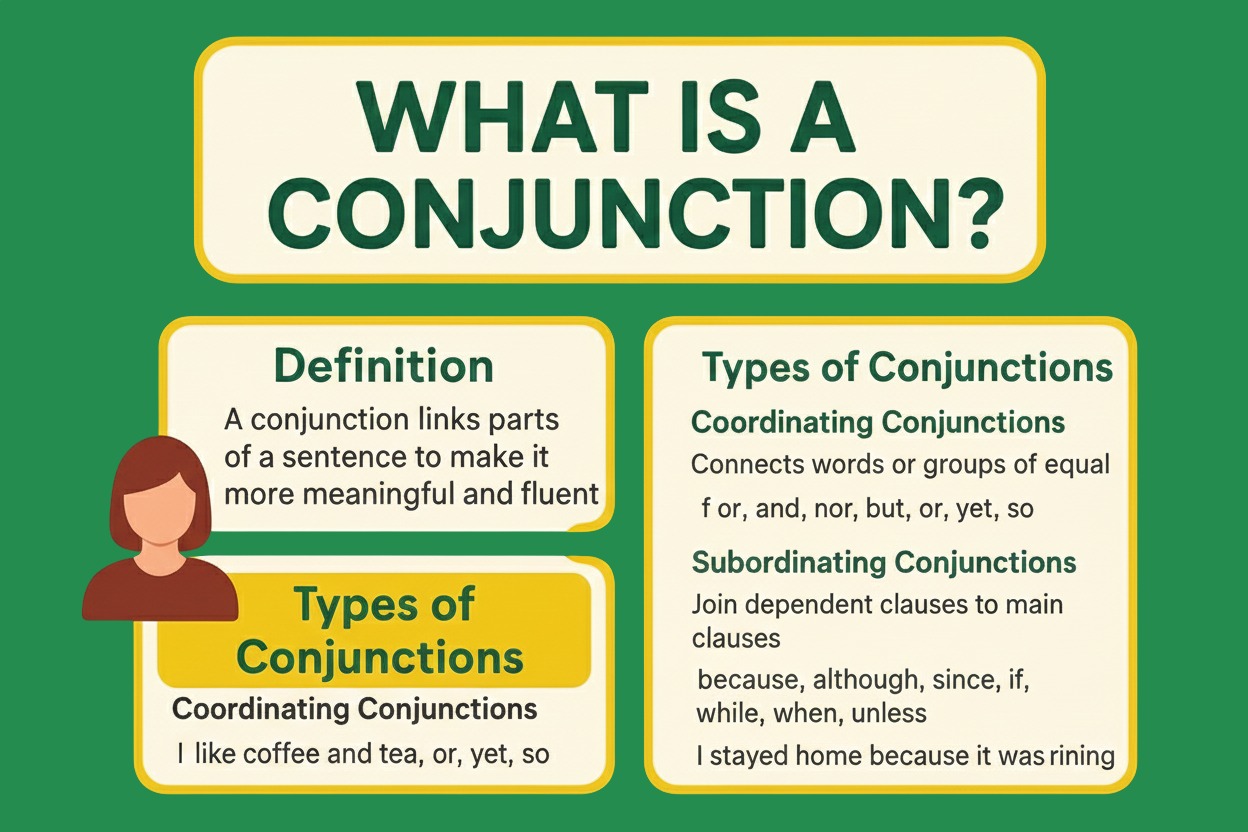
A conjunction is a word used to connect words, phrases, clauses, or sentences. By creating these links, conjunctions make sentences more meaningful, fluent, and complex, preventing the need for short, choppy statements.
Importance of Conjunctions
Without conjunctions, our language would be a series of simple, disconnected thoughts. Conjunctions are crucial because they:
- Combine Ideas Smoothly: They allow us to show the relationship between ideas, such as addition, contrast, cause, and effect.
- Ensure Coherence and Logic: They make writing and speech flow logically, guiding the reader or listener through the progression of thoughts.
Types of Conjunctions
Understanding the different types of conjunctions is key to using them effectively. The main categories are Coordinating, Subordinating, and Correlative conjunctions.
1. Coordinating Conjunctions
What is a coordinating conjunction? It connects words, phrases, or independent clauses of equal grammatical rank. A simple way to remember them is with the acronym FANBOYS.
- F = for
- A = and
- N = nor
- B = but
- O = or
- Y = yet
- S = so
Examples:
- Connecting words: I like coffee and tea.
- Connecting clauses: She was tired, yet she finished her work.
2. Subordinating Conjunctions
These conjunctions join a dependent (subordinate) clause to an independent (main) clause, showing a relationship like cause, time, or condition.
Examples: because, although, since, if, while, when, unless
Examples:
- I stayed home because it was raining. (The reason)
- Although it was difficult, we persevered. (Contrast)
Difference between subordinating and coordinating conjunctions:
The key difference lies in what they connect. Coordinating conjunctions link equal elements, while subordinating conjunctions introduce a clause that is less important than the main clause. For instance, in “I stayed home because it was raining,” “I stayed home” can stand alone as a sentence, but “because it was raining” cannot.
3. Correlative Conjunctions
These types of coordinating conjunctions work in pairs to link balanced elements within a sentence.
Examples: either…or, neither…nor, both…and, not only…but also
Examples:
- You can have either cake or ice cream.
- She is not only intelligent but also very kind.
Examples in Sentences
Here are five sentences of conjunction demonstrating their use:
- (Coordinating) I tried to call, but you didn’t answer.
- (Subordinating) We can go to the park if the weather is nice.
- (Correlative) Neither my brother nor my sister could attend the event.
- (Coordinating) He must be tired, for he has been working all day.
- (Subordinating) She finished her homework while dinner was cooking.
Join the Sentences Using Conjunctions
Using a suitable conjunction or appropriate conjunction is essential for merging ideas.
- Separate: I like reading. My brother likes sports.
- Joined: I like reading, but my brother likes sports.
- Separate: We were late. There was heavy traffic.
- Joined: We were late because there was heavy traffic.
- Separate: You can come with us. You can stay here.
- Joined: You can either come with us or stay here.
Paragraph with Conjunctions
To see how they work in context, read this paragraph with conjunctions:
“I wanted to go for a run this morning, but the sky was dark and threatening. Although I was disappointed, I decided to workout at home instead. I could do either bodyweight exercises or use my yoga mat, so I chose a mix of both. After I finished, I felt great, for I had still been productive.”
Common Mistakes with Conjunctions
- Overusing “And” or “But”: Using “and” repeatedly can make writing sound childish. Using “but” too often can make an argument seem weak. Vary your conjunctions.
- Weak: I woke up, and I brushed my teeth, and I had breakfast.
- Better: I woke up, brushed my teeth, and then had breakfast.
- Using Multiple Conjunctions Incorrectly: Starting a sentence with “and” or “but” is often acceptable for style, but using them to connect multiple ideas in one long sentence is an error called a run-on.
- Incorrect: I went to the store and I bought milk and then I saw a friend but I was in a hurry.
- Correct: I went to the store and bought milk. Then, I saw a friend, but I was in a hurry.
- Misplacing Subordinating Conjunctions: The dependent clause should be placed clearly to avoid confusion.
- Unclear: She saw the dog while walking to the store that was barking.
Clear: While walking to the store, she saw the dog that was barking.
Conjunctions may be small words, but they make a big difference in how we speak and write. They help connect ideas, build clear sentences, and make communication smoother and more meaningful. When students understand how different types of conjunctions work, they can express their thoughts more confidently and avoid choppy or confusing sentences. Strong grammar skills also improve reading comprehension, writing quality, and overall language development.
At the best schools in Bangalore, grammar is taught in a practical and engaging way so students learn how to use language naturally in conversations, assignments, and creative writing. By practicing regularly and applying conjunctions in everyday communication, learners can build a strong foundation in English that supports academic success and confident expression in all areas of life.