

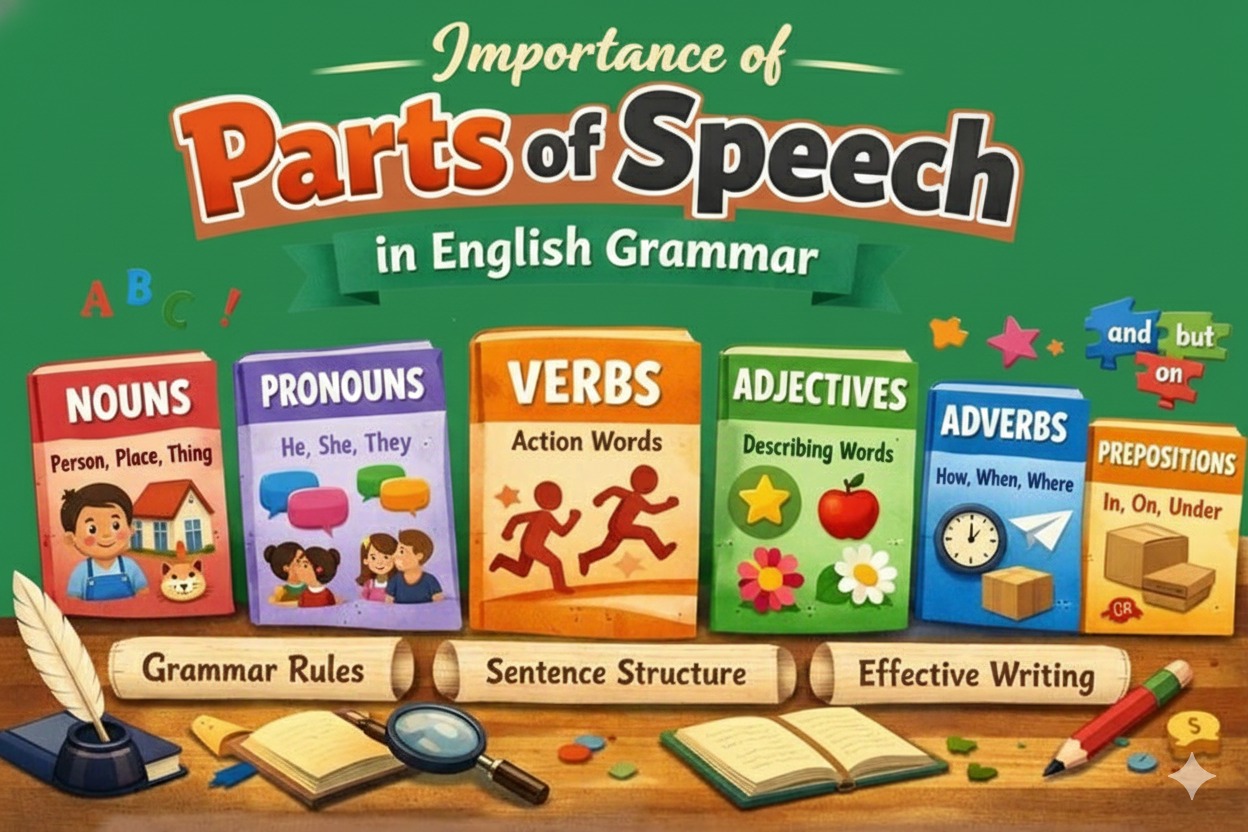
Parts of speech are integral to mastering English – the global language that opens doors to communication, learning, and career opportunities. Understanding the importance of parts of speech improves vocabulary, enhances writing skills, and builds confidence in both speaking and comprehension.
What Are Parts of Speech?
Parts of speech are categories that show the function of each word in a sentence. Learning different parts of speech and their examples helps students understand sentence structure and use words correctly.
For instance, nouns name people, places, or things, while verbs indicate actions or states. By knowing parts of speech and their examples, learners can construct sentences that are grammatically correct and easy to understand.
Why Are Parts of Speech Important in English?
Parts of speech are an essential component of English grammar for many reasons. They provide the structure for correct sentence formation and enhance the overall understanding and experience of the language. Without parts of speech, it would be impossible to convey anything in English with clarity.
For example, look at this sentence: The cat sat the table. Does it make any sense?
Not until we add a preposition like “on” or “under”, so it becomes: The cat sat on/ under the table. Now it makes perfect sense.
Types of Parts of Speech (With Quick Examples)
Noun – Names people, places, or things.
Example: The teacher explained the lesson.
Pronoun – Replaces a noun to avoid repetition.
Example: She went to the market.
Verb – Shows action or state.
Students often ask, “What part of speech is play?” In the sentence He plays football, “play” is a verb.
Another common doubt is, “Which part of speech is ‘has’?” In She has finished her work, “has” is a helping verb.
Example: He plays football.
Adjective – Describes a noun.
Example: It was a sunny day.
Adverb – Modifies verbs or adjectives.
Examples: She sings well, “well” is an adverb.
He is very happy. “very” is an adverb showing intensity.
Preposition – Shows relationship between words.
Example: The book is on the table. “on” is a preposition which shows Position
Conjunction – Connects ideas or clauses.
Examples: I read while he studied, “while” is a conjunction joining two actions.
I like tea and coffee.
Interjection – Expresses sudden emotion.
Example: Wow! That’s amazing. “Wow” is an interjection that show surprise
Everyday Uses of Parts of Speech
Parts of speech are used in daily life more than we realise. Some examples include:
- Conversations and chats: Using the right words makes everyday talking easy to understand.
- Social media posts: Clear word choice helps others quickly understand your thoughts.
- School assignments and reports: Proper grammar keeps your writing neat and easy to read.
- Emails and letters: Choosing the correct words makes your message polite and clear.
- Presentations and speeches: Accurate word use helps the audience follow your ideas.
- Stories and creative writing: Well-chosen words make stories engaging and expressive.
Common Mistakes Students Make
Parts of speech can be easy to mix up, but with simple tips and a little attention, these mistakes are easy to avoid. Here are some common errors and how to correct them:
Confusing Adjectives with Adverbs
Students often use an adjective where an adverb is needed, which makes sentences sound awkward.
Example: “She sings beautiful.” → Correct: “She sings beautifully.”
Tip: If the word describes an action, use an adverb.
Using Incorrect Verb Tenses
Switching tenses unknowingly can make writing or speech confusing.
Example: “I go to school yesterday.” → Correct: “I went to school yesterday.”
Tip: Check the time reference (past, present, future) before choosing the verb form.
Choosing the Wrong Prepositions
Incorrect prepositions can change meaning or make sentences unclear.
Example: “She is good in maths.” → Correct: “She is good at maths.”
Tip: Learn common preposition patterns (good at, interested in, depend on).
Overusing Conjunctions
Students sometimes join too many ideas with “and” or “but,” resulting in long, messy sentences.
Example: “I went to the park and I met my friend and we played.”
Tip: Split long ideas into shorter sentences for clarity.
Difficulty Identifying Parts of Speech
If students can’t recognise nouns, verbs, or adjectives, they may form unclear sentences.
Example: Confusing “run” (verb) with “runner” (noun).
Tip: Practise spotting each part of speech in simple sentences daily.
Not Reviewing Mistakes
Skipping revision leads to repeated errors and reduced accuracy over time.
Example: Writing “Their going to school” multiple times without correction.
Tip: Re-read your work slowly and fix small mistakes before finalising.
General Do’s and Dont’s to Master Parts of Speech
Do’s
- Do practise with short, meaningful sentences every day.
- Do read actively and label words (noun, verb, adjective, etc.) as you go.
- Do use flashcards or apps to drill quick examples and definitions.
- Do write a few sentences using a target part of speech (e.g., five sentences that use adverbs).
- Do speak aloud simple sentences to hear how words change meaning.
- Do check verb tense against time words (yesterday, now, tomorrow).
- Do break long sentences into two for clarity.
- Do review and correct your own errors—make the same sentence twice, then fix the second one.
- Do ask for feedback from a teacher, peer, or language app when unsure.
Don’ts
- Don’t memorise rules without using them in writing or speaking.
- Don’t guess prepositions — learn common pairs (good at, depend on, interested in).
- Don’t use adjectives where adverbs are needed (e.g., not she sings beautiful).
- Don’t chain too many clauses with “and” — keep sentences focused.
- Don’t skip re-reading your work; small slips repeat if you don’t catch them.
- Don’t ignore parts of speech you find hard — give them extra short practice sessions.
Quick Practice Exercises
Here are fun, simple examples for each exercise, so students know exactly how to practise:
Spot the Word Detective
Task: Circle one noun, one verb, and one adjective in a sentence.
Example sentence: The happy dog runs quickly.
- Noun: dog
- Verb: runs
- Adjective: happy
Fix-It Challenge
Task: Rewrite a sentence containing a mistake.
Error sentence: He run fast every morning.
Correct sentence: He runs fast every morning.
Fill-the-Gap Puzzle
Task: Choose the correct part of speech to complete the blank.
Example:
She bought a ___ bag.
Options: red (adjective) / quickly (adverb)
Correct: She bought a red bag.
Talk & Track
Task: Pick one sentence from a conversation or text and label two parts of speech.
Example text message: I will meet you outside.
- Verb: meet
- Preposition: outside
Daily Mini-Mission
Task: Set a tiny goal for the day.
Example goal: Use three adverbs today.
Example sentence you create: She sang beautifully and moved gracefully on stage.
Theory-to-Reality Test
Task: Write a short message and check how many parts of speech you used.
Example message: I bought a new notebook today.
- Pronoun: I
- Verb: bought
- Adjective: new
- Noun: notebook
- Adverb (time): today
Conclusion
Parts of speech shape every sentence we speak or write. When learners, especially those in pre-primary school, understand how each word works, communication becomes clearer and more confident. With steady practice and attention to daily usage, mastering them becomes easier over time. Keep learning a little every day. Your English will grow stronger, and so will your confidence.