

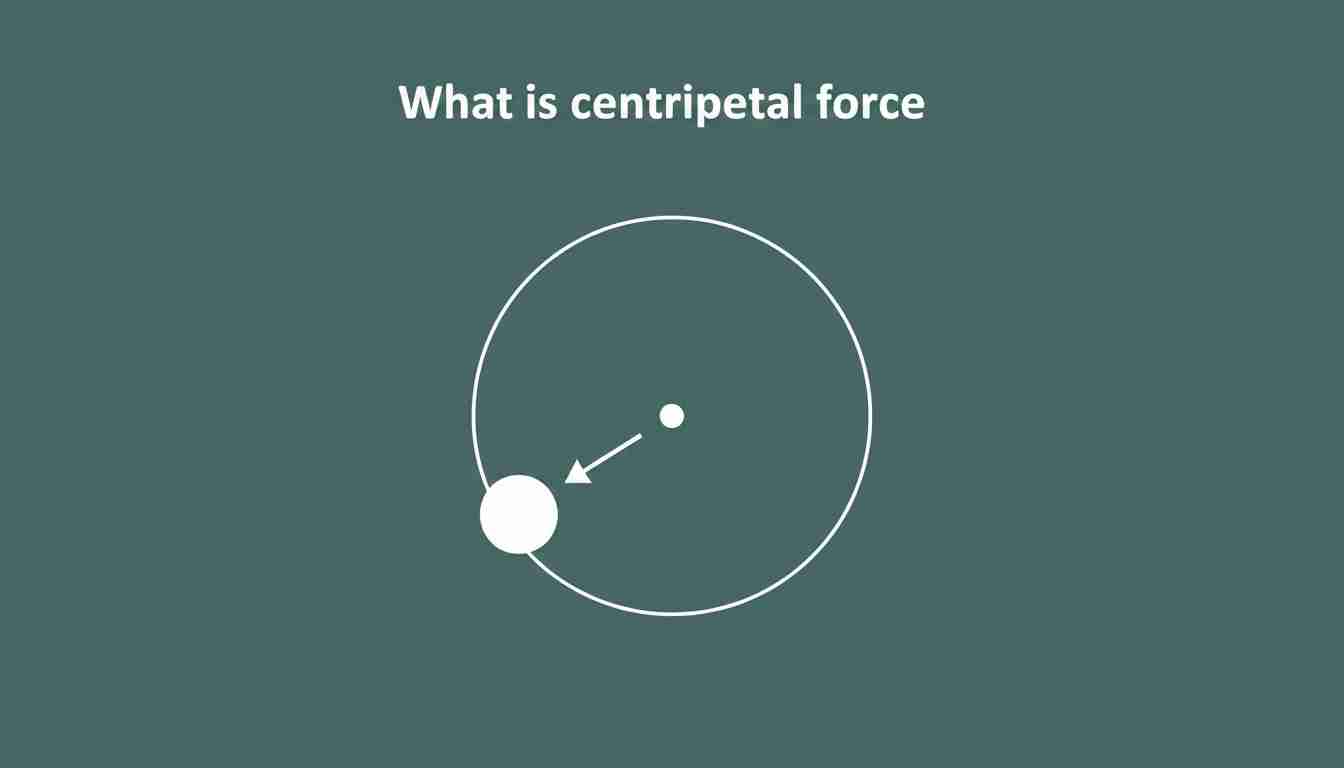
You’ve seen a car take a turn and not just slide off the road. Or the Earth going around the Sun. Or maybe you’ve swung a ball on a string as a child. All of that works because of a force called centripetal force.
Honestly, it’s a simple idea. If you want something to go in a circle, you’ve got to keep pulling it toward the middle. Stop pulling, and it’ll fly off straight. That’s it.
What does “centripetal” even mean?
It’s from old Latin words: centri (center) + petal (seeking). So it means “center-seeking.”
Take a ball on a string. Swing it around. Feel that tug on your hand? That’s the string pulling the ball inward. That inward pull is centripetal force. If the string snaps, the ball doesn’t keep going in a circle—it zips off in a straight line. No inward pull, no circle.
The formula (don’t worry, it’s easy)
Here’s what you’ll need for problems:
F = (m × v²) / r
- F = centripetal force (in Newtons)
- m = how heavy the thing is (mass)
- v = how fast it’s going (speed)
- r = radius (how big the circle is)
What this tells you:
Go faster → need more pull. Heavier object → need more pull. Bigger circle → less pull.
But how does it really work?
Even if you’re going at a steady speed, in a circle your direction is always changing. Changing direction means your velocity is changing. Changing velocity means you’re accelerating. That’s called centripetal acceleration, and yep, it points toward the center too.
Think of a car turning. Friction between the tires and the road is what pulls it inward. If the road’s icy, that friction drops, and the car skids outward. You’ve probably felt that.
Real-life examples (stuff you’ve actually seen)
Car taking a turn
Friction does the job. No friction = skid.
Planets going around the Sun
The Sun’s gravity pulls them inward. That gravity is the centripetal force. That’s why Earth hasn’t floated away or crashed into the Sun.
Roller coasters
When you go through a loop, the track pushes the car toward the center of the loop. That push keeps you on the track.
Swinging a ball on a string
Your hand feels the pull. That’s tension acting as centripetal force.
Washing machine spin cycle
Clothes spin in a circle. The drum pulls them inward. Water droplets don’t get pulled in enough, so they fly out through the holes—in a straight line.
Here’s what confuses most students
Centripetal force is not a separate force like friction or gravity. It’s just a name for whatever force happens to be pulling inward.
For a planet: gravity is the centripetal force.
For a car turning: friction is the centripetal force.
For a ball on a string: tension is the centripetal force.
So don’t go looking for a “centripetal force” on a list of forces. It’s a role, not a new player.
The whole centrifugal thing (people get this wrong all the time)
You’ve felt it: a car turns left, and you feel thrown to the right. Some call that centrifugal force. But here’s the truth—it’s not a real force. It’s just a feeling.
What’s really happening? Your body wants to go straight (that’s inertia). The car turns left. So you feel pressed against the door. No outward force actually acts on you.
Centripetal = real, inward.
Centrifugal = fake, feels outward.
A quick example (so you see how it works)
Let’s say a 2 kg ball moves in a circle of radius 4 m at a speed of 6 m/s. What’s the centripetal force?
F = (2 × 6²) / 4
6² = 36
2 × 36 = 72
72 / 4 = 18 newtons.
Answer: 18 N. That’s how hard the string (or whatever) has to pull.
Where do we use this stuff?
- Keeping satellites from flying off into space
- Designing curved roads so cars don’t slide
- Building safe roller coasters
- Sports like hammer throw
- Washing machines and lab centrifuges
- Figuring out how planets move
Engineers use it all the time to keep things safe.
A few things to watch out for in exams
- Don’t treat centrifugal force as real. It’s not.
- Remember: centripetal force always points to the center.
- Use the right radius. The radius is from the center to the path, not the diameter.
- Don’t call it a “new force.” It’s just whatever force is pulling inward.
Get those right, and you’re good.
So yeah, that’s centripetal force
It’s just an inward pull that makes things go in circles. You see it every day—cars turning, washing machines spinning, planets orbiting. Once you realize it’s not a magic new force, but just friction or gravity or tension doing a different job, it all makes sense.