

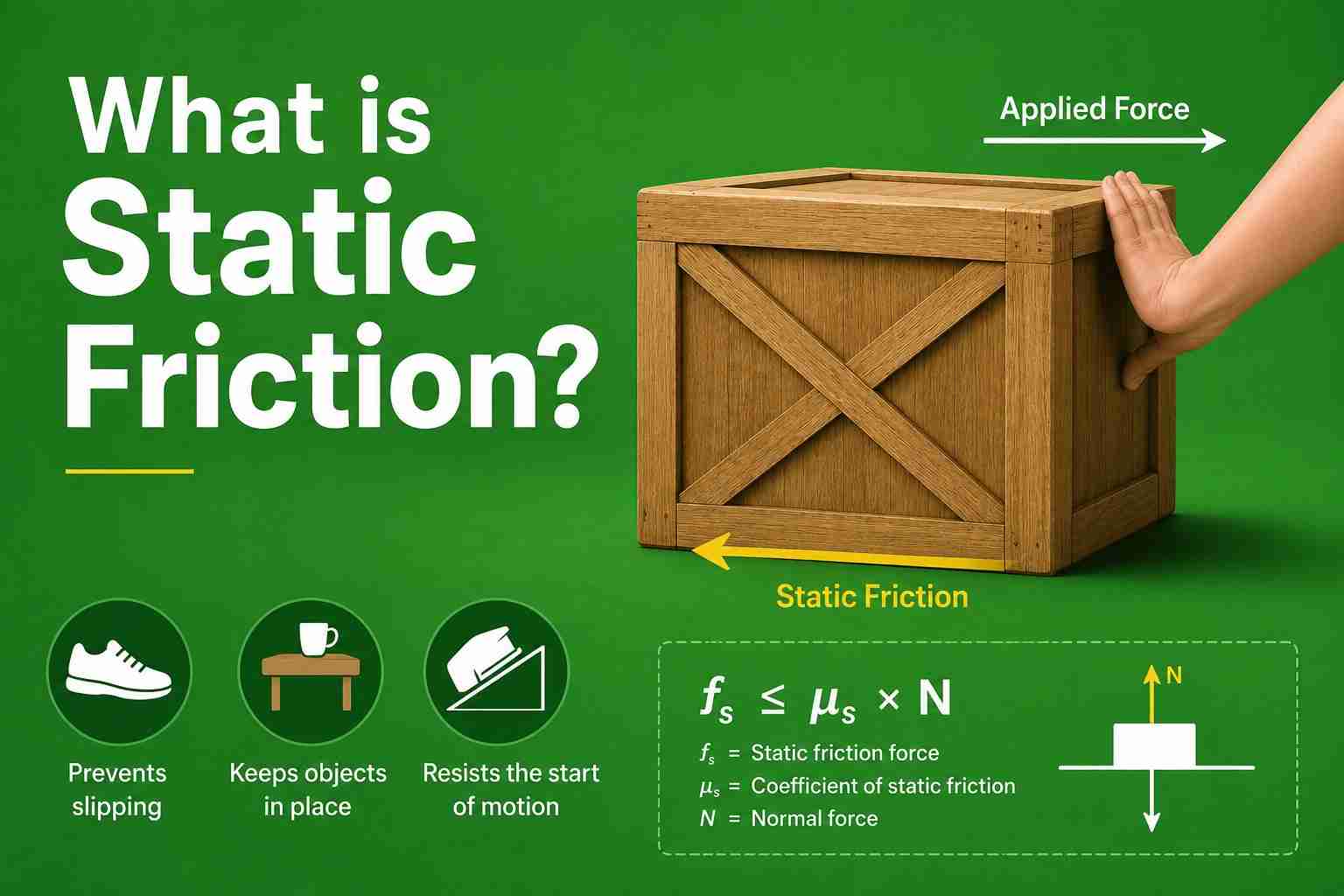
You know when you try to push something heavy, like a table, and for a second it just doesn’t move? That annoying resistance? That’s static friction. It’s the friction that happens before anything starts sliding.
Featured Snippet (Quick Answer Block)
Static friction is the force that keeps a still thing still when you push it. Like when you push a box and it stays put – that’s static friction pushing back.
Definition of Static Friction
Here’s the easy way to say it: static friction acts on things that aren’t moving. It tries to keep them that way. Once something starts sliding, static friction disappears and another type of friction shows up.
Real-Life Examples of Static Friction
You deal with this all day without thinking about it.
- Walking – Your shoe pushes back. The ground pushes you forward. That grip is static friction. Without it, you’d slip like you’re on ice.
- Pushing a sofa – That “stuck” feeling before it finally moves? Static friction. Notice how it gets easier once it’s already sliding? That’s because static friction is gone.
- Parked car on a hill – Why doesn’t it just roll down? Static friction holding the tires. That’s it.
How Static Friction Works
Honestly, it’s very simple.
You push something. It pushes back exactly as hard. You push harder? It pushes back harder too. It just matches whatever you do.
But only till a point.
Push too hard, and it gives up. The thing breaks loose and starts moving. That’s when static friction quits and kinetic friction takes over.
Think of it like a friend who pushes back in a game of tug of war – but only until they can’t anymore.
Formula of Static Friction
Yeah, there’s a formula. But don’t worry.
fₛ ≤ μₛ × N
In normal words:
- fₛ = how much static friction is happening right now (this changes)
- μₛ = a grip number (high for rubber on road, low for ice on metal)
- N = how heavy the thing is pushing down
The little ≤ sign just means “less than or equal to”. So static friction can be small or big. It’s not one fixed number.
Factors Affecting Static Friction
Three things matter:
- What the surfaces are made of – Rubber on wood grips a lot. Wet glass on wet glass? Almost nothing.
- How heavy the object is – Heavier stuff has more static friction. That’s why a fridge is harder to move than a book.
- Roughness – Tiny bumps on surfaces hook into each other. That’s basically all friction is.
Static Friction vs Kinetic Friction
People mess this up all the time. Here’s the difference.
| Static Friction | Kinetic Friction | |
| When? | When an object is still | When an object is sliding |
| Does it change? | Yes, it grows as you push harder | No, it stays about the same |
| Which is stronger? | Stronger | Weaker |
Main thing to remember: Starting something is harder than keeping it going. That’s why you feel a sudden looseness when something finally moves.
Common Mistakes to Avoid
- Thinking they’re the same thing – No. Static = still. Kinetic = moving.
- Thinking static friction is always the same number – Nope. It changes. Only the maximum is fixed.
- Thinking rougher always means more friction – Not really. Two very rough surfaces might touch less. It’s about how they fit.
Conclusion
Static friction is just the force that keeps stationary things still. It pushes back as hard as you push – until it can’t. Then things slide. You’ve felt this a hundred times today. That’s all there is to it.
FAQs
What is static friction in simple words?
It’s the force that fights you when you try to move something that’s sitting still.
Give examples of static friction.
- A phone on a slightly tilted book that doesn’t fall off.
- Your shoes are not slipping when you stand up.
- A cup on a table stays put when you nudge the table.
What is the formula of static friction?
fₛ ≤ μₛ × N. But honestly? Just know that static friction grows until it hits a limit, then stuff moves.
Is static friction stronger than kinetic friction?
Yes. Almost always. That’s why it’s harder to start moving something than to keep moving it.