

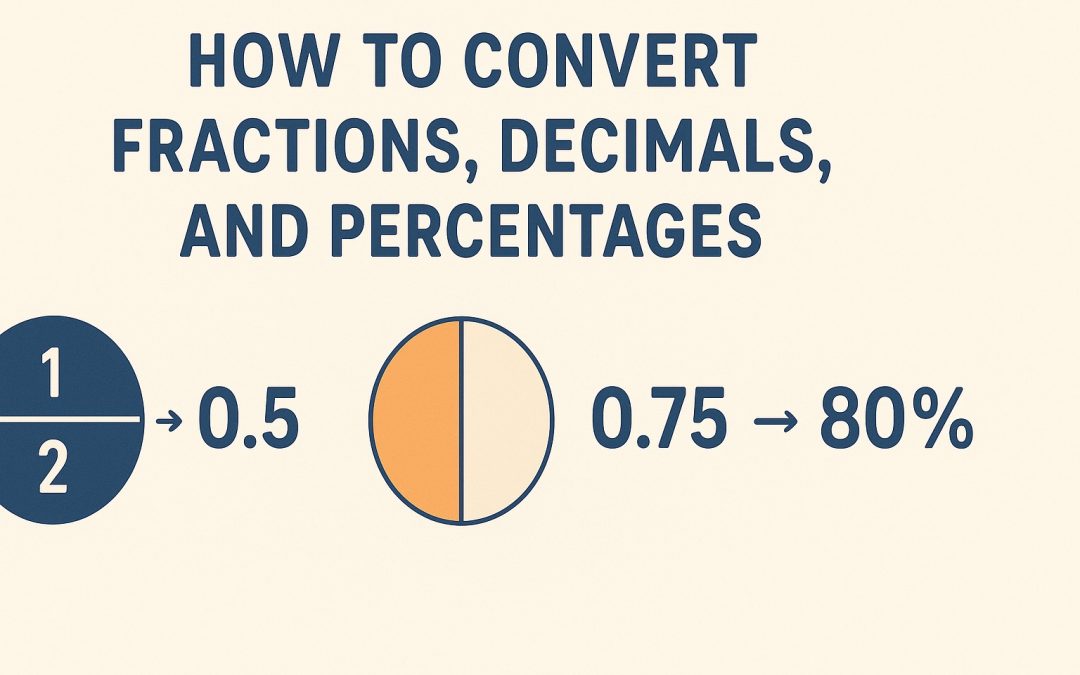
How to Convert Fractions, Decimals, and Percentages With Chart
Fraction decimal percent conversion is not only a must for exams but also for smart everyday decisions. And the good news? It’s much easier than it looks once you know the steps.
In this blog, we’ll walk you through simple rules, quick methods, and charts like fraction to percentage charts and percentages to fractions tables that you can use as a handy reference.
Step-by-Step Explanation
1. Converting Fractions to Decimals
To turn a fraction into a decimal, all we do is divide the numerator (top number) by the denominator (bottom number).
Example:
¾=3÷4=0.75\frac{3}{4} = 3 ÷ 4 = 0.7543=3÷4=0.75
So, ¾ becomes 0.75.
2. Converting Decimals to Fractions
Decimals can easily become fractions. Just place the decimal over a power of 10 and simplify.
Example:
0.25 = 25/100 = ¼
3. Converting Fractions to Percentages
A percentage is just a fraction out of 100. So, we multiply the fraction by 100.
Example:
¾ ×100=75%\frac{3}{4} × 100 = 75\%43×100=75%
4. Converting Percentages to Fractions
Take the percentage, put it over 100, and simplify.
Example:
75% = 75/100 = ¾
5. Converting Decimals to Percentages
Move the decimal point two places to the right or multiply by 100.
Example:
0.85 × 100 = 85%
6. Converting Percentages to Decimals
Do the opposite – divide by 100 or move the decimal two places to the left.
Example:
85% ÷ 100 = 0.85
Key Rules / Tips
- Always reduce fractions to their simplest form.
- Remember: “Percent” means “per 100.”
- Moving the decimal point two places is the quickest trick for converting between decimals and percentages.
- Learn shortcuts for common values, like:
- ½ = 0.5 = 50%
- ¼ = 0.25 = 25%
- ¾ = 0.75 = 75%
Common Mistakes Students Make
We’ve noticed that most errors happen because of three things:
- Forgetting to simplify fractions. Example: Writing 75/100 instead of ¾.
- Moving the decimal point the wrong way. This often happens with 0.25 → 25% (correct) vs 0.25 → 0.0025% (wrong!).
- Mixing up multiplying vs dividing by 100. Remember: multiply to go to percentages, divide to come back.
Example / Quick Illustration
Let’s try a full conversion with one number:
Convert ¾ into a decimal and percentage.
- Fraction → Decimal: 3 ÷ 4 = 0.75
- Decimal → Percentage: 0.75 × 100 = 75%
So, ¾ = 0.75 = 75%.
Handy Conversion Tables
Here are some ready-to-use fraction decimal percent conversion charts that can be a lifesaver for exams and homework.
Fraction to Percentage Chart (1 to 20)
| Fraction | Decimal | Percentage |
| 1/2 | 0.5 | 50% |
| 1/3 | 0.333 | 33.3% |
| 2/3 | 0.666 | 66.6% |
| 1/4 | 0.25 | 25% |
| 3/4 | 0.75 | 75% |
| 1/5 | 0.2 | 20% |
| 2/5 | 0.4 | 40% |
| 3/5 | 0.6 | 60% |
| 4/5 | 0.8 | 80% |
| 1/8 | 0.125 | 12.5% |
| 3/8 | 0.375 | 37.5% |
| 5/8 | 0.625 | 62.5% |
| 7/8 | 0.875 | 87.5% |
| 1/10 | 0.1 | 10% |
| 1/20 | 0.05 | 5% |
This table of percentages, fractions and decimals makes it easy to check common values quickly.
Percent to Decimal Chart (1 to 100)
| Percentage | Decimal | Fraction (Simplified) |
| 1% | 0.01 | 1/100 |
| 5% | 0.05 | 1/20 |
| 10% | 0.1 | 1/10 |
| 20% | 0.2 | 1/5 |
| 25% | 0.25 | 1/4 |
| 33% | 0.33 | 1/3 |
| 40% | 0.4 | 2/5 |
| 50% | 0.5 | 1/2 |
| 60% | 0.6 | 3/5 |
| 66% | 0.66 | 2/3 |
| 75% | 0.75 | 3/4 |
| 80% | 0.8 | 4/5 |
| 90% | 0.9 | 9/10 |
| 100% | 1.0 | 1/1 |
This percentage into the fraction table is perfect when you need quick conversions without calculations.
Why This Matters in Real Life
Let’s pause for a moment – why do we need to bother with this at all?
- Exams: Many math problems expect quick conversions between forms.
- Money: Discounts, GST, and bank interest rates are all given in percentages.
- Data: Graphs, surveys, and statistics often show percentages but can be easier to compare as fractions or decimals.
When we see a “25% off” sign in a store, we’re really calculating ¼ off the price. Knowing this instantly makes us smarter decision-makers.
Conclusion
At Bethany High, we love reminding our students that math is not just numbers on paper – it’s a toolkit for everyday life. Once you understand how to switch between fractions, decimals, and percentages, you’ll start seeing them everywhere – from shopping discounts to cricket scores.
It all comes down to remembering the basic steps and practicing with charts like the fraction to percentage chart or the percent to decimal chart we’ve shared. And the more you practice, the faster and more confident you’ll become.
So, the next time someone says, “What’s ¾ as a percentage?” – you’ll smile and say, “75%, easy!”
FAQs
- Why do I need to learn these conversions?
Because they appear everywhere – in exams, in shopping discounts, in bank rates, and even in cricket scores. - Which conversion should I memorize?
Start with the most common ones: ½ = 50%, ¼ = 25%, ¾ = 75%. These show up most often. - What’s the fastest way to convert decimals to percentages?
Just move the decimal point two places to the right. Example: 0.45 → 45%. - What about fractions like 1/7 or 1/9?
Those give repeating decimals (like 0.1428… or 0.111…) but you can still multiply by 100 to get the approximate percentage. - Can I use these charts in exams?
Usually no but memorizing a few values from the 1 to 20 percentage table can save you loads of time in a test.
- Why do I need to learn these conversions?