by Bethany Institutions | Mar 10, 2026
Interest is one of those things we hear about very early in life. It comes up in maths classes, at the bank, and later when we start earning or saving money. If you’ve ever wondered why banks give you extra money on savings or why loans cost more than what you borrow, interest is the reason.
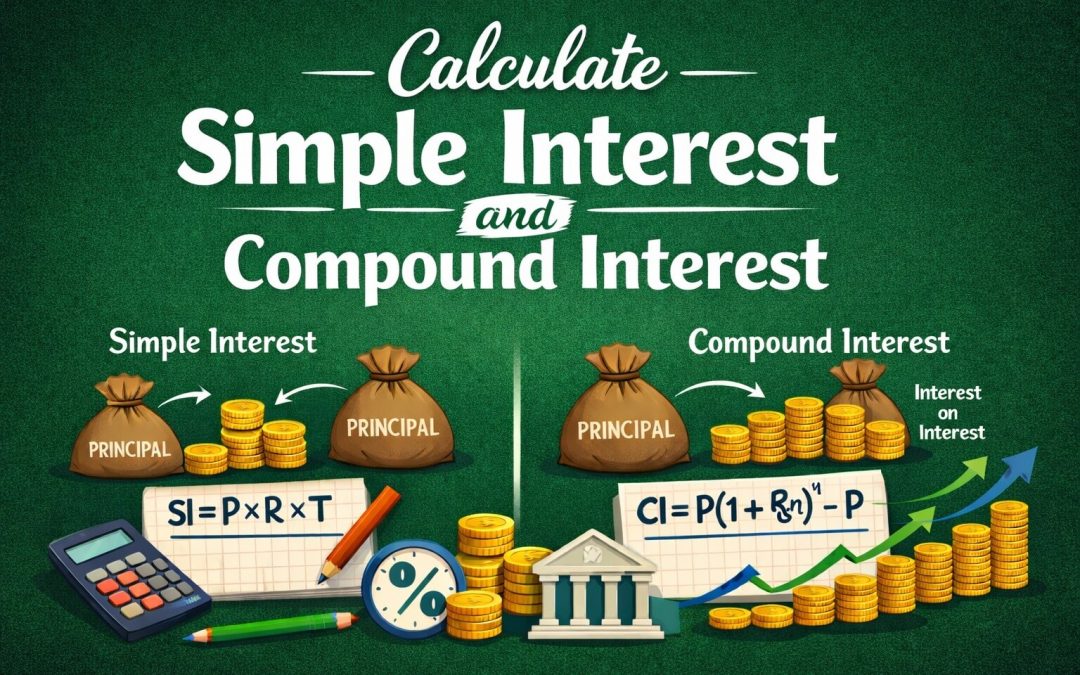
In simple terms, simple interest is calculated only on the original amount, while compound interest keeps adding interest to interest. This article explains both in an easy way, with formulas, steps, and examples you can actually understand.
What Is Interest?
Interest is the extra money involved when money changes hands.
- When you borrow money, interest is what you pay back in addition to the amount taken.
- When you save money, interest is what the bank gives you for keeping your money with them.
There are two main types of interest you need to know:
- Simple Interest
- Compound Interest
We see interest being used in banks, loans, fixed deposits, and savings accounts.
What Is Simple Interest?
Simple interest is the most basic form of interest. It is calculated only on the principal amount, which means the original amount stays the same throughout the time period.
Simple interest is usually used in:
- Short-term loans
- Small money transactions
- School-level calculations
Simple Interest Formula
SI = (P × R × T) / 100
Where:
- P is the principal amount
- R is the rate of interest per year
- T is the time in years
How to Calculate Simple Interest (Step by Step)
To find simple interest:
- Write down the principal amount.
- Note the rate of interest.
- Check the time period in years.
- Put the values into the formula.
- Solve it to get the interest.
That’s all there is to it.
What Is Compound Interest?
Compound interest is slightly different. Here, interest is calculated on the principal plus the interest already earned.
This means the amount keeps increasing every year. That is why compound interest is often called interest on interest.
Compound interest is commonly used in:
- Fixed deposits
- Savings accounts
- Long-term investments
Compound Interest Formula
CI = P (1 + R/100)ᵀ − P
Where:
- P is the principal
- R is the rate of interest
- T is the time in years
How to Calculate Compound Interest
- Write down the principal, rate, and time.
- Divide the rate by 100 and add 1.
- Raise it to the power of the time period.
- Multiply the result by the principal.
- Subtract the principal to find the interest.
Difference Between Simple Interest and Compound Interest
- Simple interest is calculated only on the principal.
- Compound interest is calculated on the principal and the interest added earlier.
- Over time, compound interest gives more returns than simple interest.
Worked Examples
Example – Simple Interest
₹1,000 is borrowed at 10% per year for 2 years.
Simple Interest = (1000 × 10 × 2) / 100
Simple Interest = ₹200
So, the total amount to be paid is ₹1,200.
Example – Compound Interest
Now take the same ₹1,000 invested at 10% per year for 2 years.
Amount = 1000 (1 + 10/100)²
Amount = ₹1,210
Compound Interest = ₹210
Even with the same values, compound interest gives a higher amount.
Where Do We Use Simple and Compound Interest?
- Simple interest is mostly used for short-term loans and basic lending.
- Compound interest is used by banks for savings, fixed deposits, and investments.
Common Mistakes Students Make
- Using the wrong formula for the question.
- Forgetting to convert months into years.
- Not subtracting the principal in compound interest.
- Making calculation mistakes while solving powers.
Conclusion
Simple interest is easy to understand and calculate, which is why it is taught first. Compound interest may look a little confusing at the beginning, but it helps money grow faster over time. Knowing the difference between the two is useful not just for exams, but also for making better financial choices later in life.
FAQs
What is simple interest in easy words?
It is interest calculated only on the original amount.
What is compound interest in easy words?
It is interest calculated on the original amount and the interest added to it.
Which is better, simple or compound interest?
Compound interest gives more money over a longer period.
Do banks use compound interest?
Yes, banks use compound interest for savings and fixed deposits.
Can interest be calculated yearly or monthly?
Yes, interest can be calculated for different time periods.
Why is compound interest called interest on interest?
Because interest is earned on previously earned interest.
by Bethany Institutions | Mar 6, 2026
Quadratic equations are one of those topics that look scary at first—but once you understand the logic, they actually become quite manageable. You’ll start seeing them from Class 9 onwards, and they play a very important role in Class 10 board exams, competitive exams, and higher maths too.
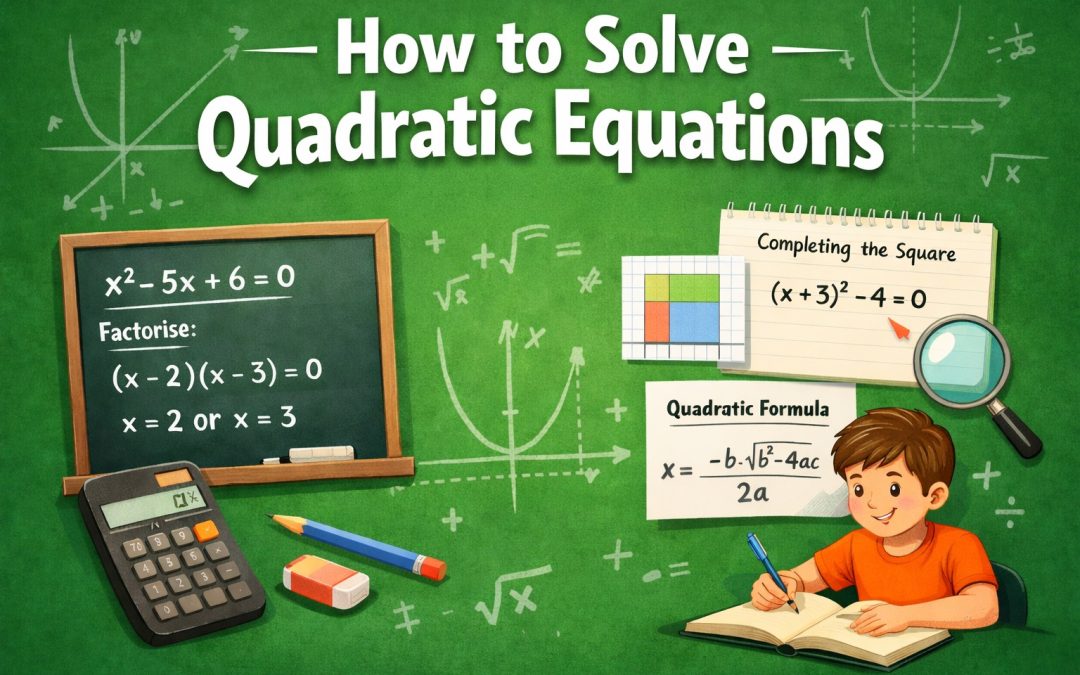
A quadratic equation can be solved in more than one way. Some methods are quick, some help you understand the concept better, and one method works every single time. In this guide, I’ll walk you through all the main methods step by step, with clear explanations and examples, so you know which method to use and when.
What is a Quadratic Equation? (Simple Meaning)
A quadratic equation is an equation where the highest power of the variable is 2.
The standard form is:
ax² + bx + c = 0
Here:
- a, b, and c are real numbers
- a ≠ 0 (this is very important)
- x is the variable
If the highest power of x is 2, it’s quadratic. If it’s 1, it’s linear. If it’s 3, it’s cubic.
Graphically, a quadratic equation forms a parabola, which is a U-shaped curve. But for now, we’ll focus on solving it algebraically.
Before You Solve: Quick Checks
Before jumping into any method, always do these quick steps:
- Bring the equation to standard form
Make sure it looks like ax² + bx + c = 0 - Identify a, b, and c clearly
- Check for common factors
If all terms can be divided by a number, simplify first. This can make solving much easier.
These small checks save time and prevent silly mistakes in exams.
Method 1 — Factorisation (Fastest When It Works)
When to Use Factorisation
Factorisation is the fastest method, but it doesn’t always work easily.
Use it when:
- Numbers are small
- Factors are easy to spot
- The constant term (c) is simple
This method is very common in Class 10 board questions.
Step-by-Step Factorisation Process
Let’s understand the steps clearly:
- Write the equation in standard form
- Split the middle term (if required)
- Factorise into two brackets
- Set each bracket equal to zero
- Solve for x
Common Factorisation Patterns
- (x + p)(x + q) = 0
- (ax + p)(x + q) = 0 when a ≠ 1
- Perfect square trinomials like (x + 3)²
With practice, your eyes will start recognising patterns quickly.
Method 2 — Completing the Square
(Best for Understanding Concepts)
When to Use Completing the Square
This method is useful when:
- Factorisation is difficult
- You want to understand how the graph behaves
- You later need to find the minimum or maximum value
It may feel long initially, but it builds strong conceptual clarity.
Step-by-Step Completing the Square
- Make the coefficient of x² equal to 1 (divide if needed)
- Move the constant term to the other side
- Take half of the coefficient of x, square it, and add it to both sides
- Write the left side as a perfect square
- Take square roots on both sides
- Solve for x
Go slow with this method—accuracy matters more than speed here.
Method 3 — Quadratic Formula
(Works for All Quadratic Equations)
The Formula
x=−b±b2−4ac2ax = \frac{-b \pm \sqrt{b^2 – 4ac}}{2a}x=2a−b±b2−4ac
This formula works every single time, no matter how difficult the equation looks.
Step-by-Step Using the Formula
- Identify values of a, b, and c
- Substitute carefully into the formula
- Solve the part inside the square root first
- Simplify the square root if possible
- Write two answers using ±
Most calculation mistakes happen here, so work neatly.
Understanding the Discriminant (b² − 4ac)
The expression b² − 4ac is called the discriminant. It tells us about the nature of roots.
- b² − 4ac > 0 → Two different real roots
- b² − 4ac = 0 → Two equal roots
- b² − 4ac < 0 → No real roots
This is often asked directly in exams.
Worked Examples
Example 1 — Easy Factorisation
Solve: x² + 5x + 6 = 0
Factorising:
(x + 2)(x + 3) = 0
So,
x = −2 or x = −3
Example 2 — Completing the Square
Solve: x² + 4x + 1 = 0
x² + 4x = −1
Add (4/2)² = 4 to both sides
(x + 2)² = 3
x = −2 ± √3
Example 3 — Quadratic Formula
Solve: 2x² + 3x − 1 = 0
Here,
a = 2, b = 3, c = −1
Using the formula:
x = [−3 ± √(9 + 8)] / 4
x = (−3 ± √17) / 4
Common Mistakes to Avoid
- Not converting to ax² + bx + c = 0
- Sign errors while factorising
- Forgetting ± when taking square roots
- Wrong value of b² or 2a
- Skipping simplification before solving
Most lost marks come from small errors—not lack of knowledge.
Quick Practice Questions
- Solve: x² − 7x + 10 = 0
- Find the roots of: 2x² + 5x + 2 = 0
- Solve using quadratic formula: x² − 4x + 1 = 0
- Find the nature of roots: x² − 6x + 9 = 0
- Solve: x² + 2x + 5 = 0
Try them before checking answers—it builds confidence.
Conclusion
Quadratic equations don’t have to be confusing. If the equation factorises easily, go with factorisation. If you want a deeper understanding, try completing the square. And when in doubt, remember—the quadratic formula always works. With regular practice, you’ll start solving these questions faster and with fewer mistakes.
FAQs
What is the standard form of a quadratic equation?
ax² + bx + c = 0, where a ≠ 0.
Which method is the easiest?
Factorisation is the easiest when it works.
When should I use the quadratic formula?
When factorisation is difficult or not possible.
What does the discriminant tell us?
It tells us the number and type of roots.
Can a quadratic equation have no real roots?
Yes, when the discriminant is negative.
Why do we get two answers?
Because squaring a number gives the same result for positive and negative values.
How do I check my answers?
Substitute the value of x back into the original equation.
by Bethany Institutions | Feb 13, 2026
Simple definition of LCM and HCF
When we work with numbers, especially in maths exams, two terms appear again and again—LCM and HCF. They may look confusing at first, but once you understand the idea behind them, they actually become quite easy and logical.
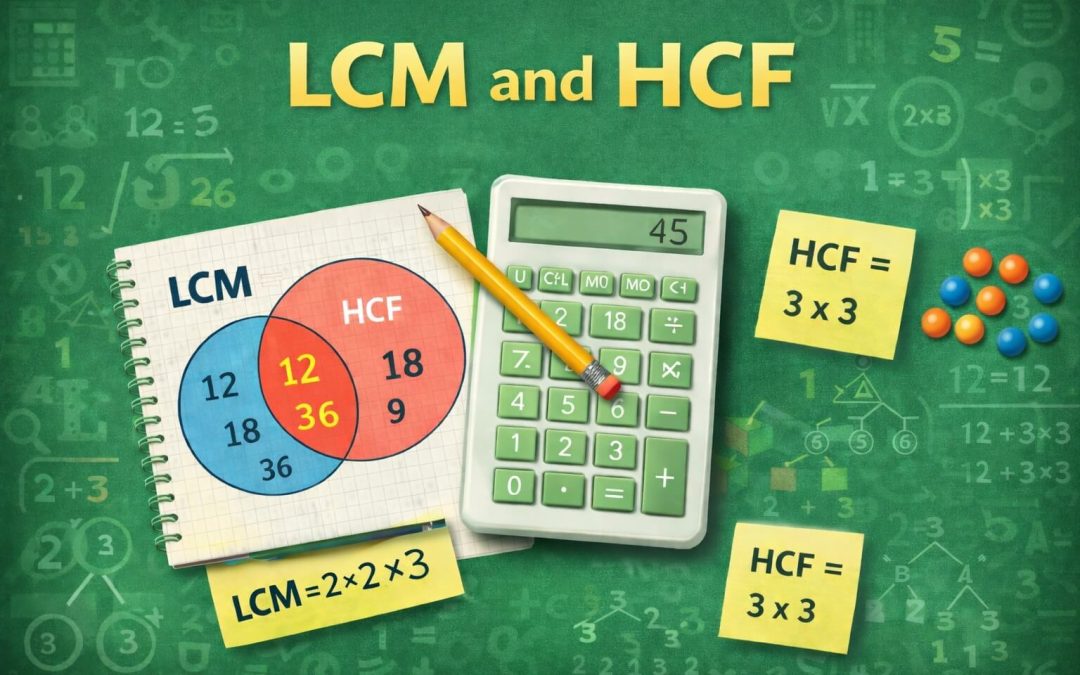
- LCM (Least Common Multiple) is the smallest number that is a multiple of two or more numbers.
- HCF (Highest Common Factor) is the greatest number that divides two or more numbers exactly.
In this article, I’ll explain what LCM and HCF are, how to calculate LCM and HCF, the difference between LCM and HCF, and their real-life applications, using simple steps and clear examples.
Why Students Need Both LCM and HCF
Students often ask me, “Why do we need both LCM and HCF?” The answer is simple—they solve different types of problems.
- LCM helps when we need to combine things, match cycles, or repeat events together.
- HCF helps when we need to divide things equally, group objects, or simplify fractions.
Understanding when to use LCM and when to use HCF can save a lot of time in exams and reduce silly mistakes.
What Is LCM?
Definition
LCM is the smallest number that is exactly divisible by two or more given numbers.
Full Form
The full form of LCM is Least Common Multiple.
When LCM Is Used
LCM is used when:
- Finding a common time for repeating events
- Solving problems related to fractions
- Working with time schedules
- Adding or subtracting fractions with different denominators
For example, when you want to find how to take LCM of fractions, you calculate the LCM of the denominators.
What Is HCF?
Definition
HCF is the largest number that divides two or more numbers without leaving a remainder.
Full Form
The full form of HCF is Highest Common Factor.
When HCF Is Used
HCF is used when:
- Dividing things into equal groups
- Simplifying fractions
- Finding the largest possible size of items
- Solving measurement problems
Difference Between LCM and HCF
Understanding the difference between LCM and HCF is very important for exams.
Purpose
- LCM is used to find the smallest common multiple
- HCF is used to find the largest common factor
Type of Result
- LCM is usually greater than or equal to the given numbers
- HCF is always less than or equal to the given numbers
Use Cases
- Use LCM for together, next time, repeat, when will they meet
- Use HCF for maximum, largest, divide equally, grouping
This clearly explains what is the difference between LCM and HCF.
Methods to Find LCM
There are several ways to calculate LCM. Let’s look at them one by one.
LCM by Listing Multiples
In this method, we list multiples of each number and find the smallest common one.
Example: Find LCM of 4 and 6
- Multiples of 4: 4, 8, 12, 16
- Multiples of 6: 6, 12, 18
LCM = 12
This method is simple but not suitable for large numbers.
LCM by Prime Factorization
This is the most common and exam-friendly method.
Steps:
- Write each number as a product of prime numbers
- Take the highest power of all prime factors
- Multiply them
This method is also called find LCM by prime factorization method.
LCM Using Division Method
In this method, numbers are divided by common prime numbers until 1 is left.
This method is quick and helpful when working with more than two numbers.
Methods to Find HCF
Just like LCM, HCF can also be found using different methods.
HCF by Listing Factors
List all factors of each number and find the greatest common one.
Example: Factors of 12 = 1, 2, 3, 4, 6, 12
Factors of 18 = 1, 2, 3, 6, 9, 18
HCF = 6
HCF by Prime Factorization
This is one of the most reliable methods.
Steps:
- Find prime factors of each number
- Take only the common prime factors
- Multiply them
This method clearly shows the properties of HCF and LCM.
HCF Using Division Method
Also called the Euclidean division method, this is very useful for large numbers and competitive exams.
Step-by-Step Examples
Example to Find LCM
Find LCM of 8 and 12 using prime factorisation.
- 8 = 2 × 2 × 2
- 12 = 2 × 2 × 3
Take highest powers:
LCM = 2³ × 3 = 24
Example to Find HCF
Find HCF of 18 and 24.
- 18 = 2 × 3 × 3
- 24 = 2 × 2 × 2 × 3
Common factors: 2 × 3
HCF = 6
Relationship Between LCM and HCF
There is an important formula linking LCM and HCF:
LCM × HCF = Product of the two numbers
When the Formula Applies
- This formula applies only for two numbers
- It helps to calculate one if the other is known
This relationship often appears in exam questions.
Common Mistakes Students Make
Mixing LCM and HCF
Many students use LCM when the question actually needs HCF—and vice versa.
Tip: Look for keywords like together (LCM) and divide equally (HCF).
Missing Prime Factors
Forgetting to include all prime factors while using LCM using prime factorization is a common error.
Calculation Errors
Simple multiplication mistakes can cost marks. Always recheck your steps.
Real-Life Applications of LCM and HCF
Time Schedules
LCM helps in finding when buses, bells, or events will happen together again.
Grouping Objects
HCF is used to divide chocolates, books, or students into equal groups.
Measurement Problems
HCF helps find the largest length or size that can measure things exactly.
These examples clearly show the application of LCM and HCF in daily life.
FAQs
Can LCM Be Smaller Than the Numbers?
No. LCM is always greater than or equal to the largest number.
Is HCF Always a Factor of the Numbers?
Yes. HCF is always a factor of each given number.
Can LCM and HCF Be the Same?
Yes. When the numbers are the same, LCM and HCF are also the same.
Which Method Is Easiest for Exams?
The prime factorization method is usually the easiest and safest for exams.
by Bethany Institutions | Oct 16, 2025
In geometry, the circumcentre is a crucial point – it is the centre of the circumcircle, the unique circle that passes through all three vertices of a triangle. Understanding how to find it is a fundamental geometric skill.
What is the Circumcentre?
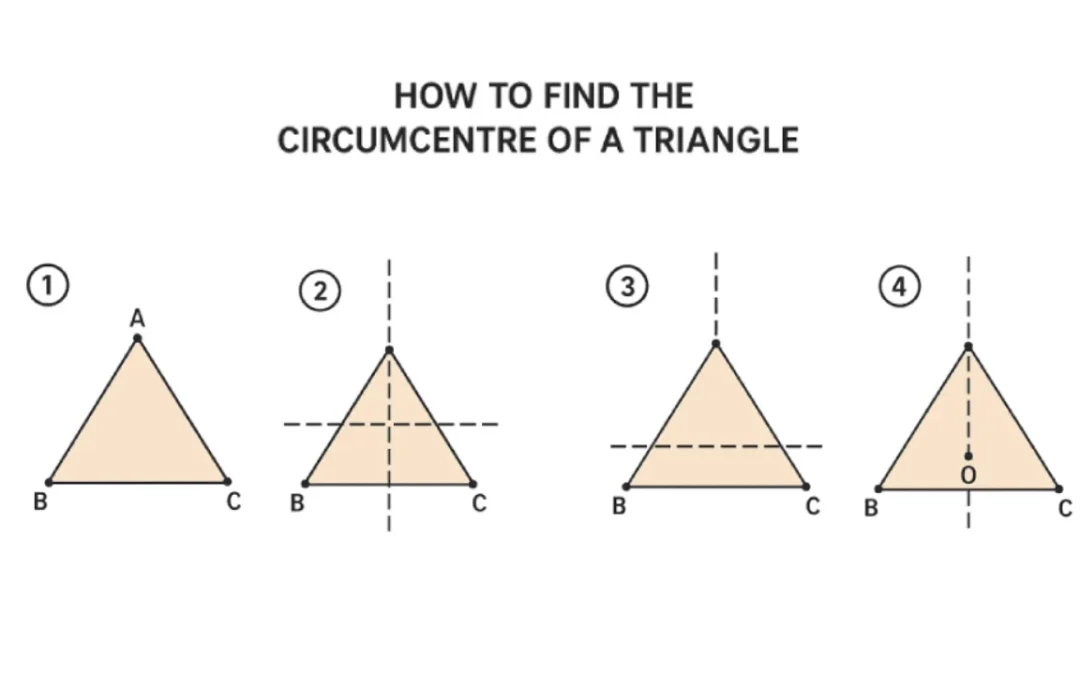
The circumcentre is the point where the three perpendicular bisectors of a triangle’s sides intersect. A perpendicular bisector is a line that cuts a side in half at a 90-degree angle.
Its location depends on the type of triangle:
- Acute Triangle: The circumcentre lies inside the triangle.
- Right-Angled Triangle: The circumcentre lies on the midpoint of the hypotenuse.
- Obtuse Triangle: The circumcentre lies outside the triangle.
How to Find the Circumcentre Using Coordinates
When the triangle’s vertices are given as coordinates on a graph, you can calculate the circumcentre using a straightforward method. There’s no need to physically draw the perpendicular bisectors; the circumcentre can be found algebraically using their equations.
Step 1: Understand the Formula
The circumcentre is equidistant from all three vertices (A, B, C). Its coordinates (x, y) can be found by solving the equations of the perpendicular bisectors of any two sides.
The standard formula for the circumcentre (x, y) of a triangle with vertices A(x₁, y₁), B(x₂, y₂), and C(x₃, y₃) is derived from the distance formula. However, a more practical method is to use the following process.
Step 2: The Calculation Process
- Find the midpoints of two sides (e.g., AB and AC).
- Calculate the slopes of those same two sides (AB and AC).
- The slope of a perpendicular bisector is the negative reciprocal of the slope of the original side.
- Use the point-slope form to find the equations of the two perpendicular bisectors.
- Solve these two equations simultaneously to find the intersection point (x, y). This is the circumcentre.
Example:
Let’s find the circumcentre of a triangle with vertices A(2, 3), B(4, 7), and C(10, 5).
- Find the perpendicular bisector of AB.
- Vertex A(2, 3), Vertex B(4, 7).
- Midpoint of AB = ((2+4)/2, (3+7)/2) = (3, 5).
- Slope of AB = (7-3)/(4-2) = 4/2 = 2.
- Slope of its perpendicular bisector = -1/2 (negative reciprocal).
- Equation using point-slope form: y – 5 = -½(x – 3) ⇒ x + 2y = 13. (Equation 1)
- Find the perpendicular bisector of AC.
- Vertex A(2, 3), Vertex C(10, 5).
- Midpoint of AC = ((2+10)/2, (3+5)/2) = (6, 4).
- Slope of AC = (5-3)/(10-2) = 2/8 = 1/4.
- Slope of its perpendicular bisector = -4 (negative reciprocal).
- Equation using point-slope form: y – 4 = -4(x – 6) ⇒ 4x + y = 28. (Equation 2)
- Solve the equations simultaneously.
- From Equation 2: y = 28 – 4x.
- Substitute into Equation 1: x + 2(28 – 4x) = 13
- x + 56 – 8x = 13
- -7x = -43
- x = 43/7 ≈ 6.14
- y = 28 – 4*(43/7) = (196 – 172)/7 = 24/7 ≈ 3.43
Therefore, the circumcentre is at (43/7, 24/7) or approximately (6.14, 3.43).
The Special Case: Circumcentre of a Right-Angled Triangle
This is the simplest case to remember. For any right-angled triangle, the circumcentre is located exactly at the midpoint of the hypotenuse.
Why? The hypotenuse of a right-angled triangle is the diameter of its circumcircle. The centre of a circle is always the midpoint of the hypotenuse.
Example:
Consider a right-angled triangle with vertices at A(0, 0), B(0, 6), and C(8, 0). The right angle is at vertex A.
- The hypotenuse is BC.
- Midpoint of BC = ((0+8)/2, (6+0)/2) = (4, 3).
The circumcentre is at (4, 3). No complex calculations are needed.
Key Properties of the Circumcentre
- Equidistance: It is the same distance from all three vertices of the triangle (OA = OB = OC); this distance is the circumradius (R).
- Triangle Type Dictates Location: Its position (inside, on, or outside the triangle) instantly reveals whether the triangle is acute, right-angled, or obtuse.
- Centre of the Circumcircle: It is the centre of the only circle that passes through the triangle’s three vertices.
Common Mistakes to Avoid
Here are some common mistakes to watch out for when finding the circumcentre:
- Confusing with Centroid or Orthocentre: The centroid is where the medians meet. The orthocentre is where the altitudes meet. Do not mix these up with the circumcentre (where perpendicular bisectors meet).
- Incorrect Perpendicular Slope: Remember, the slope of a perpendicular line is the negative reciprocal. A common error is simply using the negative of the original slope.
- Assuming it’s Always Inside: A frequent misconception is that the circumcentre is always inside the triangle. This is only true for acute triangles.
Frequently Asked Questions (FAQs)
Q1. Is the circumcentre always inside the triangle?
No. It is inside only for acute triangles. It is on the hypotenuse for right triangles and outside for obtuse triangles.
Q2. How is the circumcentre different from the centroid?
The centroid is the point where the medians intersect (each median connects a vertex to the midpoint of the opposite side) and represents the triangle’s centre of mass.
The circumcentre, by contrast, is the intersection of the perpendicular bisectors and serves as the centre of the circumcircle.
Q3. Why is the circumcentre important?
It is used in geometry, trigonometry, and real-world applications like finding the optimal location for a facility that needs to be equidistant from three points (e.g., a fire station or a cell tower).
Conclusion
Finding the circumcentre is a systematic process. In a right-angled triangle, it’s simply the midpoint of the hypotenuse. For all other types, the coordinate geometry method—using the equations of perpendicular bisectors—is the most reliable approach. With a clear understanding of its properties and common pitfalls, you can confidently locate the circumcentre of any triangle.
by Bethany Institutions | Sep 18, 2025
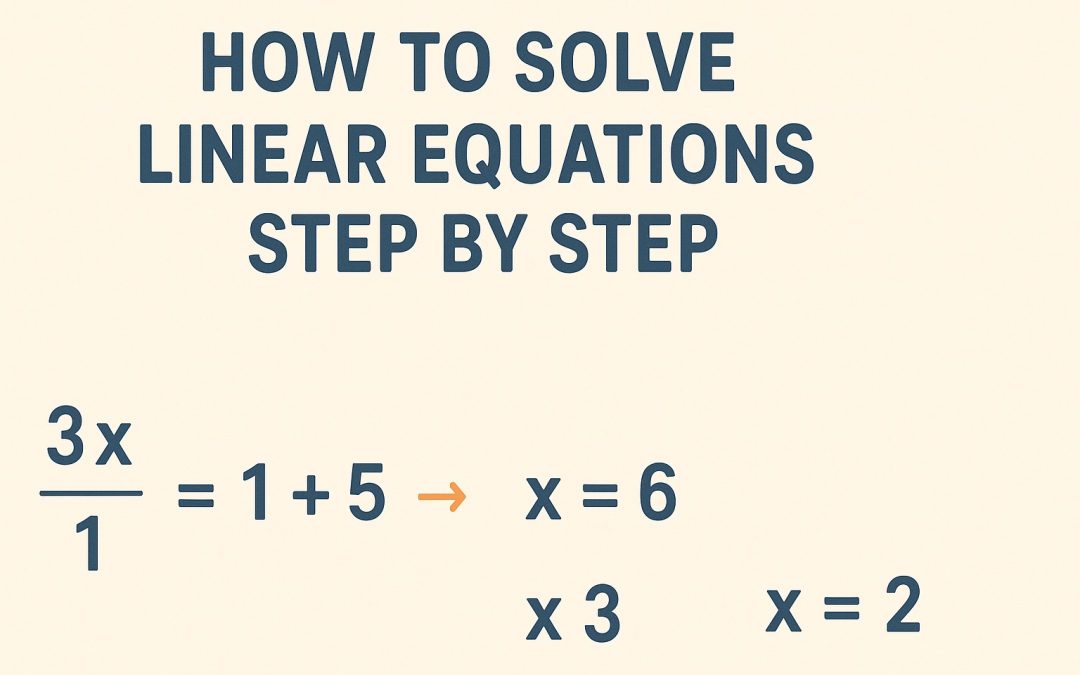
Ever looked at a problem like 2x + 3 = 11 and felt a tiny bit of panic? Or maybe you’re just looking to solidify your skills for an upcoming test. Whatever brought you here, we’re so glad you came. Together, we’re going to break down exactly how to solve algebraic equations, specifically linear ones, and make it feel less like a chore and more like a fun puzzle.
Think of linear equations as the foundation of so much in math. From figuring out your budget for the month to calculating speeds in physics, linear equations are everywhere. They’re our first step into the wider, exciting world of algebra. So, grab a pencil and some paper, and let’s dive in. We’ll tackle everything from simple linear equations questions to some hard linear equations, and by the end, you’ll be a pro!
What Exactly is a Linear Equation?
Before we start solving, let’s get on the same page. A linear equation is an equation that describes a straight line. It has variables (usually x or y) raised only to the power of 1 (so no fancy x² or √y business). Our main goal is always the same: to find the value of the variable that makes the equation true.
Your Step-by-Step Guide to Solving Linear Equations
Alright, team. This is our game plan. We’ll use these steps for almost any linear equation we encounter.
Step 1: Understand the Equation
First things first, we need to know what we’re looking at. Identify the variable (the letter we’re solving for), the constants (the plain numbers), and the coefficients (the numbers multiplying the variable).
In 5x – 3 = 2x + 9:
- x is our variable.
- 5 & 2 is the coefficients of x.
- 3 and 9 are constants.
Step 2: Simplify Both Sides
This is our “clean-up” step. If our equation contains parentheses/brackets, or like terms on either side, we need to combine them before we start rearranging terms.
For example, with 3(x + 2) + x = 18, we’d first distribute the 3 and then combine like terms:
3x + 6 + x = 18 becomes 4x + 6 = 18.
This makes the next steps significantly easier and helps us avoid common mistakes.
Step 3: Move Variables to One Side
Sometimes, you’ll encounter equations where variables are on both sides of the equals sign (e.g., 5x – 3 = 2x + 9). Our job is to get all the variable terms on one side and all the constant terms on the other.
We use the golden rule of algebra: Whatever you do to one side, you MUST do to the other. It’s all about keeping the equation balanced!
To move a term, we use its opposite. To eliminate the +2x on the right, we subtract 2x from both sides.
5x – 3 – 2x = 2x + 9 – 2x simplifies to 3x – 3 = 9.
Or, just reverse the sign and shift it to the other side of the equation (Transpose).
5x – 3 = 2x + 9 becomes 5x – 3 – 2x = 9
Step 4: Move Constants to the Other Side
Now that our variables are cosy on one side, let’s move the constants away from them. We do the same thing: use the opposite operation.
In 3x – 3 = 9, we have -3 on the left. To move it, we add 3 to both sides.
3x – 3 + 3 = 9 + 3 simplifies to 3x = 12.
Or, just shift -3 to the other side and reverse its sign.
3x – 3 = 9 becomes 3x = 9 + 3 and simplifies to 3x = 12
Step 5: Isolate the Variable
We’re almost there! The variable is still being multiplied by its coefficient (3). To completely isolate x and find out what it equals, we do the opposite of multiplication: division.
We divide both sides by 3.
3x / 3 = 12 / 3 simplifies to our answer: x = 4.
Step 6: CHECK Your Answer!
This might be the most important step and the one most of us skip. Always, always check your work by plugging/substituting your solution back into the original equation.
Original: 5(4) – 3 = 2(4) + 9
20 – 3 = 8 + 9
17 = 17 ✔
Hooray! It works. If it didn’t, we’d know to go back and find where we made a misstep.
Let’s Practice with a “Harder” Linear Equation
Let’s apply our steps to a tougher one to see how it all comes together.
Solve: 4(y – 2) + 6 = 3y + 10
- Simplify Both Sides:
- Left side: Distribute the 4. 4y – 8 + 6 becomes 4y – 2.
- Right side: 3y + 10 is already simplified.
- New equation: 4y – 2 = 3y + 10
- Move Variables to One Side:
- Transpose 3y from the right to left.
- 4y – 2 – 3y = 10
- Simplifies to: y – 2 = 10
- Move Constants to the Other Side:
- Transpose 2 to the other side.
- y = 10 + 2
- Simplifies to: y = 12
- Check!
- Substitute y = 12 into the original: 4((12) – 2) + 6 = 3(12) + 10
- 4(10) + 6 = 36 + 10
- 40 + 6 = 46
- 46 = 46 ✔ Perfect!
Common Mistakes to Avoid
We all make them! Here’s what to watch out for:
- Imbalanced Operations: Forgetting to perform the same action on both sides. If you subtract 3 on the left, you must subtract 3 on the right!
- Sign Errors: Be super careful with negative signs when moving terms. -x is different from x.
Skipping the Check: This is our safety net. It only takes a second and can save you from a lost point on a test.
Conclusion
Solving linear equations is like following a simple recipe. Once you know the steps you have to Simplify, Move, Isolate, and Check. You can tackle any of them, from the simple to the super hard linear equations.
The most effective way to improve is through practice. Search for a linear equations worksheet online or create your own linear equations practice problems. The more you do, the more confident you’ll become.
These skills serve as the building blocks for much more in math and in life. You’ve got this!
FAQs
Q: What is the first step in solving a linear equation?
A: The very first step is to simplify both sides of the equation as much as possible. Look for parentheses to distribute and combine like terms (terms with the same variable). A clean equation is much easier to solve!
Q: How do I know my answer is correct?
A: The only way to know for sure is to substitute your solution back into the original equation. If both sides equal the same number, your answer is correct!