by Bethany Institutions | Jan 10, 2025 | Blog Recent Post
The Role of Parents in Supporting ICSE Education
Like silent architects, parents shape the foundation of an ICSE student’s success, crafting a blueprint of support, encouragement, and understanding that transforms challenges into triumphs.
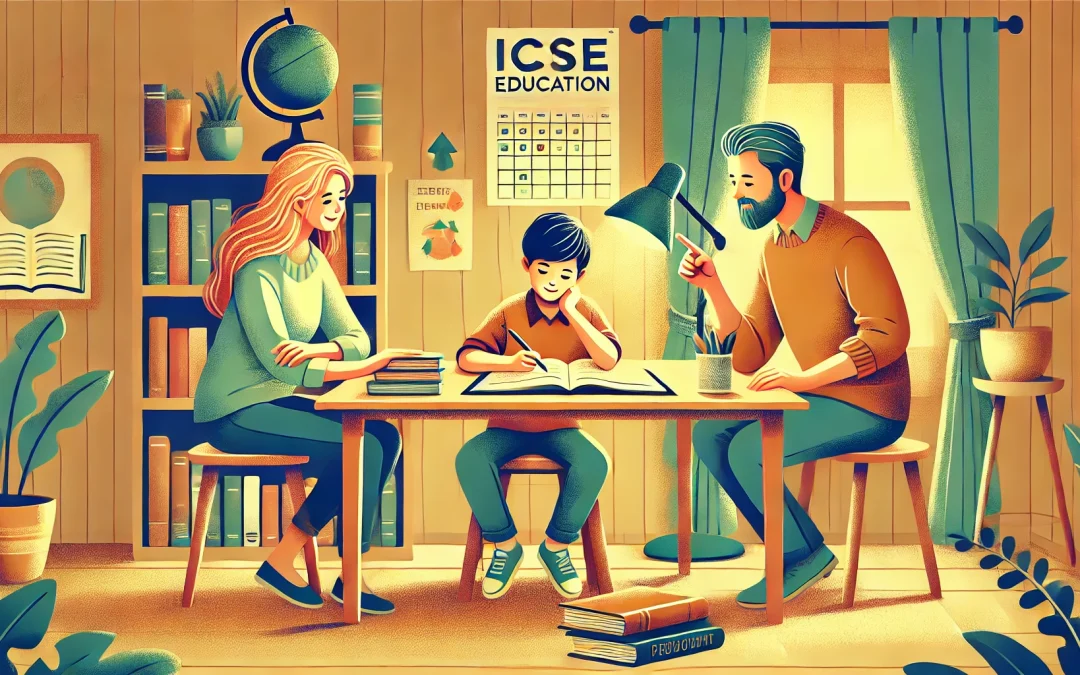
Being an ICSE student myself, it is important to remember that I am not alone. My parents are behind every paper I study for and every exam I prepare for. My parents support me, motivate me to stay on track, and help manage stress as they have an important place in my academic life. It goes without saying that the ICSE curriculum is a very comprehensive and detailed one that requires inward and outward support. With heavy workloads, co-curricular activities, it is safe to say that the ICSE curriculum is one that appreciates all rounded development.
In this article, I will enumerate how parents can provide useful support to their children’s ICSE journey and give some pointers and observations on how they can make a difference. The syllabus provided by the ICSE system is well structured and cohesive. It includes Languages, Sciences, Humanities, and Social Studies with an emphasis on the English language and analytical skills. ICSE education, unlike other education systems, is a complete structure of facts which improves the understanding and encourages us to excel outside the classroom. While focusing on education, ICSE also ensures the development of emotional, social and creative aspects. Integration of extracurriculars, sports and life skills ensures that students are trained to face every aspect of life’s challenges. What this calls for is active parenting from the parents since we need help in managing studies, time and stress levels. Parents are involved in their child’s education and development and therefore have an important place in the ICSE approach.
Our home environment plays an important role in academic progress. An organized study area that is self-contained and has minimal disturbances helps me concentrate better and minimises distractions. To begin with, I select a location customised for studies. A location that is quiet and distinguished from noises of the household. This helps in mentally differentiating the time for work and time for leisure.
It is just as crucial to ensure that there is necessary material at the study location. Plenty of good lighting and space at the study table, stationery and minimising wastage of time and utilising resources are key to the enhancement of our organisation and productivity. In the current context of education, even having reference books, a computer, and monitored internet access to conduct studies are good resources to have.
Positive affirmations encourage me to put in more effort towards academics. It is necessary for parents to set boundaries when it comes to assisting students’ studies and providing constructive feedback through praise and support for accomplishments. Often all we need is a reminder that we are doing well. Having realistic expectations and enjoying the experience of achieving goals demonstrates a developmental attitude. You can also include surprising elements into the routine to make studying interesting, along with breaks, rewards, and promoting interest. This inspires us, our attitude towards learning becomes more positive and proactive.
Staying in contact with my teachers and the school staff has been one of the most helpful things throughout my ICSE journey. It’s easy to get lost in the hustle of exams and assignments, but regular communication helps keep me on track. The teachers are a great source of guidance in subjects where I’m struggling and supportive where I’m doing well.
Parents are constantly in touch with our progress through Parent-Teacher Meetings. It is a perfect opportunity for parents to get an insight into the details of the curriculum and test performances. Parents get an opportunity to discuss their concerns directly with the teachers.
It makes a great difference when parents are an active part of students’ school life. It shows us that what we are being taught has value and that there are people at home and in school who are there to provide guidance. Additionally, it helps us identify our problems or the areas where we need help, understanding of a topic, or just the extra motivation to push through things. Active
involvement brings out confidence and ambition.
Extracurricular activities are just as important to our overall development as academics. Benefits include gaining experience, demonstrating initiative, and developing gratitude. My parents have always supported me regarding extracurriculars. Whether cheering in a game or displaying my paintings on the fridge, their encouragement pushes me to try my best. Their support in helping make schedules ensures that I don’t get too overwhelmed during school days.
The ICSE curriculum integrates various Lit Activities, Debates, Mono-acting and more to promote a holistic education. The ICSE curriculum emphasizes a blend of learning in classrooms, sports, arts, and other interests to nurture creativity, teamwork, and discipline.
It is important to let students understand what works best for them when it comes to academics and extracurriculars. There is a fine line between supporting and helping your children and doing their work for them. While it’s comforting to know my parents are there to help, I’ve learned a lot from figuring things out on my own. When they give me space to manage my tasks, it boosts my confidence and problem-solving skills.
An easy practice to encourage self-reliance and intuitivity is to suggest solutions to a problem instead of outright solving it. It makes us feel more capable. What is most helpful for us students is letting us make mistakes and learning from them. It’s not about controlling every move; it’s about being there when we need it, whilst letting us grow. Positive reinforcement motivates me to improve. When my parents praise my efforts, it boosts my confidence and keeps me motivated. Their constructive feedback helps me learn without pressure. They support my emotional well-being by listening and noticing when I’m stressed, offering reassurance and building resilience. Your involvement in your child’s ICSE journey is key to their success. Balance support with independence while encouraging growth. Feel free to share your tips or experiences in the comments!
by Bethany Institutions | Jan 8, 2025 | Blog Recent Post
Introduction
The CICSE (Council for the Indian School Certificate Examinations) is a private organization which administers what are commonly referred to in India as ICSE schools. It was established in 1958.
The CICSE was a successor of sorts to the Cambridge Board examinations which were slowly phased out to be replaced by an Education Board more representative of catering to Indian society and students. It now plays a very important rule in the school sector in India.
We will continue to refer to the schools as ICSE schools and in coming sessions discuss the various facets of the ICSE curriculum.
1. Overview of the ICSE Board and Its Objectives
ICSE refers to one of the main public examinations conducted by CISCE for affiliated schools. Students take this at the end of Class 10.
ISC refers to the other public examination conducted by CISCE for affiliated schools. Students take this at the end of Class 12.
Every ICSE school may not offer ISC also as they are separate affiliations.
The ICSE curriculum is an English medium curriculum offered by CISCE.
It lays emphasis on academic education as well as extracurricular activities for the well-rounded development of students.
Within a framework offered by the CISCE, affiliated schools have a considerable amount of freedom in how to manage the school and the teaching-learning process.
The CISCE offers an extensive master list of subjects from which individual schools can select their options to offer. Other Boards do not offer such a wide variety of subjects to choose from – Science and Social Studies are taught as single subjects
Students are exposed to a wide variety of subjects in increasing depth as they grow.
2. Structure and Framework of the ICSE Curriculum
In an ICSE school students spend 3 years in the Kindergarten department and 10 years in the main school in Classes 1 to 10.
For convenience the main school years are divided into departments Primary (Class 1 to 4), Middle (Class 5 to 7) and High (8 to 10).
The detailed syllabus is published by CICSE and many publishers study these and produce textbooks which adhere to these syllabus guidelines.
The ICSE curriculum is continuously monitored and updated by the activities of their research wing RDCD (Research Development & Consultancy Division). RDCD monitors latest trends and developments in the education space and adapts them appropriately to the ICSE curriculum to keep it up to date and relevant
3. Subject-wise Breakdown: Science, Mathematics, Languages, and Humanities (Word Count: 250-300)
In the Primary department, the subjects offered are English (Literature & Language), 2nd language, Environmental Science, Social Studies, Science and Mathematics.
Value Education, General Knowledge, Arts & Craft and Physical Education are also integral parts of the curriculum
In the Middle department, the subjects offered are English (Literature & Language), 2nd language & Mathematics. Science is trifurcated into Biology, Chemistry & Physics. Social Studies is bifurcated to Geography and History & Civics. Value Education, General Knowledge, Arts & Craft and Physical Education continue to be integral parts of the curriculum.
In the High, students are offered the option of Stream selection. Based on their interests, abilities and future plans students can select an ICSE school that offers the best choices for them. At this level English, 2nd language, Geography and History Civics are compulsory subjects. The remaining subjects offered typically identify the stream.
For Ex. A Science stream may have Mathematics, Physics, Chemistry & Biology
A Commerce stream may offer Commerce, Economics and Accountancy
A Humanities stream may offer Economics, EVS, Commercial applications, Arts
ICSE offers a rich choice of subjects including Computer Applications,
Music (Western & Indian), Drama, Fine Arts, Physical Education, Home Science, Cookery, Fashion Design etc.
4. Pedagogical Approaches in ICSE Schools (Word Count: 250-300)
The learning methodology espoused by the CISCE leads to increased critical thinking and communication skills as children tackle subject matter through group projects. The mandatory inclusion of Value Education as a subject leads to regular discussions and activities for the development of life skills
Technology is presented to students with the inclusion of Computer Science as a subject from the very youngest classes. Depending upon their resources schools may also offer advanced technical; subjects like Robotics. The Govt of India has earmarked one of the “National Awards for School teachers for innovative use of Information and Communication Technology (ICT)” for CICSE schools.
5. Preparation for ICSE Board Exams and Assessment Methods (Word Count: 250-300)
The format of the ICSE exam is as follows
Final Exam (per subject) – 80 marks
Internal Assessment (per subject) – 20 marks
The Council also provides schools with inputs on how to frame questions, how to create a marking scheme etc. Based on this input, in High school, teachers start getting students accustomed to this method of evaluation by having 2 exams each year for 80 marks,
Students thus learn to get comfortable with revising the large portions, learn time management to ensure they can answer all the questions in the stipulated 3 hours, how to answer and how much to answer for different question types etc.
The Council also publishes past question papers along with an excellent resource called Pupil performance analysis. This helps teachers interpret their students’ results and adjust their teaching methodologies appropriately.
6. Advantages of Choosing an ICSE Affiliated School (Word Count: 200-250)
An ICSE school comes about only after passing a rigorous process to become affiliated. Parents can be assured that an ICSE school is a stable institution vetted by and supported by the CICSE in the execution of its functions.
Choosing to attend an ICSE school offers the following benefits
An excellent education leading to fluency in English, engagement in an up-to-date curriculum which provides focus on academics (STEM and Humanities) as well as extra-curricular activities. This is evidenced by a list of illustrious alumni who have excelled in various fields having completed the ICSE curriculum.
- Rahul Dravid – cricketer
- Nandan Nilekani IT
- Sabeer Bhatia – IT
- Altamas Kabir- Chief Justice of India
- Shankar Roy Chowdhary – Army Chief of Staff
- Swapan Dasgupta – Editor
- Kiran Mazumdar Shaw – Scientific entrepreneur
- Sharmila Nicollet – Golf
Conclusion
ICSE schools provide an excellent education with a choice of a wide variety of subjects to cater to different interests. The emphasis on English produces students confident of communicating effectively in the language which is a bonus when considering education or employment overseas. The balance provided by mandatory inclusion of PE, Arts, Value education etc produces well-rounded individuals.
by Bethany Institutions | Jan 6, 2025 | Blog Recent Post
Introduction to ICSE
ICSE stands for Indian School Certificate Examinations. It is one of the exams and the biggest one conducted by the CISCE – Council for the Indian School Certificate Examinations
After India attained independence in 1947, ICSE was set up as part of the process of replacing the British Cambridge School Certificate Examination with an All India Examination system.
ICSE affiliated schools have made an important contribution to Indian Education by providing high quality education in both the academic and extra-curricular fields. Currently there are 2750 plus schools affiliated to ICSE in India and in 5 countries abroad.
The Council for the Indian School Certificate Examinations conducts three examinations annually
- The ICSE in Class 10
- The ISC in Class 12
- The CVE (Vocational Education) in Class 12
– LSI Keywords: Indian education, About ICSE, ICSE history, importance of ICSE, ICSE Board Exam Details
Understanding the ICSE Curriculum
The ICSE curriculum is an English medium curriculum. In the Primary classes students learn English, Mathematics, Environment Sciences, Social Studies, Second Language, Value Education, GK, Arts & crafts
In the Middle School, Science and Social Studies are subdivided into Physics, Chemistry, Biology and History & Civics and Geography respectively.
In the High School students have the option of selecting the Science stream or Commerce & Humanities stream.
CICSE provides a large number of subjects for schools to select and curate streams from. ICSE students can do Drama & Theatre studies, Western Music, Indian Music, Fine Arts, a variety of Indian and Foreign languages, Physical Education (P.E) etc.
Other Boards do not offer such a wide variety of subjects to choose from. They also focus only on functional English as a medium of instruction.
The ICSE curriculum is continuously monitored and updated by the activities of their research wing RDCD (Research Development & Consultancy Division). RDCD monitors latest trends and developments in the education space and adapts them appropriately to the ICSE curriculum to keep it up to date and relevant.
The ICSE curriculum is implemented as per the guidelines laid down by the Council. The number of teaching days in the academic year, guidelines for the hours of instruction per subject per class are provided and must be adhered to.
The Council conducts regular training modules for teachers and Principals as part of their professional development. This enables the schools to implement innovative teaching methods among the students.
Technology is presented to students with the inclusion of Computer Science as a subject from the very youngest class. Depending upon their resources, schools may also offer advanced technical subjects like Robotics. The Governmentt of India has earmarked one of the “National Awards for School teachers for innovative use of Information and Communication Technology (ICT)” for CICSE schools.
– LSI Keywords: ICSE curriculum, teaching methods, technology in education, Bangalore schools, education in Bangalore, comparison of boards, CBSE vs ICSE, ICSE syllabus
Many of Bangalore’s oldest and most reputed schools offer the ICSE curriculum.
These include:
Bethany High (Koramangala), Bishop Cotton’s School (Boys & Girls), Baldwin High School (Boys & Girls), St. Joseph’s Boys High School, Clarence High School etc.
Many new ICSE schools have been set up in the Sarjapur road area. These have soon gained repute as some of the best ICSE schools in Bangalore.
Some of these are:
Bethany High (Sarjapur), Greenwood High, Inventure Academy. Headstart International Academy etc.
– LSI Keywords: Top ICSE schools in Bangalore, best icse schools in south bangalore, best icse schools in Koramangala Bangalore, Best icse schools in Sarjapur road Bangalore.
Benefits of Choosing an ICSE School
Choosing to attend an ICSE school offers the following benefits:
An excellent education leading to fluency in English, engagement in an up-to-date curriculum which provides focus on academics (STEM and Humanities) as well as extra-curricular activities. This is evidenced by a list of illustrious alumni who have excelled in various fields
Rahul Dravid – cricketer
Nandan Nilekani- IT
Sabeer Bhatia – IT
Altamas Kabir Chief Justice of India
Shankar Roy Chowdhary – Army Chief of Staff
Swapan Dasgupta – Editor
Kiran Mazumdar Shaw – Scientific entrepreneur
Sharmila Nicollet – golf
– LSI Keywords: Benefits, ICSE schools, Bangalore, Why choose ICSE, Advantages of ICSE
Understanding the core values and Philosophy of ICSE schools
ICSE schools have a “child centric” approach and their core values are the holistic development and nurturing of students in their care. The philosophy is to guide the students to be inquisitive and creative learners.
– LSI Keywords: Core Values, Philosophy, ICSE schools
Admission Process in ICSE Schools
- Within the framework provided by the Council, individual ICSE schools have the freedom to create their own ethos.
- Parents seeking admission for their children should do their research to find out which ICSE school in Bangalore is likely to be a good fit for their child.
For most schools the bulk of the admissions happen in the Kindergarten section.
As per the Government and Council regulations, a child joining the youngest class must have completed 3 years before the start of the academic year.
The steps followed are
- Intimation of opening of admissions on school website and other media
- Filling of online Enquiry form by the parents
- Verification of Enquiry form data
- Selection of candidates for interaction – priority is usually given to siblings, children of school alumni, children of staff members etc.
- The child is assessed only through an informal interaction where the child is observed at play, engaged in conversation and the main discussion is held with parents.
- The school’s philosophy and rules are discussed with the parents
- When a message is received about the child’s selection the parents pay the fees and complete other admission formalities.
For higher classes, admissions are advertised only against vacancies
- Students shortlisted for admission usually have to write an age appropriate test in English, Math and Second language to judge their suitability.
- Students who pass the entrance test and their parents meet the department Head for discussions
- The school’s philosophy and rules are discussed with the parents.
- When a message is received about the child’s selection the parents pay the fees and complete other admission formalities.
Documents for admission
- Municipal birth certificate
- Aadhar card
- Report card from any previous school attended
- Transfer certificate from previous school attended (for higher classes)
LSI Keywords: Admission guide, ICSE schools, Admission documents, Banagalore, ICSE interviews, Admission process
Extracurricular activities in ICSE schools
- The Council lays great importance in activities other than academics. ICSE schools host various inter-school tournaments.
- Bethany High has hosted the Council Table tennis games and sends participants in many fields to all the Council events.
- The school provides guides to accompany students representing Bethany to other venues.
Sports, debates, literary contests, elocution contests, quizzes, tech contests , music and dance competitions etc. are some of the popular extracurricular activities offered by Bethany High and many ICSE schools.
Balancing academics and extracurricular activities
Teachers at Bethany High go the extra mile to ensure that students who participate in extracurricular activities are able to balance the academic load by providing study material and tutoring during free periods etc.
Students too learn the importance of academics and prioritize and balance their extracurricular activities with academics
Parental involvement in ICSE schools
Parents are important stakeholders in the journey of their child in an ICSE school. Parents should do their research and select an ICSE school whose philosophy matches their own and commit to being a supportive partner to the school.
Parents can effectively engage with the school by abiding by the rules in the school diary, ensuring their child comes to school on time, well-rested and with all the materials required for the school day.
They should refrain from criticising school staff and policies in front of their children and should use proper channels to discuss their issues with the teachers and escalate matters if need be.
Facilities and Infrastructure of ICSE schools
– Proper facilities and infrastructure are a condition for a school to get ICSE affiliation
– The school should have a playing field, classrooms large enough to accommodate the children comfortably, suitable labs, libraries and an auditorium to conduct events and public exams etc.
– Most ICSE schools offer all these and additionally some offer classrooms with internet connected smartboards, dance and music studios etc.
– All ICSE schools are required to have emergency protocols and processes and to conduct frequent drills for the same
– They also have to enforce government policies for the safety of children such as POCSO
Faculty in ICSE schools
Well trained, professional faculty and staff are the backbone of a school.
The Council lays down qualifications required for each teaching role and adherence is mandatory to get affiliation.
The Council offers many training modules and also facilitates access to training modules provided by the Department of Education.
Bethany High also organizes professional development opportunities for its faculty and staff.
The Council has many awards to recognize and motivate excellence in teacher performance.
Bethany High recognizes the important role of teachers and cares for the welfare of their staff. We have a low attrition rate and many of our teachers have been with us for 10 to 35 years.
by Bethany Institutions | Jan 2, 2025 | Blog Recent Post
Introduction
The role of parents in their children’s educational journey is indispensable. Their involvement goes far beyond helping with homework; it revolves around creating an environment where learning is encouraged and curiosity is celebrated. With the ICSE curriculum’s emphasis on a well-rounded education, parents need to understand how they can best support their child’s development. This article guides parents through practical ways to actively and effectively engage in their child’s ICSE education.
Understanding ICSE Education
The ICSE (Indian Certificate of Secondary Education) curriculum is well-regarded for its balanced approach to academics and extracurricular activities. It focuses on building a strong foundation in various subjects while encouraging critical thinking, creativity, and problem-solving skills. The ICSE framework includes languages, sciences, humanities, arts, and physical education, promoting a well-rounded personality and knowledge base.
In this educational framework, parental involvement is not just helpful but essential. It ensures that students have the necessary support and encouragement to excel academically and personally. By engaging with their children’s learning process and staying informed about their academic journey, parents can significantly contribute to their success.
Creating a Supportive Learning Environment
A conducive study environment at home is vital for effective learning. Parents can create a quiet, organised, well-equipped study area that minimises distractions and allows children to focus. Encouraging a positive attitude toward learning is equally important; showing genuine interest in their studies and celebrating their progress reinforces motivation.
Bethany’s philosophy aligns with this philosophy by promoting a positive and motivating school atmosphere. We work with parents to help them extend this supportive environment at home, ensuring a seamless learning experience between school and home.
Engaging with School and Teachers
Regular communication with teachers and school staff is essential to stay informed about a child’s progress and challenges. At Bethany, we believe in building strong partnerships with parents by providing numerous opportunities for engagement, such as regular parent-teacher meetings, workshops, and open communication channels. Through these interactions, parents gain valuable insights into their child’s strengths, areas for improvement, and overall development. Workshops and awareness programs on “Digital Addiction” provide parents strategies and solutions to handle this challenge faced by students today.
Our teachers work closely with students and actively collaborate with parents to ensure they are informed and involved in their child’s learning journey. This partnership reinforces the support students receive at home and school, creating an environment where they can thrive academically and personally.
Parents are encouraged to discuss their child’s academic progress and emotional and social development, gaining a well-rounded understanding of their child’s growth. By staying updated on the curriculum, assessments, and special projects, parents can more effectively support their child’s learning. This collaboration with teachers helps promptly address gaps or concerns, ensuring that each child feels supported and empowered to succeed.
Encouraging Extracurricular Activities
The ICSE curriculum significantly emphasises extracurricular activities, recognising that a child’s overall development goes beyond academics. Bethany wholeheartedly embraces this philosophy by offering diverse extracurricular programs, including sports, arts, music, drama, dance, and more. These activities allow students to explore their interests, develop unique talents, and cultivate social connections in a nurturing environment.
By helping children discover passions outside of academics, parents contribute to their physical, emotional, and social well-being. This alignment between home and school promotes a balanced approach to education, empowering students to thrive in all aspects of life.
Balancing Support and Independence
While providing support is crucial, it’s equally important for parents to encourage independence. Teaching children to take responsibility for their studies, set goals, and find solutions to challenges helps build self-reliance and critical thinking skills. Showing children how to manage their time and encouraging them to organise their study schedules can be beneficial in the long run.
At Bethany, we promote a balanced approach between support and independence, allowing students to develop essential life skills in a nurturing environment. Through our guidance and supportive frameworks, we empower students to take ownership of their learning journey, building confidence and resilience as they navigate academic and personal challenges.
Parents should guide their children without micromanaging. Allowing children the space to make decisions, face challenges, and learn from their experiences leads to greater confidence and resilience. When children are free to choose, they also learn to take accountability for their actions, an essential life skill.
The Impact of Positive Reinforcement
Positive reinforcement plays a significant role in motivating children. Acknowledging their efforts, praising their achievements, and providing constructive feedback can significantly boost their confidence. Celebrating small milestones, such as completing a project or scoring well in an exam, encourages children to strive for excellence. At Bethany, we understand the importance of creating an environment where students feel supported and appreciated. Our educators actively celebrate each student’s progress and achievements, promoting a culture of encouragement and growth.
Parents can similarly appreciate their child’s hard work through words of encouragement, reward systems, or simple gestures like a family celebration. Constructive feedback is equally essential, helping children learn from their mistakes without feeling discouraged. Working together at school and home, we can ensure that children feel valued and inspired to reach their full potential.
Supporting Emotional Well-being
A child’s emotional well-being is just as important as academic success. Parents play a vital role in recognising signs of stress or anxiety and maintaining open communication. It is crucial to create a supportive environment at home where children feel safe to share their concerns.
Children should be encouraged to speak their hearts and minds out without the fear of being judged by the family. This helps in building trust and confidence in the child. They should not fear the parents reaction if they say something or the fear of being ridiculed should not hinder the child from expressing himself.
Parents can encourage children to discuss their feelings and coping strategies during challenging times to help them build resilience. Engaging in family discussions, outdoor activities, or creative hobbies can provide a healthy outlet for emotions. Helping younger students to identify their emotions and manage them is important at this stage in their life.
Bethany supports students’ academic and emotional well-being, ensuring balanced, holistic development. We work closely with families to support this approach, helping children build resilience and emotional strength. Our school has a team of counsellors apart from the teachers who are ready to lend an ear to the students.
Encouraging a Growth Mindset
One of the most impactful ways parents can support their children is by encouraging a growth mindset. This involves teaching children to view challenges as opportunities for growth rather than obstacles. Parents can model this mindset by sharing their experiences of overcoming difficulties and encouraging a positive attitude towards setbacks.
By promoting resilience and adaptability, parents can help their children become more open to new experiences, more willing to take risks, and better equipped to handle failures. A growth mindset empowers children to persevere, even when faced with difficulties in their studies or personal lives. Empowering children to wade through failures and develop grit to rise through various challenges is an essential skill to be learnt.
Conclusion
Parents play an essential role in helping their children thrive academically, emotionally, and socially by staying engaged, creating a supportive environment, and encouraging independence. At Bethany, we believe in the power of collaboration between parents, teachers, and the school community. Together, we can create a nurturing and empowering environment that helps each child reach their fullest potential.
We invite you to continue supporting and actively participating in your child’s ICSE journey with us. Let’s work hand in hand to guide our young learners toward a bright, successful future. Share your insights, join us in school events, and let’s keep building a community where every child feels valued and supported.
by Bethany Institutions | Dec 31, 2024 | Blog Recent Post
Introduction
As parents and educators, we play a central role in helping children develop essential social skills for life. Social skills in early childhood lay the foundation for meaningful relationships, confidence, and effective communication. By encouraging these skills with gentle guidance, we can support empathy, cooperation, and respect. At Bethany, early social development is as important as academic growth, creating well-rounded individuals prepared for a collaborative world.
Why Social Skills are Crucial in Early Childhood
Social skills are vital for developing a child’s ability to communicate, share, and connect with their peers. They also enable children to work in teams, resolve conflicts, and manage their emotions effectively. These early abilities contribute significantly to a child’s overall well-being, both academically and personally.
At Bethany, we emphasise these skills from a child’s formative years, ensuring they learn to interact positively with peers and adults. Through structured activities as a part of our curriculum, we support empathy, cooperation, and resilience, setting the stage for a successful social and emotional journey.
Key Social Skills to Develop in Early Childhood
In early childhood, there are several social skills that form the groundwork for a child’s confidence and adaptability:
- Empathy: Understanding and valuing others’ feelings.
- Communication: Expressing thoughts clearly and listening actively.
- Cooperation: Working with others, sharing, and turn-taking.
- Problem-Solving: Tackling challenges constructively.
How Play Supports Social Development
Play is one of the most effective ways for children to develop social skills. Through play, children experiment with roles, express their emotions, and practice working together in groups. This environment allows them to navigate emotions, build empathy, and negotiate safely. At Bethany, we understand that play is not a form of entertainment but a powerful learning tool, and we have integrated play-based learning deeply into our curriculum.
Activities that Promote Social Skills through Play:
- Role-playing games: Enable children to view situations from others’ perspectives, supporting empathy and understanding.
- Group games: Reinforce cooperation, teamwork, and the importance of sharing.
- Storytelling sessions: Enhance listening skills and encourage empathy with characters’ experiences and emotions.
At Bethany, the arts play a vital role in supporting this development. Our focus on music, drama, and performance encourages children to express themselves confidently, collaborate with peers, and embrace creativity. Through events like musicals, choir performances, and drama productions, we provide children with a platform to learn essential social skills. The ICSE curriculum’s holistic growth emphasis aligns with our approach, enabling children to develop emotionally and academically.
Encouraging Positive Social Interactions at Home
Creating a supportive home environment is key to reinforcing social skills. Parents can encourage their children’s social growth by setting up playdates, involving them in family discussions, and practicing good manners at home. By modelling empathy and effective communication, parents provide children with a strong example.
Tips for Parents:
- Practice sharing and turn-taking during play.
- Encourage polite communication, like saying “Please” and “Thank you.”
- Support social interaction through regular playdates or family activities.
- Read or share real life stories about friendship and the need to be a good friend too.
At Bethany, we believe in a partnership between school and home, encouraging parents to reinforce these social lessons and maintain a consistent approach to social skills development.
The Role of Preschool in Social Skills Development
Preschool is a crucial stage where children learn the basics of social interaction in a structured, nurturing environment. Our curriculum is carefully curated to promote social development through group activities, role-play, and interactive learning, supporting children in becoming confident and compassionate individuals.Our field trips are designed to provide opportunities for students to interact with each other and develop social skills in settings other than the school and home.
With over 60 years of commitment to holistic education, Bethany Pre-Primary offers a welcoming environment that allows each child to explore, express, and discover their unique potential. Located conveniently near our main campus, our preschool serves as a safe, joyful space where young learners embark on a journey of growth and self-reliance.
Overcoming Common Social Challenges in Early Childhood
Some children naturally face social challenges, such as shyness or difficulty sharing or expressing emotions. Addressing these challenges with patience and consistent guidance helps children build confidence in interacting positively.
Strategies to Address Social Challenges:
- Shy Children: Gently encourage interaction in smaller, familiar settings.
- Sharing Difficulties: Use positive reinforcement to encourage sharing.
- Emotional Expression: Help children label and talk about their feelings.
At Bethany, our experienced staff work closely with children facing these challenges, supporting them in building resilience and social comfort at their own pace.
Social Skills Activities for Toddlers and Preschoolers
Engaging in targeted activities can enhance a child’s social skills in fun and meaningful ways. These activities encourage sharing, listening, and cooperation, all while making social learning enjoyable.
Suggested Activities:
- Puppet Shows: Encourage emotional expression, creativity and empathy.
- Building Towers with Blocks: Promote teamwork and patience.
- Story Circles: Practice listening and turn-taking.
- Art and Craft: Encourage sharing and communication.
Bethany’s daily routine includes many activities designed to allow children to engage, share, and learn within a supportive and collaborative environment.
Supporting Emotional Well-being
A child’s emotional well-being is just as crucial as academic success. Recognising signs of stress or anxiety early and maintaining open communication helps create a safe space for children to share their thoughts and concerns. Parents can support this by discussing feelings at home, validating their emotions, and introducing coping mechanisms like deep breathing or positive thinking.
At Bethany, we take a balanced approach that values emotional and academic growth. By building emotional resilience and empathy, we ensure that children feel safe and supported as they grow socially and academically.
Encouraging a Growth Mindset
Helping children develop a growth mindset encourages them to see challenges as learning opportunities. Teaching children to view setbacks positively builds resilience and adaptability. As parents and educators, modelling this mindset through positive reinforcement and sharing our own experiences with overcoming difficulties can be transformative.
Conclusion
Developing social skills in early childhood is essential for creating confident, empathetic, and well-adjusted individuals. By actively supporting social interactions, encouraging positive behaviour and addressing social challenges, parents and educators can equip children with tools for lifelong success.
At Bethany, we are committed to building these skills through our inclusive, nurturing environment. We work closely with parents to support each child’s unique journey. We invite parents to actively participate in their child’s social development, building a strong foundation for a brighter future.