by Bethany Institutions | Nov 25, 2025 | Blog Featured Post
Mobile phones have become an inseparable part of our lives. From school projects to social chats, everything happens through a screen. However, too much mobile use can quietly harm our body, mind, and focus. Many students are unaware of the long-term mobile side effects that can affect their health and academic performance.
Understanding the bad effects of mobile phones on students helps parents, teachers, and learners make better choices about screen time and digital habits.
Let’s understand the harmful side effects and how to stay safe.
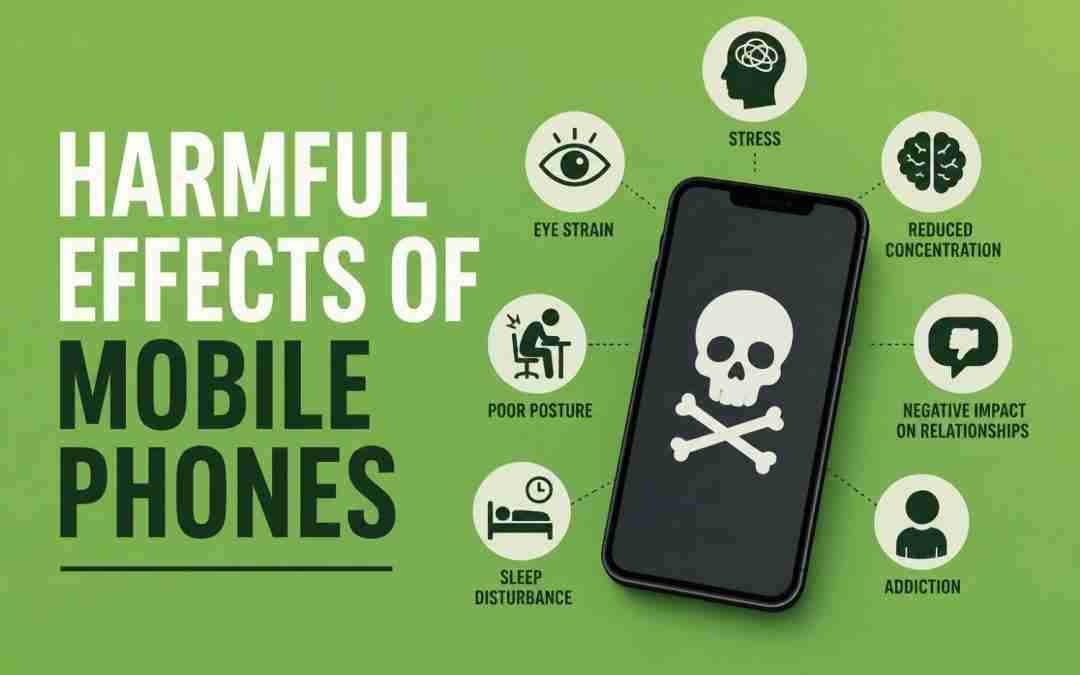
1. Eye Strain
Staring at bright screens for long hours can lead to digital eye strain. Your eyes start to feel dry, itchy, and tired. Over time, this bad effect of mobile phone use can cause blurred vision or headaches. Students who use phones for studying or watching videos often complain of these symptoms.
Continuous screen exposure is one of the most common side effects of watching mobile for long periods, especially when students sit close to the screen without breaks.
To stay safe, follow the 20-20-20 rule. Every 20 minutes, look at something 20 feet away for 20 seconds. It’s a simple step that keeps your eyes relaxed and healthy.
2. Poor Sleep
Using phones at night reduces deep rest. The glow from your screen tricks your brain into staying awake. As a result, your sleep quality drops, and you feel tired the next day.
Sleep disturbance is among the most common mobile phone side effects, particularly when students scroll through social media or watch videos before going to bed.
Keep your phone away at least 30 minutes before bed. A good night’s rest helps you focus, think better, and stay active the next day.
3. Less Focus on Studies
Among the many phone use side effects, loss of concentration is one of the biggest challenges students face today.
It’s tough to focus on homework when your phone keeps buzzing. Every notification, message, game, or social post pulls your attention away. This leads to poor time management and reduced academic performance.
This negative impact of smartphones is especially visible among students. The use of mobile phones in school advantages and disadvantages debate continues, but one thing is clear: constant distractions hurt concentration. Turning off notifications during study time helps maintain focus and productivity.
4. Posture Problems
Do you ever notice how you bend your neck while scrolling through your phone? That’s called “text neck,” and it’s a common side effect of phone use. Prolonged bad posture can cause severe neck, shoulder, and back pain.
Holding your phone at eye level and taking short breaks to stretch can reduce this strain. Remember, your posture today shapes your health tomorrow.
5. Social Impact
Mobile phones connect us virtually, but often disconnect us emotionally. Spending more time on screens means spending less time with family and friends. This is one of the most overlooked bad effects of mobile use.
Instead of sharing a real laugh, we react with emojis. Over time, this can weaken relationships and communication skills, especially among youth. The impact of mobile phones on youth is visible in reduced face-to-face interactions and increased loneliness.
6. Addiction Risk
Mobile addiction is real. The endless scrolling, games, and short videos create a dopamine rush that keeps you hooked. Studies show that the average person checks their phone over 150 times a day.
Experts warn that the harmful effects of overusing cell phones include addiction, reduced productivity, and increased mental fatigue among students.
This overuse turns into dependence; students can’t focus without checking their phones. This mobile use side effect is one of the most harmful because it affects both mental health and productivity. Setting screen time limits helps you regain control.
7. Reduced Physical Activity
The more time you spend on your phone, the less time you spend moving. Long hours of sitting and scrolling can lead to weight gain and low energy. Lack of exercise also affects your mood and overall health.
This clearly shows the difference between the uses and abuses of mobile phone, where helpful technology becomes harmful when used excessively instead of responsibly.
Try replacing some phone time with outdoor play, cycling, or a quick walk. It keeps both body and mind active.
8. Hearing Issues
Earphones placed directly into the ear canal amplify sound pressure. S, when we listen to music or videos at high volumes, we risk causing damage to our ears.
Over time, this harmful effect of mobile phones can lead to tinnitus (ringing in the ears) or hearing loss. Keep your volume below 60% and take breaks from headphones to protect your hearing.
9. Anxiety and Stress
Constant alerts, social media comparisons, and online pressure can increase anxiety and stress. Many students feel the need to stay “always online,” fearing they’ll miss out on something.
This negative impact of smartphones leads to emotional fatigue and lower confidence. Try digital detox days. Put your phone aside and spend time doing something creative or relaxing.
10. Reduced Academic and Social Growth
Too much mobile use affects both learning and personal growth. Students may struggle to think creatively or communicate clearly. The effects of mobile phones on students include poor grades, short attention spans, and less interest in outdoor activities.
While the advantages and disadvantages of mobile phones essay often highlights connectivity as a benefit, excessive use blurs the line between use and misuse. Striking the right balance is the key to avoiding long-term harm.
Example / Quick Illustration
Imagine Riya, a bright student, who studies with her phone nearby. Each notification distracts her. One message turns into another, and one hour becomes two. But when she puts her phone on silent, she completes her homework faster and scores better. Her secret is being focused and disciplined.
Conclusion
Mobile phones are both a boon and bane of mobile phones. Powerful when used wisely, harmful when overused. While there are many advantages of phone use, the side effects of using mobile phones can’t be ignored. The merits and demerits of mobile phone use depend entirely on how we handle them. Understanding the uses and misuses of mobile phone helps students develop responsible habits and maintain a healthy balance between digital life and real-world experiences.
FAQs
Are mobile phones always harmful?
No. They are helpful for learning and staying connected, if used in limitation and with appropriate awareness. Balance is key.
Can kids get addicted to mobile phones?
Absolutely! Overuse can lead to addiction and lead to various behavioural problems. Therefore, setting daily limits is necessary.
How long should students use phones daily?
Less than 1-2 hours of non-study screen time is ideal and allows them to experience life outside the digital screen, which is essential for their overall development and wellbeing.
by Bethany Institutions | Sep 9, 2024 | Blog Featured Post, Blog Recent Post
A Junior College is a post-secondary educational institution that serves as a stepping stone between high school and a full-fledged degree programme at a university. These institutions play a vital role in making higher education more accessible through flexible curriculum, affordable tuition, and convenient locations.
Junior Colleges emerged in the early 20th century as a revolutionary concept in education which served as an experiment to extend high school education. Pioneered by William Rainey Harper, the first president of the University of Chicago, these institutions were designed to bridge the gap between high school and university education. Harper’s vision of dividing the university into senior and junior colleges laid the foundation for a system that, by the late 20th century, had grown to over 1,200 junior colleges in the United States, accounting for nearly 40% of all undergraduate enrolments. These colleges became vital hubs for accessible, democratic education, providing opportunities that were previously out of reach for many.
In India, the concept took root in the 1950s when educational leaders sought to adapt the Cambridge School Certificate Examination to better serve Indian students. This led to the establishment of the Council for the Indian School Certificate Examinations (CISCE), which began administering the Indian School Certificate Examination (ISC) after Class 10. The ISC, conducted in English, is a pivotal examination that follows two years of rigorous study, aligning with the national educational goals and setting the stage for students’ success in higher education.
Bethany Junior College, Koramangala, established in 1991 exemplifies our desire to set higher standards in higher secondary education to our students in the two crucial years that precede their University education. The Junior College got its own campus in 2005, diagonally opposite the old campus, catering to the needs of our students in choosing their desired streams in Classes 11 and 12.
Importance of Junior College in the Education System
- In India, one of the pioneers in the successful establishment and functioning of Junior Colleges is the CISCE. As a National Board, it has a rich legacy beginning in 1958, rooted in the Cambridge University Examinations conducted in India at the time. The CISCE has always stood firm on its values and principles, as stated in its mission statement and motto: Empowering Minds and Transforming Lives since 1958.
- CISCE’s approach to education is built on the core belief that diversity and plurality are the fundamental strengths for the evolution of ideas. Our schools are designed to motivate pupils towards the cultivation of excellence, both in the Indian and global experience. We place a strong emphasis on values, both spiritual and cultural, which form the bedrock of our educational experience.
- Our schools are dedicated to fostering an ‘Indian Ethos,’ ensuring that they have strong roots in the national psyche while being sensitive to national aspirations. This commitment helps cultivate students who are not only academically proficient but also deeply aware of their cultural heritage and societal responsibilities.
Purpose and Benefits of Junior College
Junior Colleges have always stood out and pioneered many changes, always adopting and adapting to the global scenario and demands. With the release of the New Education Policy (NEP 2020) introduced by the Government and the changes proposed, CISCE too will be making suitable course corrections to be in sync with these proposals.
Benefits of attending a Junior College
Every Junior College affiliated to the CISCE ensures that certain key ideas, such as trust and fair play, are at the core of our values. In such a system, there is minimum monitoring by the CISCE, thereby allowing schools to evolve their own niche.
Junior Colleges in India also strive to have an Indian ethos, that is, strong roots in the national psyche. We are always sensitive to our national aspirations.
- Catering to the needs of the children.
- Giving freedom to experiment with new ideas and practices.
- Diversity and plurality – the basic strength for evolution of ideas.
- Schools to motivate pupils towards the cultivation of:
- Excellence – The Indian and Global experience.
- Values – Spiritual and cultural – to be the bedrock of the educational experience.
- Trust and fair play.
- Minimum monitoring.
- Allowing schools to evolve their own niche.
Meet Our Alumni
Poojitha Reddy, a proud alumnus of Bethany Junior College owes majority of her personality development to Bethany. “Serving as President during my time at Junior College, I was able to make memories for a lifetime while learning skills like effective people and time management. The kind of exposure one gets at Bethany truly prepares them for the real world whilst providing a comforting environment to grow. Further, the high competence of all the students in Junior College nudges one to be the best versions of themselves, inculcating a positive competitive spirit. With highly knowledgeable and experienced teachers, classes are engaging and allow for personal attention as well. Be it academics, extra curricular activities or the overall quality of education, there isn’t a better place to be. Bethany will always be Home!”
Junior College Programmes
The Indian School Certificate Examination (ISC) has been framed and designed as an Examination through the medium of English, after a two-year course of studies beyond the Indian Certificate of Secondary Education Examination (Class X) or its equivalent. All candidates eligible to appear will be required to enter for English (Compulsory) with three, four or five elective subjects and be assessed by the school in Socially Useful Productive Work and Community Service (Compulsory).
Differences between various Junior College programmes(Humanities, Commerce and Science)
The CISCE offers a range of subjects from which students can select subjects of their choice, across the boundaries of Humanities, Commerce and Science, in keeping with their aptitude and ability.
- The ISC curriculum emphasises on the development of effective communication skills in English and other languages.
- The vast practical experiences built into the curriculum enable students to become active problem-solvers, in addition to gaining academic excellence.
- ISC offers a wide range of subjects for students to select from, based on their aptitude and abilities.
- The ISC examination caters to the needs of all students, where the assessment is based on an array of simple, difficult, analytical, and critical thinking questions.
- The curriculum is framed to ensure students are equipped for tackling all forms of competitive entrance examinations at the National & Global arena.
- It focuses on soft skills development which helps in handling new and complex situations successfully in life.
- ISC provides opportunities for holistic education.
Specialised programmes at Bethany Junior College.
Bethany Junior College offers specialised programs to the ISC aspirants in the three respective streams- Science, Commerce and Humanities. We also offer a wide variety of subjects for the students to choose from- English, Physics, Chemistry, Mathematics, Biology, Economics, Computer Science, Physical Education and Fine Arts respectively for the Science stream. Accounts, Commerce, Business Studies, Economics, English, Mathematics, Fine Arts and Physical Education are the subjects offered to the Commerce stream.
For the Humanities stream, the range of subjects to choose from are- English, Sociology, Psychology, Economics, Home Science, Elective English, Fine Arts and Physical Education.
Admission to Junior College
The admission process at the Bethany Junior College consists of filling up the applications online, an entrance examination that tests the students’ basic knowledge followed by an interactive session with the prospective students and parents..
Students who have cleared the ICSE examination or any equivalent one by any other board, with 90% and above are the candidates preferred for the Science stream and 85% and above for the Commerce stream and 80% and above for the Humanities stream.
Key dates and application procedures
Application Availability: Forms are available online in August (for feeder schools) and September (for the main school).
Submission: Fill out and submit the online application along with required documents.
Entrance Test and Interaction
- Pre-Nursery/Nursery: Selection is based on interaction with Academic Coordinators.
- Classes above Junior 1: Selection is based on entrance tests in English, Maths, and a second language.
Notification and Confirmation: Parents receive confirmation and are required to complete fee payment.
Final Step: Submit the signed application form and documents at the school office to finalize admission.
Tips for prospective students and parents.
Understand the Curriculum
Familiarise yourself with the courses and programs offered. Review the curriculum and understand the prerequisites for your intended program.
Develop Study Skills
Junior college often requires more self-directed learning. Enhance your study habits, time management, and organisational skills to stay on top of assignments and exams.
Review Basic Concepts
If you’re entering a specialised field, brush up on relevant basic concepts to ensure you’re well-prepared for advanced topics.
By staying organised, proactive, and open-minded, you’ll set yourself up for a successful and fulfilling junior college experience.
Junior College vs. High School
One of the key differences between Junior College and traditional high school lies in the level of academic rigour and the focus on career preparation. Junior Colleges provide a more specialised education, with programmes designed to prepare students for specific fields of study at the university level.
In contrast to high schools, where the curriculum is often more general, Junior Colleges offer courses that are directly aligned with the demands of higher education and the job market. This means that students who attend Junior Colleges are often better prepared for the challenges of university and have a clearer sense of their career goals.
Furthermore, Junior Colleges typically offer more flexibility in terms of course selection and scheduling, allowing students to tailor their education to their individual needs and interests. The smaller class sizes also mean that students receive more personalised attention, which can greatly enhance their learning experience.
Conclusion
Junior Colleges play a pivotal role in the education system, providing an accessible and supportive pathway to higher education. By offering a range of academic programmes and fostering a holistic approach to learning, these institutions help students develop the skills and knowledge they need to succeed in university and beyond.
At Bethany Junior College, we are committed to empowering our students through a comprehensive education that combines academic excellence with personal growth. Whether you are looking to pursue a career in science, commerce, or the humanities, our programmes are designed to help you achieve your goals.
We invite you to explore the opportunities that await you at Bethany Junior College and take the first step towards a bright and successful future.
by Bethany Institutions | Aug 1, 2024 | Blog Featured Post, Blog Recent Post
The Importance of Choosing the Right School
Choosing the right school for your child is a daunting task for parents. With a myriad of options available, selecting a suitable school for your child is an important decision. The school shapes and moulds the child to face life confidently.
An ICSE (Indian Certificate of Secondary Education) curriculum offers a wide range of subjects and exposes students to the world around them. One has to look at the past achievements of the students in a school, as well as the faculty, current facilities, and additional activities provided by the institution.
A strong foundation along with sound values is essential for many parents and is of paramount importance to the management of Bethany Institutions, Koramangala, Bangalore, one of the top ICSE schools in Bangalore.
Points to consider when selecting an ICSE school
An ICSE school comes about only after passing a rigorous process to become affiliated. Parents can be assured that an ICSE school is a stable institution vetted by and supported by the CICSE in the execution of its functions.
Regardless of the curriculum a school is only as good as the stakeholders make it. The management, the faculty, the students and the parent body have to all be in sync to make a school great. This finds expression in the good results gained by the students. Most schools are only too happy to advertise the victories gained by their students and news also spreads by word of mouth.
Landscape of Top ICSE Schools in Bangalore
Many of Bangalore’s oldest and most reputed schools offer the ICSE curriculum.
These include:
Bethany High (Koramangala), Bishop Cotton’s School (Boys & Girls), Baldwin High School (Boys & Girls), St. Joseph’s Boys High School, Clarence High School etc.
Many new ICSE schools have been set up in Sarjapur road area. These have soon gained repute as some of the best ICSE schools in Bangalore.
Some of these are:
Bethany High (Sarjapur), Greenwood High, Inventure Academy. Headstart Educational Academy etc.
They provide additional facilities at different price points. Parents should make their decisions based on the factors important to their family and the distance from their home.
Standout features of Bethany High Schools in Bangalore
Bethany High is a well-known ICSE school, currently in its 61st year.
The school offers the complete curriculum up to Class 12 and offers many unique subjects and activities not offered by all ICSE schools.
Bethany High is one of the few schools to offer Home Science, Western Music, Drama and Fine Arts as core academic subjects, not just extra-curricular activities. The school has produced many students who have gone on to pursue careers in creative fields also.
Bethany High implements the ICSE curriculum in spirit and letter. Our Mission and Vision tie in with those of the ICSE.
Bethany offers a wide sampling of the subjects permitted by the Council, and provide resources for a wide variety of extracurricular activities. The students regularly participate in various inter-school events. Bethany High participates in and hosts many Council activities like the Regional Council games which are attended by participants from many Karnataka ICSE schools.
The school leverages the Music, Drama and Dance classes to host the Biennial Bethany Musical. A professional staging of a well-known musical with cast and crew drawn from the students is held. It is an extremely popular event in Bangalore and raises funds for our social initiatives.
Conclusion
Bethany High provides a nurturing environment along with an excellent academic education and extracurricular activities. The faculty are experienced professionals of long standing, backed by a management team who run the school as an educational institution and not as a business venture. This commitment to education and holistic development makes Bethany High one of the top ICSE schools in Bangalore.
by Bethany Institutions | Jul 31, 2024 | Blog Featured Post
The philosophy of ICSE schools in Bangalore is epitomized by the Council for Indian School Certificate Examination, renowned for its comprehensive curriculum and high academic standards akin to the Cambridge School Certificate Examination. ICSE is celebrated both nationally and internationally for its rigorous curriculum, continuous evaluation, and project-based learning. The curriculum not only champions academics but also promotes sports, arts, and other extracurricular activities, fostering well-rounded development. It prioritizes analytical thinking, problem-solving, and ethical values, aiming for an all-encompassing education. Bethany High School, a leading name among ICSE schools in Bangalore, is dedicated to upholding ICSE standards and fostering an environment conducive to holistic student development.
The ICSE schools’ motto include its commitment in serving the children through top notch educational endeavours, empowering them to contribute towards a humane, just and pluralistic society, promoting introspective living, by creating exciting learning opportunities, with a commitment to excellence. This learning platform gives room for intellectual curiosity and creativity, thereby the love for learning, exploration, and inquiry is kindled. The practical learning encapsulates problem solving, innovation, self-expression and therefore the students turn out to be fully equipped, socially responsible, global citizens. Inculcating values in the children is imperative as the world needs better individuals who are empathetic, service-oriented with embedded qualities of integrity, honesty and fairness.
Projects are an integral part of the ICSE curriculum and are designed to foster collaboration and teamwork among students. Through engagement in team activities, the students learn to work efficiently in groups, contribute their thoughts and insights, give a listening ear to others’ thoughts, accept and appreciate different thought processes, intelligently and maturely resolve any conflict that arises and accept setbacks and take it positively. Apart from project works, ICSE curriculum also professes community service to foster a sense of empathy and to make students appreciate and inculcate the art of giving. Character building and moral education is imparted to the students through the daily acts of kindness. ICSE textbooks are designed inculcating the moral and ethics that the students need to practice and imbibe.
Bethany High School aims at addressing the growing developmental concerns of our country and also in moulding the children for the competitive world. The project-based learning fosters intellectual curiosity and creativity in the children. When the understanding and knowledge is put to test, the children bring out their best at the hands-on activities and projects. At Bethany, children are given a variety of opportunities to not only bring their academic talents but also to nurture and exhibit their social responsibility. The community service programs prove to be an example of the same. The club activities help students in honing their skills under professional guidance and supervision. A very unique initiative of LEAP – Learning Enrichment
and Achievement Program provides hands on training, multi-sensory learning aids, curriculum adaptations, life skills training, and strength-based training. The Inter-school tournaments and competitions, bring out the innate talents of the children.
In today’s technologically fast evolving system, children are smarter, more academically superior, but the wide exposure to negativity and violence, affects their behaviour. To alleviate this condition, Value Education (VE) for children is universally accepted. We need VE to shape well-rounded personalities, to raise well-adjusted, adaptive, strong and happy children. At Bethany High School, the Value education classes and the counselling orientations reiterates the need and importance of staying grounded and extending support to the peers as well as in one’s own self. The students are taken on field trips to orphanages and old age homes to help them develop empathy towards the less privileged. Cleanliness drives, carnivals and musicals conducted biannually to raise funds for noble causes, tuck shops etc. are some of activities conducted at Bethany to make the students understand their duties towards the society. The students embrace the opportunities to learn, grow and turn out to be Lifelong learners, Critical thinkers, Effective communicators, Responsible citizens, Ethical leaders.
ICSE schools stand out because of their core values and integrated learning approach that go beyond mere academic excellence. The curriculum has immense potential to take students to the pinnacle of academic achievement. The need of the hour is a value-driven education. Bethany Institutions, embodying the Philosophy of ICSE schools in Bangalore, stands out not only for imparting knowledge but also for creating exemplary human beings for the community and the nation by providing values through education and activities. Bethany High School takes care of the all-round personal enrichment of all the children, and the faculty is robust in training the students intellectually, physically, morally, and spiritually, irrespective of caste, creed, and social status.