by Bethany Institutions | Dec 12, 2025 | Blog Recent Post
When we think about building strong English sentences, the first thing that comes to mind is the verb. Every sentence in English needs a verb, which is why I like to call it the heart of a sentence. Whether we talk, write, read or explain something, verbs help us express actions, ideas and even our feelings. Words like run, eat, is, are, have, and think are all verbs we use every single day.
Definition of a Verb
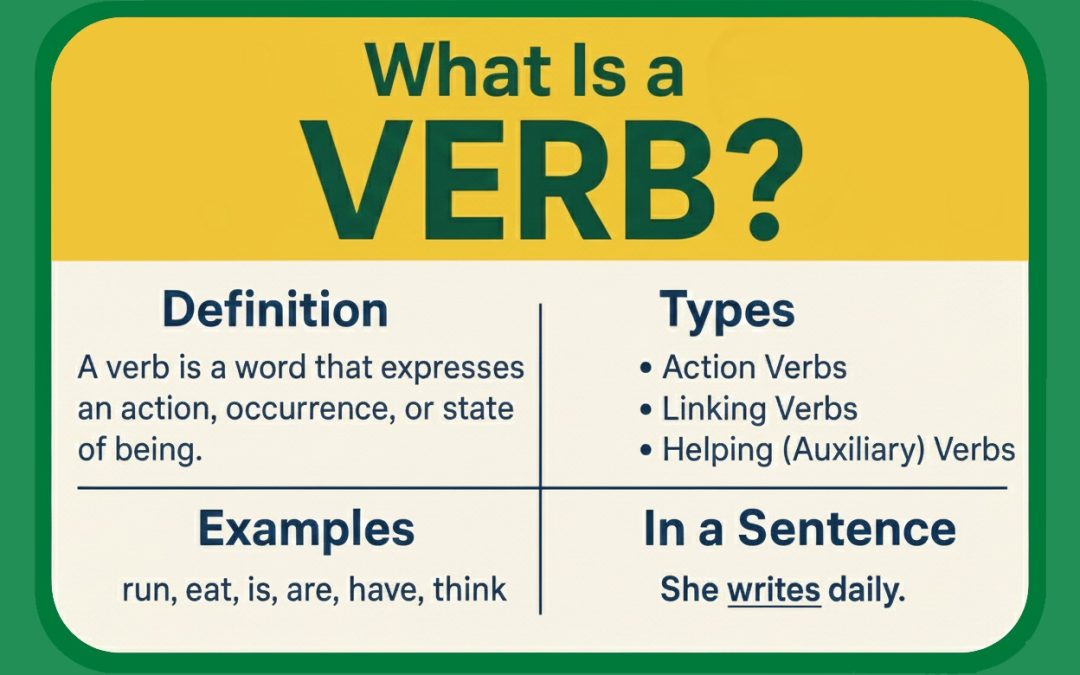
A verb is a word that expresses an action, an occurrence, or a state of being.
In simple textbook language: A verb tells us what the subject of a sentence does or experiences.
Without a verb, a sentence feels incomplete:
- Riya in the park. (No verb → incomplete)
- Riya plays in the park. (Verb makes it complete)
So, verbs are essential because they bring meaning, clarity and time (past, present or future) into every sentence.
Why Are Verbs Important?
Verbs do more than just show action. They help us:
1. Understand Time
Verbs change forms to show when something happens.
- I walk (present)
- I walked (past)
- I will walk (future)
2. Build Clear Meaning
Without verbs, we cannot express thoughts properly. Imagine trying to describe your day without using went, ate, studied, or slept !
Verbs hold the entire sentence together, making them the backbone of English grammar.
Types of Verbs
Let’s look at the main types of verbs students use in everyday writing and speaking.
1. Action Verbs
Action verbs show what the subject is doing. The action can be physical or mental.
Examples: run, write, jump, read, think
- She writes daily.
- The children run across the field.
- I think about my goals often.
2. Linking Verbs
Linking verbs do not show action. Instead, they connect the subject to extra information in the sentence.
Common linking verbs: is, am, are, was, were, seem, become
- He is tired.
- The soup smells good.
- They seem excited.
Here, is, smells and seem link the subject to a description or condition.
3. Helping (Auxiliary) Verbs
Helping verbs support the main verb. They help form questions, negatives, continuous tenses and perfect tenses.
Common helping verbs include: is, am, are, have, has, do, does, did, will, can, may, should
- She is reading a book.
- We have finished our homework.
- Did you enjoy the play?
Helping verbs + main verb = complete meaning
(is reading, have finished, did enjoy)
This is why learning the kinds of auxiliary verbs is so important for forming correct sentences.
Transitive and Intransitive Verbs
Another important area students often confuse is the difference between transitive and intransitive verbs.
Transitive Verbs
Transitive verbs need an object to complete their meaning.
- He plays football.
- She wrote a letter.
- I ate an apple.
Here, football, a letter, and an apple are objects that receive the action.
Intransitive Verbs
Intransitive verbs do not need an object.
- He sleeps.
- The children laughed.
- They arrived early.
The verb makes sense on its own.
Key difference:
Transitive = action + object
Intransitive = action only
This helps students understand different sentence structures when practising verb usage.
Regular Verbs in English
Regular verbs are the easiest to learn because they follow a simple rule in the past tense:
Base form + ed
Examples:
- walk → walked
- play → played
- clean → cleaned
- listen → listened
- finish → finished
Here is a short list of regular verbs in English:
- Talk
- Work
- Cook
- Open
- Move
- Wash
- Call
- Laugh
- Paint
- Help
All of these verbs take –ed to form the past tense.
Understanding Phrasal Verbs
A phrasal verb is a verb + preposition/adverb that creates a new meaning. Students often find them confusing because the meaning is not always literal.
Here are 10 phrasal verbs with meanings and sentences:
- Break down – stop working
The car broke down on the road. - Look after – take care of
She looks after her younger brother. - Turn on – switch on
Please turn on the lights. - Turn off – switch off
Turn off the fan before leaving. - Call back – return a call
I will call you back later. - Find out – discover
We found out the answer in class. - Give up – stop trying
Don’t give up on your goals. - Put off – postpone
They put off the meeting. - Run into – meet unexpectedly
I ran into an old friend yesterday. - Set up – arrange / organise
The school set up a science fair.
Phrasal Verb Rules (Simple Guide)
- The meaning often changes completely.
- Some phrasal verbs are separable (turn off the fan → turn the fan off).
- Some are inseparable (look after a child → NOT look a child after).
- Always learn phrasal verbs with examples to understand usage.
Verb–Noun Sentence Examples
Here are some simple sentences showing verbs used with nouns:
- The teacher explains the lesson.
- Riya reads a book.
- They built a bridge.
- We celebrated the festival.
These combinations help students understand sentence building clearly.
Main Verb and Helping Verb Examples
A main verb expresses the action.
A helping verb adds meaning to the main verb.
Examples:
- She is (helping verb) singing (main verb).
- They have (helping verb) completed (main verb) their work.
- Do* you know the answer?*
This also helps explain question formation in English.
Which Form of the Verb Is Used With “Did”?
A very common doubt students have is:
Which form of the verb comes after “did”?
Answer:
After did, we always use the base form of the verb.
- Did you eat? (NOT ate)
- He did not go.
- Did they finish the project?
Did already shows past tense, so the main verb does not change.
Common Mistakes Students Make With Verbs
1. Subject–Verb Agreement
- He go to school.
- He goes to school.
2. Wrong Verb Forms
- I seen him yesterday.
- I saw him yesterday.
3. Overusing “is/was”
Students often rely too much on is or was instead of stronger action verbs.
- The boy is making noise.
- The boy makes noise.
Stronger verbs improve writing quality instantly.
In Summary
Verbs are one of the most important parts of English grammar. They show action, connect ideas, and help us express thoughts clearly. Whether it’s understanding action verbs, linking verbs, auxiliary verbs or phrasal verbs, learning verbs step by step builds confidence and helps students write beautifully in English at the best school in Bangalore.
by Bethany Institutions | Dec 10, 2025 | Blog Recent Post
Introduction
A conjunction is a fundamental part of speech often referred to as a “joining word.” Its primary job is to connect words, phrases, or clauses within a sentence. Think of conjunctions as the glue that holds related ideas together, making our communication clear and structured. For example, in the sentence “I wanted to go out, but it was raining,” the word “but” is a conjunction that links two contrasting ideas.
Definition of a Conjunction
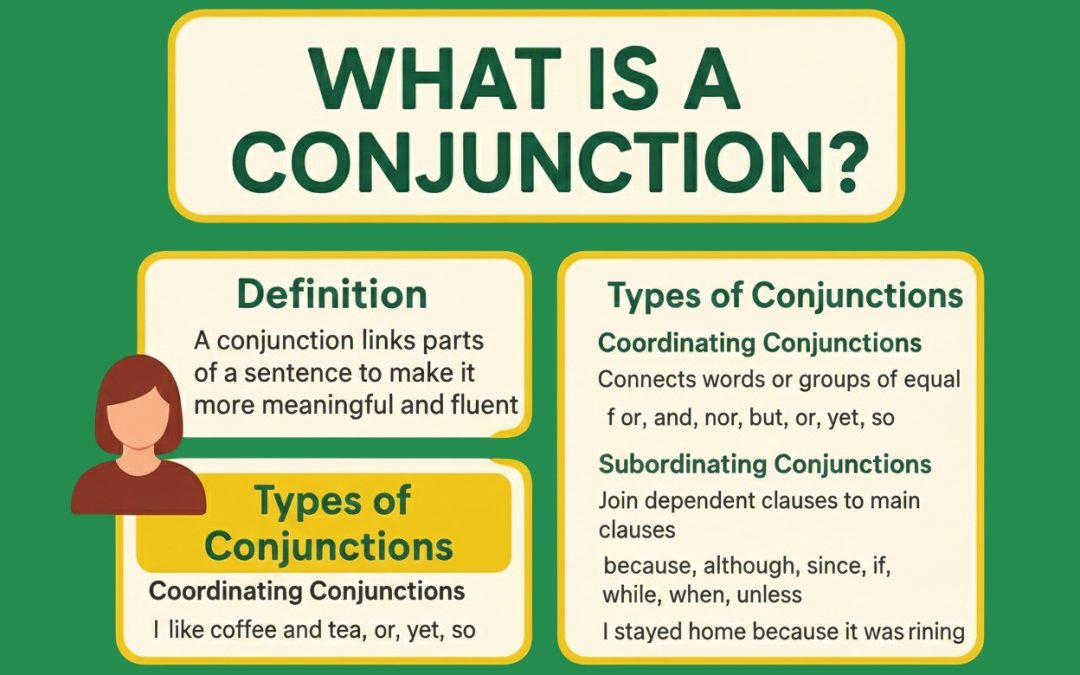
A conjunction is a word used to connect words, phrases, clauses, or sentences. By creating these links, conjunctions make sentences more meaningful, fluent, and complex, preventing the need for short, choppy statements.
Importance of Conjunctions
Without conjunctions, our language would be a series of simple, disconnected thoughts. Conjunctions are crucial because they:
- Combine Ideas Smoothly: They allow us to show the relationship between ideas, such as addition, contrast, cause, and effect.
- Ensure Coherence and Logic: They make writing and speech flow logically, guiding the reader or listener through the progression of thoughts.
Types of Conjunctions
Understanding the different types of conjunctions is key to using them effectively. The main categories are Coordinating, Subordinating, and Correlative conjunctions.
1. Coordinating Conjunctions
What is a coordinating conjunction? It connects words, phrases, or independent clauses of equal grammatical rank. A simple way to remember them is with the acronym FANBOYS.
- F = for
- A = and
- N = nor
- B = but
- O = or
- Y = yet
- S = so
Examples:
- Connecting words: I like coffee and tea.
- Connecting clauses: She was tired, yet she finished her work.
2. Subordinating Conjunctions
These conjunctions join a dependent (subordinate) clause to an independent (main) clause, showing a relationship like cause, time, or condition.
Examples: because, although, since, if, while, when, unless
Examples:
- I stayed home because it was raining. (The reason)
- Although it was difficult, we persevered. (Contrast)
Difference between subordinating and coordinating conjunctions:
The key difference lies in what they connect. Coordinating conjunctions link equal elements, while subordinating conjunctions introduce a clause that is less important than the main clause. For instance, in “I stayed home because it was raining,” “I stayed home” can stand alone as a sentence, but “because it was raining” cannot.
3. Correlative Conjunctions
These types of coordinating conjunctions work in pairs to link balanced elements within a sentence.
Examples: either…or, neither…nor, both…and, not only…but also
Examples:
- You can have either cake or ice cream.
- She is not only intelligent but also very kind.
Examples in Sentences
Here are five sentences of conjunction demonstrating their use:
- (Coordinating) I tried to call, but you didn’t answer.
- (Subordinating) We can go to the park if the weather is nice.
- (Correlative) Neither my brother nor my sister could attend the event.
- (Coordinating) He must be tired, for he has been working all day.
- (Subordinating) She finished her homework while dinner was cooking.
Join the Sentences Using Conjunctions
Using a suitable conjunction or appropriate conjunction is essential for merging ideas.
- Separate: I like reading. My brother likes sports.
- Joined: I like reading, but my brother likes sports.
- Separate: We were late. There was heavy traffic.
- Joined: We were late because there was heavy traffic.
- Separate: You can come with us. You can stay here.
- Joined: You can either come with us or stay here.
Paragraph with Conjunctions
To see how they work in context, read this paragraph with conjunctions:
“I wanted to go for a run this morning, but the sky was dark and threatening. Although I was disappointed, I decided to workout at home instead. I could do either bodyweight exercises or use my yoga mat, so I chose a mix of both. After I finished, I felt great, for I had still been productive.”
Common Mistakes with Conjunctions
- Overusing “And” or “But”: Using “and” repeatedly can make writing sound childish. Using “but” too often can make an argument seem weak. Vary your conjunctions.
- Weak: I woke up, and I brushed my teeth, and I had breakfast.
- Better: I woke up, brushed my teeth, and then had breakfast.
- Using Multiple Conjunctions Incorrectly: Starting a sentence with “and” or “but” is often acceptable for style, but using them to connect multiple ideas in one long sentence is an error called a run-on.
- Incorrect: I went to the store and I bought milk and then I saw a friend but I was in a hurry.
- Correct: I went to the store and bought milk. Then, I saw a friend, but I was in a hurry.
- Misplacing Subordinating Conjunctions: The dependent clause should be placed clearly to avoid confusion.
- Unclear: She saw the dog while walking to the store that was barking.
Clear: While walking to the store, she saw the dog that was barking.
Conjunctions may be small words, but they make a big difference in how we speak and write. They help connect ideas, build clear sentences, and make communication smoother and more meaningful. When students understand how different types of conjunctions work, they can express their thoughts more confidently and avoid choppy or confusing sentences. Strong grammar skills also improve reading comprehension, writing quality, and overall language development.
At the best schools in Bangalore, grammar is taught in a practical and engaging way so students learn how to use language naturally in conversations, assignments, and creative writing. By practicing regularly and applying conjunctions in everyday communication, learners can build a strong foundation in English that supports academic success and confident expression in all areas of life.
by Bethany Institutions | Dec 3, 2025 | Blog Recent Post
Modern learning often involves multitasking. It’s common for students to juggle between screens, tabs, and notifications from group chats.
Although it looks busy on the surface, very little gets done beneath it. Despite spending hours, you realise you haven’t accomplished much. This phenomenon of doing a lot and achieving little is called trashing.
However, the problem runs deeper than just productivity.
An article by the California State University rings a warning bell:
“Students can’t resist multitasking, and it’s impairing their memory.”
Research has shown a correlation between multitasking and poor academic performance. That’s just the tip of the iceberg.
Left unchecked, it can leave a lasting impact on the career and future success of students.
But it’s not just them. trashing can, and does, affect teachers and parents as well.
Let’s explore how we can help our students – the future pillars of our society – overcome this challenge, and in the process, learn to manage it ourselves.
Understanding trash
trash is the hidden drain on our energy that comes from doing a lot but moving very little. It’s the mental noise of switching between tabs, juggling too many things, comparing ourselves to others, and chasing milestones that don’t really matter.
But how do you know what you’re experiencing is trash and not just regular stress, a heavy workload, or everyday busyness? The difference is in the patterns.
That’s why the first step is learning to recognise the signs.
Recognising the Signs
trash hides inside “normal” busyness. Here’s how it often appears:
Constant multi-tasking
You’re studying, but your phone pings. You check WhatsApp, scroll Instagram, reply to a mail, then return to your notes, only to realise half an hour has gone by.
Research from the University of Liverpool found that students who switched between multiple applications during lectures learned less and performed worse than those who stayed with a single application.
Fatigue
Constant multitasking also leads to feelings of exhaustion and dissatisfaction. Nothing feels finished.
Studies on digital overload link this exact pattern to burnout: it’s not the workload, but the overload of fragmented attention that drains energy and erodes resilience.
Shallow engagement
Skimming readings, cramming facts, and using hacks (like YouTube) might feel fast in the moment. But later, nothing sticks. That’s trash replacing depth with speed.
In UAE classrooms, students overloaded by digital inputs reported “technostress” and disengagement. Their minds were busy, but the learning was superficial.
Emotional fatigue and reduced resilience
Anxiety creeps in, irritability rises, and even minor setbacks feel crushing. One bad grade or critical email can spiral into hopelessness.
Research shows that when students face digital overload, their ability to bounce back from stress weakens, making them feel less capable, even when they’re working harder than ever.
Now, if you were nodding your head to any or all of these signs, take a deep breath. trash is not a personal failing. Most of us are falling prey to it due to the growing digital noise and the pressures around us. Recognising it is the first step to managing it.
How to Address trash Without Making it Worse
Educators and parents can play a big role in helping students recognise and manage trash. Here are some ways.
Pause & Reflect
When you feel yourself bouncing between unfinished tasks, resist the urge to force productivity. Instead, pause long enough to write down everything pulling at your mind.
Ask yourself:
- Which task truly matters right now?
- What has the closest deadline or biggest impact?
Write down 3-4 things on your plate. Circle the one that deserves your attention first.
Set Priorities
With the noise out of your head, pick the single task that will move the needle most:
- Select 1-2 high-impact tasks for the day.
- Commit to finishing them before touching minor ones.
- Cross them off visibly. It trains your brain to register progress.
This is the heart of effective trash management strategies.
Change Your Routine
Your surroundings shape your focus. Minor tweaks can stop trash before it starts:
- Mute notifications during work blocks.
- Tidy your desk as visual clutter feeds mental clutter.
- Time block 45–50 minutes of focus and 5-10 minutes of rest.
Even one Pomodoro cycle can dramatically improve concentration. Studies comparing fixed break schedules (such as the Pomodoro method) with self-chosen breaks found lower fatigue and better concentration in the fixed-break group.
Get Support and Feedback
trash thrives in isolation. And accountability is the most powerful method to eliminate it.
- Share your plan with a peer, mentor, or colleague.
- Ask for feedback on what’s working, what isn’t.
Research shows that peer support improves both academic performance and emotional resilience. Knowing someone is watching makes it easier to follow through on your commitments.
Key Rules / Tips
Breaking trash starts with understanding it, but understanding alone isn’t enough, you need simple, repeatable rules you can follow daily.
Clarity over busyness
Don’t let a long to-do list trick you into thinking you’re productive. Focus on why each task matters. For example, start with the math worksheet due tomorrow instead of juggling three unfinished tasks. That single choice instantly reduces stress and gives direction.
One task at a time
Progress beats multitasking. Completing one item fully is more satisfying and effective than spreading attention thin across many. We’ve seen students jot down their tasks on a sticky note, and suddenly, chaos became manageable.
Small breaks reset focus
Short pauses aren’t wasted time; they restore energy and prevent fatigue. After 50 minutes of focused study, a 5-minute walk or stretch refreshes attention, making the next block more productive.
Environment matters
Tidy, distraction-free spaces signal to your brain that it’s time to work. Clearing your desk of phones, clutter, and unrelated tabs helps maintain uninterrupted attention.
Reflect often
Regular reflection catches recurring patterns of trash before they spiral. Checking your screen time on apps that don’t matter is a good start to protect future work blocks from interruption.
Common Mistakes Students Make
We know that even with the best rules and habits, it’s easy to slip back into old patterns. Here are some common mistakes you can avoid to minimize trash.
Waiting until overwhelmed
Putting off work until the last minute turns manageable tasks into a source of panic. Postponing homework until the night before, scrambling to finish half-done assignments, and losing focus in the process are all things we have all been through.
Confusing busyness with progress
Rearranging notes for an hour instead of actually writing answers may give the illusion of work while nothing meaningful gets done.
Over-avoiding trash
Trying too hard to avoid distraction can lead to procrastination or perfectionism. If you delay a project, insisting on perfect planning first, you only face last-minute stress and rushed work.
Example to Understand How to Deal With trashing
Let’s take the example of a 10th grade student. We’ll call her “Riya”.
On Monday morning, Riya sits down to work on her science project, but her phone keeps buzzing with WhatsApp messages, Instagram notifications, and updates from her group project. She hops from one tab to another, checks emails, and skims through notes, thinking she’s being productive. By evening, nothing is finished, and she feels drained, frustrated, and anxious.
By Wednesday, she tries a different approach. She lists her top two tasks for the day, silences notifications, and works in uninterrupted 50-minute blocks. Suddenly, the same hours feel focused and productive, and Riya ends the day not only with tangible progress but also a sense of calm and confidence.
Conclusion
trash is common, but when we recognise it early and take small, deliberate steps, meaningful progress becomes possible. Pausing to reflect, prioritising tasks, protecting focus, and seeking support are ways to reclaim control over time, energy, and attention.
Together, as a school, as families, and as students, we can support one another in developing productive and confident work habits.
FAQs
Q1. Is trash always bad?
Not always. Occasionally, switching tasks can refresh focus or spark creativity. trash becomes a problem when it fragments attention and reduces real progress.
Q2. How long should I work on a task before switching to another one?
Focused blocks of 45-50 minutes, followed by a short 5-10 minute break, usually work best. This balances concentration with mental rest, maintaining consistent energy levels.
Q3. What if I have many important tasks and can’t narrow them down easily?
Rank tasks by impact and urgency, then tackle them one at a time. If needed, ask a teacher, mentor, or peer for guidance to clarify priorities and avoid feeling scattered.
by Bethany Institutions | Nov 25, 2025 | Blog Featured Post
Mobile phones have become an inseparable part of our lives. From school projects to social chats, everything happens through a screen. However, too much mobile use can quietly harm our body, mind, and focus. Many students are unaware of the long-term mobile side effects that can affect their health and academic performance.
Understanding the bad effects of mobile phones on students helps parents, teachers, and learners make better choices about screen time and digital habits.
Let’s understand the harmful side effects and how to stay safe.
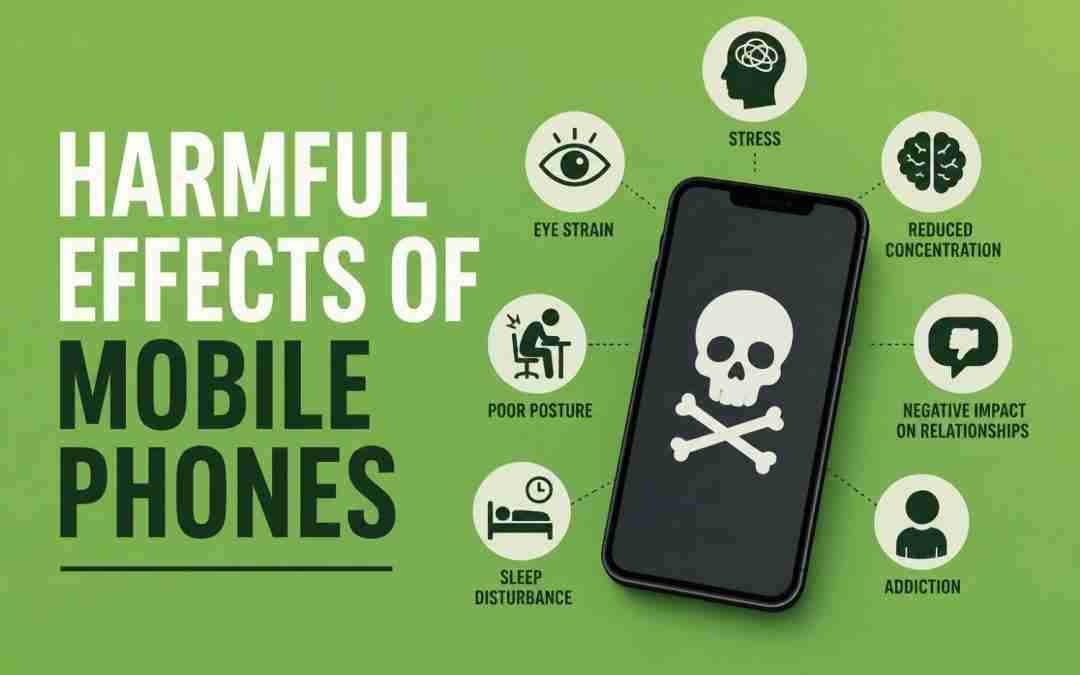
1. Eye Strain
Staring at bright screens for long hours can lead to digital eye strain. Your eyes start to feel dry, itchy, and tired. Over time, this bad effect of mobile phone use can cause blurred vision or headaches. Students who use phones for studying or watching videos often complain of these symptoms.
Continuous screen exposure is one of the most common side effects of watching mobile for long periods, especially when students sit close to the screen without breaks.
To stay safe, follow the 20-20-20 rule. Every 20 minutes, look at something 20 feet away for 20 seconds. It’s a simple step that keeps your eyes relaxed and healthy.
2. Poor Sleep
Using phones at night reduces deep rest. The glow from your screen tricks your brain into staying awake. As a result, your sleep quality drops, and you feel tired the next day.
Sleep disturbance is among the most common mobile phone side effects, particularly when students scroll through social media or watch videos before going to bed.
Keep your phone away at least 30 minutes before bed. A good night’s rest helps you focus, think better, and stay active the next day.
3. Less Focus on Studies
Among the many phone use side effects, loss of concentration is one of the biggest challenges students face today.
It’s tough to focus on homework when your phone keeps buzzing. Every notification, message, game, or social post pulls your attention away. This leads to poor time management and reduced academic performance.
This negative impact of smartphones is especially visible among students. The use of mobile phones in school advantages and disadvantages debate continues, but one thing is clear: constant distractions hurt concentration. Turning off notifications during study time helps maintain focus and productivity.
4. Posture Problems
Do you ever notice how you bend your neck while scrolling through your phone? That’s called “text neck,” and it’s a common side effect of phone use. Prolonged bad posture can cause severe neck, shoulder, and back pain.
Holding your phone at eye level and taking short breaks to stretch can reduce this strain. Remember, your posture today shapes your health tomorrow.
5. Social Impact
Mobile phones connect us virtually, but often disconnect us emotionally. Spending more time on screens means spending less time with family and friends. This is one of the most overlooked bad effects of mobile use.
Instead of sharing a real laugh, we react with emojis. Over time, this can weaken relationships and communication skills, especially among youth. The impact of mobile phones on youth is visible in reduced face-to-face interactions and increased loneliness.
6. Addiction Risk
Mobile addiction is real. The endless scrolling, games, and short videos create a dopamine rush that keeps you hooked. Studies show that the average person checks their phone over 150 times a day.
Experts warn that the harmful effects of overusing cell phones include addiction, reduced productivity, and increased mental fatigue among students.
This overuse turns into dependence; students can’t focus without checking their phones. This mobile use side effect is one of the most harmful because it affects both mental health and productivity. Setting screen time limits helps you regain control.
7. Reduced Physical Activity
The more time you spend on your phone, the less time you spend moving. Long hours of sitting and scrolling can lead to weight gain and low energy. Lack of exercise also affects your mood and overall health.
This clearly shows the difference between the uses and abuses of mobile phone, where helpful technology becomes harmful when used excessively instead of responsibly.
Try replacing some phone time with outdoor play, cycling, or a quick walk. It keeps both body and mind active.
8. Hearing Issues
Earphones placed directly into the ear canal amplify sound pressure. S, when we listen to music or videos at high volumes, we risk causing damage to our ears.
Over time, this harmful effect of mobile phones can lead to tinnitus (ringing in the ears) or hearing loss. Keep your volume below 60% and take breaks from headphones to protect your hearing.
9. Anxiety and Stress
Constant alerts, social media comparisons, and online pressure can increase anxiety and stress. Many students feel the need to stay “always online,” fearing they’ll miss out on something.
This negative impact of smartphones leads to emotional fatigue and lower confidence. Try digital detox days. Put your phone aside and spend time doing something creative or relaxing.
10. Reduced Academic and Social Growth
Too much mobile use affects both learning and personal growth. Students may struggle to think creatively or communicate clearly. The effects of mobile phones on students include poor grades, short attention spans, and less interest in outdoor activities.
While the advantages and disadvantages of mobile phones essay often highlights connectivity as a benefit, excessive use blurs the line between use and misuse. Striking the right balance is the key to avoiding long-term harm.
Example / Quick Illustration
Imagine Riya, a bright student, who studies with her phone nearby. Each notification distracts her. One message turns into another, and one hour becomes two. But when she puts her phone on silent, she completes her homework faster and scores better. Her secret is being focused and disciplined.
Conclusion
Mobile phones are both a boon and bane of mobile phones. Powerful when used wisely, harmful when overused. While there are many advantages of phone use, the side effects of using mobile phones can’t be ignored. The merits and demerits of mobile phone use depend entirely on how we handle them. Understanding the uses and misuses of mobile phone helps students develop responsible habits and maintain a healthy balance between digital life and real-world experiences.
FAQs
Are mobile phones always harmful?
No. They are helpful for learning and staying connected, if used in limitation and with appropriate awareness. Balance is key.
Can kids get addicted to mobile phones?
Absolutely! Overuse can lead to addiction and lead to various behavioural problems. Therefore, setting daily limits is necessary.
How long should students use phones daily?
Less than 1-2 hours of non-study screen time is ideal and allows them to experience life outside the digital screen, which is essential for their overall development and wellbeing.
by Bethany Institutions | Nov 19, 2025 | Blog Recent Post
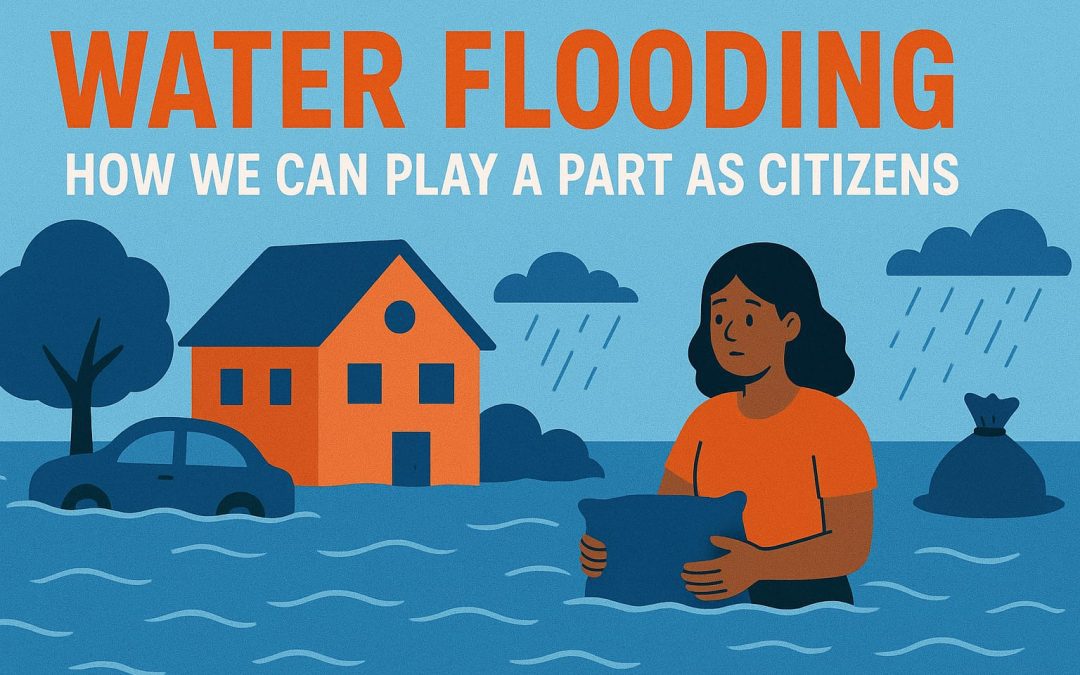
Flooding is no longer an occasional headline for Bengaluru. Each year, it brings damage, deaths, and distress to residents.
Just last year, a video of school buses stranded in rising water, children crying as they were ferried to safety on tractors, went viral. Boats have even been seen navigating the streets of India’s Silicon Valley. And only a few weeks ago, another heavy downpour battered large parts of the city.
Sadly, this isn’t only Bengaluru’s story.
In September 2025, Kolkata recorded its heaviest rainfall in nearly four decades, paralysing transport and claiming lives. Similar scenes have unfolded in Mumbai and Chennai, where climate change and rapid urban growth are converging faster than our infrastructure can cope.
While government action is critical, our everyday choices as neighbours and communities also shape how well we withstand these events.
We often underestimate what we can do as citizens. The steps we take as precautions for floods may seem small, but together they strengthen our neighbourhoods and support the larger efforts needed from city planners and government to keep communities safe.
Understanding why flooding is worsening is the first step towards making that difference, and it begins with each of us.
Know the Risk Around You
“Forewarned is forearmed,” as the old saying goes. The more you know about the risks around you, the better you can prepare for them.
Learning about your area involves checking local flood maps, past incident reports, and drainage zones to see whether your street or neighbourhood is prone to waterlogging. This simple step can help you plan safer routes and protect valuables long before the rain begins.
Timely information gives you those extra minutes to move vehicles, secure essentials, or simply stay indoors when heavy rain is on the way. However, weather reports on news channels are not the only way to stay informed. In fact, there are better options. The central government’s disaster alert portal “Sachet” allows you to keep an eye on all disaster warnings issued by authorised sources. Various states also have their own local bodies. For example, in Bengaluru, we have the BBMP or the Karnataka State Disaster Management Authority. Signing up for their notifications also ensures you receive accurate weather updates.
Prepare Your Home & Family
Flood readiness means staying a step ahead.
Start by creating a household action plan so everyone knows what to do if water levels rise. Decide on a family meeting point and map out evacuation routes in case you need to leave quickly. This prevents confusion in the event that phone networks fail or roads are blocked.
Next, pack an emergency kit with essentials, such as a torch, first-aid supplies, bottled water, dry food, basic medicines, a phone charger, and waterproof copies of important documents.
Finally, move valuables and critical electronics to higher shelves, loft spaces, or any sturdy surface above floor level. A few simple preparations, like these, can help reduce damage and keep your family safer when heavy rain hits.
Everyday Actions That Prevent Flooding
Flood prevention starts long before the rain. Small, steady habits can help your neighbourhood drain water better and reduce waterlogging.
Here are some small things you can start doing right away that can lead to a bigger impact:
- Keep drains clear by removing leaves, debris, and plastic waste, and avoid throwing garbage where it can block water flow.
- Plant trees and shrubs, which absorb excess rainwater and slow runoff. If you are paving a driveway or garden path, choose permeable surfaces like gravel or grass so water can soak into the ground.
- You can also encourage rainwater harvesting and water-saving practices to reduce the strain on stormwater systems.
On a larger scale, you can organise or join neighbourhood clean-up drives and awareness campaigns.
Bethany, for example, encourages its students to see these clean-ups as more than chores. We call it “Citizenship in Action,” a way to learn responsibility while directly protecting our own city.
Our teachers often say that when students help clear a drain or talk to neighbours about water use, they are actually shaping habits that last a lifetime.
Do’s and Don’ts During a Flood
Knowing the do’s and don’ts during a flood is part of being a responsible citizen. When more people follow these simple safety measures, rescue efforts run smoother, resources stretch further, and entire neighbourhoods stay safer.
| Do’s | Don’ts |
| Move to higher ground if water starts rising. | Avoid walking or driving through floodwater; even shallow water can sweep you off your feet or stall a vehicle. |
| Unplug devices and lift appliances to higher shelves if possible. | Don’t attempt to repair or reconnect power until authorities declare it safe. |
| Turn off the main power supply if water enters your home or if authorities warn of rising levels. | Don’t touch electrical equipment if you’re standing in water. |
| Check on neighbours, especially the elderly, children, and pets, if it’s safe to do so. | Don’t spread rumours on social media that can create panic. |
The Bigger Picture: Civic Action
Flood resilience goes beyond individual preparation. A safer city depends on collective action and our right to advocate for better drainage systems, responsible waste management, and more green spaces. Citizens must raise their voices for these changes, and schools like ours can help lead the way.
We have seen how young people can spark powerful change. Our student leaders regularly speak about reducing single-use plastics and how plastics clog drains and worsen floods. On World Environment Day, our High School Department planted saplings, donated potted plants, and pledged to keep our environment green and clean.
Practical learning matters too. Through regular emergency drills, we train students to stay calm and act quickly in natural disasters. During our Annual Road Run, students, staff, and parents join a parallel clean-up drive, proving that neighbourhood action is both possible and impactful.
These experiences teach our students that civic responsibility is not an occasional project, but a daily practice. When young people grow up seeing climate action as second nature, they inspire families, neighbours, and communities to follow. Change begins with each of us, and schools like Bethany are proud to nurture that change every day.
A Safer City Begins With Us
Preventing and preparing for floods is not a matter of government efforts alone. It’s the daily choices of families, individuals, and neighbourhoods that decide whether Bengaluru, and cities like it, can withstand the next storm.
Education plays a powerful role in this journey. When schools nurture awareness, responsibility, and respect for the environment, they shape citizens who act, not just during a crisis, but every day. Lessons learned in classrooms and through community projects grow into lifelong habits that strengthen entire neighbourhoods.
Our future depends on this collective mindset. When communities act early and stand together, we move from simply reacting to floods to building a resilient city.
Let’s stop waiting for change. Let’s become it.
FAQs
Q1. What’s the difference between a flood watch and a flood warning? A flood watch means conditions are favourable for flooding. Stay alert. A flood warning means flooding is imminent or already occurring. Take immediate action.
Q2. Can planting trees around homes really help with flooding? Yes. Trees absorb rainwater, reduce runoff, and stabilize soil. They act as natural flood buffers.
Q3. What should I include in an emergency kit for floods? Torch, batteries, first aid, bottled water, dry food, waterproof documents, charger, medicines, and cash.
Q4. Which emergency numbers should I save in Bangalore?
- BBMP Control Room: 080-22660000
- Karnataka State Disaster Monitoring Centre: 080-67355000
- Fire & Rescue: 101
- Ambulance: 108
- Police: 100